.png) 1 month ago
54
1 month ago
54
Two Shakespearean comedies dated to the last decade of the 16th century each seem to lack something. Love’s Labour’s Lost (c 1595) feels in need of a sequel, ending abruptly, with the usual climactic marriages suddenly deferred to the future. Much Ado About Nothing (c 1598) could use a prequel: there is clearly a tantalising backstory to the harsh sparring between Beatrice and Benedick.
By double-billing the plays, director Tom Littler explores the scholarly hypothesis (well advanced by HR Woudhuysen) that they may be, in Hollywood terms, parts 1 and 2. Some believe that a Shakespeare play, Love’s Labour’s Won, listed in documents but now missing, may have been Much Ado, which contains a possible Shakespeare in-joke about things seeming clearer “when you have seen the sequel.”
Each features a hate-love relationship (the sparring of Berowne and Rosaline in Love’s Labour’s Lost almost interchangeable with Beatrice and Benedick’s), Mediterranean chancers (Don Armado, Don Pedro) slapstick police officers (Dull / Dogberry) and even the writing of mock sonnets.
Christopher Luscombe’s 2015 pairing for the RSC went as far as to rename the second play Love’s Labour’s Won, but kept the original character names. Littler, in a co-production between the Guildford Shakespeare Company and his own Orange Tree Richmond theatre, retains the traditional titles but merges casts the into 17 roles for 10 actors: characters who loved and lost on the eve of war in 1939 now reuniting after the brutal ado in 1945. (Luscombe’s settings were 1914 and 1918.)
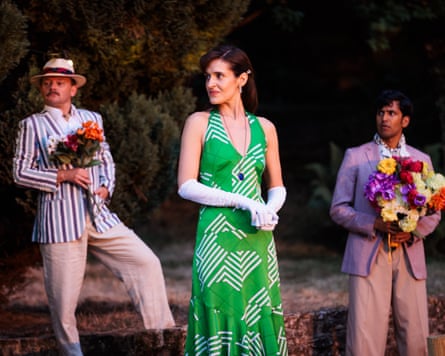
Berowne and Dumain, two of the votaries who foreswear women and other pleasures in Love’s Labours, now borrow the forenames Benedick and Claudio from Much Ado. Similarly, Rosaline and Katherine are retro-fitted as Beatrice and Hero. The curate Nathaniel and pedant Holofernes in the first play continue to the second, subsuming the roles of neighbourhood watchmen George Seacoal and Hugh Oatcake. A single constable, Dogberry, nicknamed “Dull”, polices the five hours of stage time.
Both shows premiered on Saturday, from furnace afternoon to breezy evening, outdoors in the gardens of the abandoned Braboeuf Manor in Guildford, adjacent, it would surely please Dogberry, to a police dog training centre. (Later, the shows transfer to another al fresco venue, Thomas’s College on Richmond Hill.) Neil Irish’s set is a harbour, where a boat and bar do much service for the concealment scenes in both dramas.
With the caveat that no student should use these scripts as an exam crib, Littler’s cutting and stitching is elegantly done. Most lines survive, although some are redistributed and there are Littler-written references to “that summer” or things “still” being the case, to smooth continuity. Some purists will fume but what we see as Shakespeare is very often a tentative text, incorporating collaborators and copyists’ mistakes.
Crucially, franchising the plays works dramatically, deepening both. Creakier scenes in Love’s Labours are scaffolded by becoming a preview of Shakespeare’s famous on-off lovers, with the mystery of Beatrice’s and Benedick’s hostility and past interactions in Much Ado now plausibly filled – the suggestion being that, after the couples in the first finale promise to marry in a year, he has ended the pledge by letter or absence during the six years of conflict. And the sometimes queasy psychology of Much Ado, especially the casual ruining of Hero, now occur in the context of the trauma of war. There are hints of that in the original but in this version we have seen the people before and after, Littler’s conceit well calculated for a theatre audience increasingly shaped by episodic television.
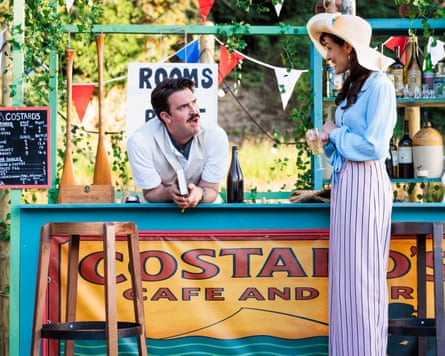
The character conflation falters only by making Boyet, formerly a lord at court, a vicar. As the first play is, even by Shakespeare standards, exceptionally stiff with sexual innuendo, this irreverent reverend seems always at risk of a summons to the bishopric.
As the combined commitment-phobe, James Sheldon tinglingly delivers Berowne’s big speech (“And I forsooth in love!”) and Benedick’s (“The world must be peopled”), making them part of the thought process of a man whose pomposity conceals confused longings. Phoebe Pryce’s Beatrice-Rosaline also finds a poignant through line from confident to bruised sarcasm. Chirag Benedict Lobo’s Claudio Dumain makes the jilting of Hero shiveringly shocking. And as Dogberry, usually a comic wordplay turn, Matt Pinches relishes this production’s promotion of the village plod to a wartime captain, giving him a self-deluded swagger recalling Captain Mainwaring in Dad’s Army.
Having added tragedy though the expanded characters and extended timeline, Littler also mines every possible comic note with slapstick involving a swing, fishing rods, a dinner gong, ice bucket and beer pump. Dons will still dispute whether these two plays are one story but, in these performances, the argument is won.