.png) 3 months ago
77
3 months ago
77
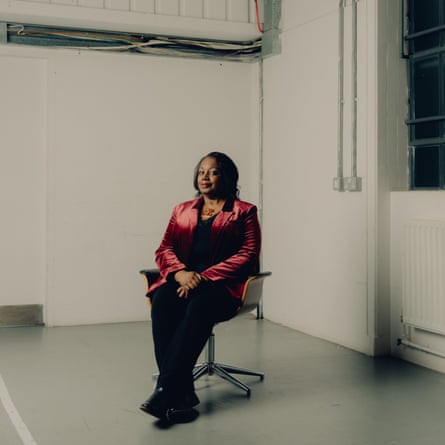
‘I’m useless at this bit,” Malorie Blackman laughs, shifting awkwardly in a plum-coloured jacket and smart black trousers. It is a gloomy February evening in the back room of a theatre in west London, and she is having her photograph taken, the rain pummelling the brick outside.
Blackman is, by any reasonable metric, one of the most significant writers Britain has produced in the past quarter of a century – the closest thing my generation, who were raised on her books, has to a literary rockstar. And yet, she seems faintly baffled by the notion that the spotlight should rest on her for long. “I hate being in front of the camera!”
This year marks a quarter century since the publication of her most famous book, Noughts & Crosses, the first in what became a nine-book young adult phenomenon. Set in Albion – an alternative Britain colonised centuries earlier by Africa – Black citizens (known as Crosses) hold political, economic and cultural power; white citizens (Noughts) are the underclass, segregated, overpoliced and structurally disadvantaged. The country is recognisable but inverted: there has never been a Nought prime minister; “flesh-coloured” plasters do not match Nought skin; segregated schools are defended as tradition; and extremist groups radicalise young men who feel they have nothing left to lose.
Noughts & Crosses was Blackman’s 50th book, and her first that tackled racism head on. “I sat down at my computer really angry,” she tells me. It was the 1990s, the time of the murder of Stephen Lawrence and the Macpherson report’s finding of institutional racism within the Metropolitan police. “It was my way of channelling that anger.”
Even before she wrote a word, she encountered resistance. “People were telling me, ‘Oh, no one wants to read about racism.’ And I thought – that’s interesting. You haven’t read it. You don’t know what it is. You’re already making assumptions.”
She remembers her mum calling her midway through reading a proof. “Is Callum [one of the protagonists] white?” she asked. “She said she was going to have to start the book again. And I thought – yes. That’s exactly what I wanted.”
The series expanded far beyond its original trilogy – through Knife Edge, Checkmate and later instalments including Crossfire and Endgame. As the real world convulsed – with Brexit, the election of Donald Trump, a global pandemic – Albion reflected it back to itself. “The world just kept giving me material,” Blackman says.
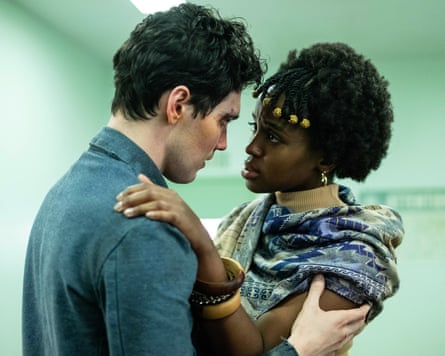
It is hard now to recapture how radical Noughts & Crosses felt on publication. No British YA novel before had tackled racism with such acuity and emotional force, or trusted young readers with moral ambiguity. The book went on to appear in the BBC’s Big Read poll of the nation’s favourite novels, was adapted for the stage and by the BBC for television, and is now a staple of school curricula across the UK.
Blackman shakes her head when I ask whether she predicted any of it. “When you sit down to write, you don’t know if it’s going to sink or swim,” she says. “You don’t know even if anyone’s going to read it. And the fact that so many people have, and have come up to me and said what it meant to them … I feel very, very lucky.”
Blackman was Born in 1962 in south London to parents who had emigrated from Barbados. Her childhood divides cleanly into two distinct chapters: a before and an after. The first few years of her life were marked by relative stability – her father, trained as a master craftsman, worked as a bus driver; her mother was a seamstress. Money was not abundant, but she was content. Their home was full of music – calypso records spinning on a Sunday, Motown drifting from the radio.
“My parents’ major thing was education,” she says. “So when we came home each afternoon, it was always ‘upstairs to do homework until dinner’.”
Then, at 13, that security shattered. One afternoon she returned from school to find a note from her father saying he had left the family. The next day bailiffs arrived – unbeknownst to her mother, the bills hadn’t been paid, and the family became homeless overnight. The first homeless shelter Blackman lived in had no fridge, the second had no central heating. In winter, her school uniform absorbed the smell of damp and paraffin from the heaters, so she kept her distance from classmates.
When I ask how these experiences shaped her, she is sanguine. “It means I don’t take anything for granted,” she says. “It gave me insight into what it’s like to have nothing, to lose everything and to have to rebuild.”
In the midst of that instability, there was one constant: her local library. “Books were my escape,” she says. “And my public library was a lifeline.” A librarian pressed Jane Eyre into her hands; then Rebecca. “The library was among the few spaces where I was allowed to go by myself, and I could sit for hours without being moved on, and without having to spend any money.”
Yet, despite having read hundreds of books before she reached secondary school, Blackman did not read a single book by a Black author until she was 21: The Color Purple by Alice Walker. “That’s a hell of an age to get to without reading anything written by someone who looks like you,” she says. As a young adult, she discovered New Beacon Books in north London, the UK’s first Black bookshop, which she describes as “a second education”. But even there she noticed the absence. “There were very few Black British authors. The African American experience wasn’t the same as mine. And I thought – where are those books?”
By that time, she was working in computing in the city, a career she describes as a response to the financial instability she had grown up with. She earned good money, travelled around the world, managed teams, and met her husband, Neil.
“For a while I thought that was success,” she says. “But I started to feel like it wasn’t enough.” The creative muscles she knew she had were laying dormant, last exercised as a child who would spend her free time writing stories. So when she overheard a doctor discussing her diagnosis of sickle cell disease and predicting she would not live beyond 30, she began to think of ways she could flex those muscles again. “I started thinking, if I’m on my deathbed, I’d rather think I gave it a damn good try – even if I failed – than think I wish I’d had the courage to try,” she says.
Her first foray into artistry was an acting course. “I was terrible,” she says cheerfully. “I mean, I really stunk up the place.” But the experience nudged her towards writing. One day, when she was in her mid 20s, she checked the children’s section of a London bookshop, to see what had changed since her own childhood. “I thought, surely now there’ll be loads of books with Black protagonists.” There was exactly one. “I just stood there thinking: nothing’s changed. And then I thought – OK. That’s what I’m going to do. I’m going to write books for children.”
After 82 rejection letters from publishers, people in her life actively discouraged her from continuing. “Friends and family told me, they don’t publish Black writers in this country,” she says. “But I just kept thinking about that dearth of Black protagonists, and that kept me going. I wanted to write the books I’d love to have read as a child.”
Her first book, a collection of short stories called Not So Stupid!, was finally published in 1990. Even then, “I’d walk into bookshops and see my books under ‘multicultural’, usually on the highest shelf out of reach,” she says. So she would diligently relocate them to ‘B’. “Face out, mind you,” she laughs. “I know those bookshops were sick of me!”
When she first started publishing novels, she was criticised by some for not writing explicitly about race, despite the protagonists in her books being Black. “I knew that if I’d written about racism immediately, I would have been pigeonholed as an ‘issues writer’, and I would never have got out of that box,” she says.
By the time she came to writing Noughts & Crosses, she thought that would no longer be a problem. “I finally felt I had enough of a backlist that I wouldn’t be boxed in,” she says. “Of course, what did they then call me? An issues writer,” she laughs. “You can’t please everyone!”
These days, Blackman’s fans include some of the most celebrated writers and artists in Britain. Novelist Caleb Azumah Nelson has described Noughts & Crosses as his favourite novel growing up, one that “blew my mind”. Benjamin Zephaniah described it as “the most original book I’ve ever read”. Candice Carty-Williams has cited Blackman as an inspiration. Some of her most iconic shoutouts, though, come from the music scene: “I’m Malorie Blackman the way I sell books,” raps Stormzy in Superheroes. Tinie Tempah calls himself “just a writer from the ghetto like Malorie Blackman” in his hit single Written in the Stars.
She recalls telling her daughter about her name-check in Superheroes, calling her into the room to witness the evidence. “She said, ‘Does he know how uncool you are?’” Blackman laughs, delighted. Three years later, she was featured in the music video for Stormzy’s 2022 single Mel Made Me Do It. “It was such a surreal, brilliant day,” she says. “A real pinch myself moment.”
Stormzy, who launched his own publishing imprint #Merky Books with Penguin Random House in 2018, has written the foreword to this year’s anniversary edition of the book: “I can’t remember exactly how old I was when I first read Noughts & Crosses, or how I first picked it up, but I do remember the impact it had on me,” he writes. “I was so taken by it – it was the first time that words on a page had gripped me in the same way that a film or TV series had.”
Has the publishing industry changed since Noughts & Crosses came out? “When I first started writing, I read every book that came out by a British writer of colour because there were so few,” Blackman says. “Now there’s no way I could read them all, and that’s wonderful. But there are still problems.”
In 2013, when Blackman was appointed children’s laureate, she used her platform to call for greater diversity in children’s publishing. The backlash was swift and vicious. Some newspapers misreported her as saying there were “too many white children in books” – a claim she never made. “I got death threats against me and my family,” she says. “It was horrible, really frightening. But so many people rallied round. ‘You come for Malorie, you come for us.’ That was so lovely.”
The years after the murder of George Floyd in 2020 saw a surge of interest in books by writers of colour in the UK and US, with publishers loudly pledging change. But that momentum has proved fragile. Last year, a literacy charity described a “catastrophic decline” in children’s titles featuring Black protagonists, reporting a drop of more than 20% between 2023 and 2024. At the same time, research published by the Bookseller in 2023 concluded that the surge of interest after 2020 had “failed to deliver the promised broadening of publishing’s output”.
“Some of the noise from the industry was definitely performative,” Blackman says. “At the time, I thought, we’ll see in five or 10 years’ time who is still committed to this and who has quietly let it fall by the wayside. I just wish publishing, and all creative spheres, were more proactive rather than reactive.”
The last few years have also brought fresh political problems. The Color Purple is among the titles most frequently banned in the US. It is a trend that concerns her deeply. “A lot of the time, what starts over there often ends up coming over here,” she says. “The books that tend to get hit are by people of colour, LGBTQ+ authors, anything seen as subversive and against the conservative mores of society.”
It is also part of a wider political climate that Blackman finds alarming. In the US, Immigration and Customs Enforcement (ICE) raids dominate headlines, while in the UK, culture war skirmishes flare up with wearying regularity. “Unfortunately, I think Noughts & Crosses is even more relevant today than it was when it first came out,” she says.
Blackman has now published more than 70 books, including Pig-Heart Boy, Hacker and Boys Don’t Cry. She has also branched out from YA fiction, writing TV screenplays – including a 2018 episode of Doctor Who, and an adaptation of Pig-Heart Boy – and her memoir, Just Sayin’, was published in 2022. As well as writing, she tries to develop a new skill each year; at the moment it is jewellery-making, a few years ago it was music production. “I like being a beginner,” she says. But as far as hobbies go, reading still reigns supreme. She owns about 15,000 books, though many are now audiobooks because, she says, “we were being crowded out of the house”.
Blackman is an ambassador for the UK’s National Year of Reading, and speaks with missionary zeal about the pleasure and power of books. “Reading changes lives,” she says. “It builds empathy, perspective, connection. Whatever you’re passionate about, you can read about it,” she says. “And if you can’t find the book you want, do what I did: write it.”