.png) 2 months ago
68
2 months ago
68
Jayson Naga is a tricycle taxi driver on the streets of Manila. In a normal day he brings home P500 (US$8) to feed his four children. But these days he is struggling. He requires four litres of gasoline a day to ferry his passengers around the city and the 60% surge in fuel prices has wiped out nearly a third of his take home pay.
“If gas prices go up any further, there will be nothing left for us,” he told the Guardian. His family’s only luxury – driving to air-conditioned malls on weekends to escape the heat – was the first to go.
The Philippines imports almost all of its crude oil from the Middle East. The government became the first in the world to declare a national energy emergency over the oil crisis triggered by the war in the Middle East, and public outcry over the response to soaring fuel prices and supply issues has spilled into the streets.
Transport workers are facing the immediate brunt of the oil crunch.
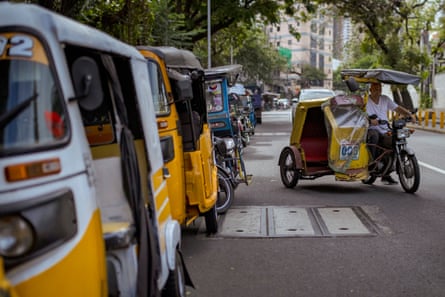
Hogan Ruben, also a tricycle driver, has to spend an extra five hours on the road to earn enough. “What we do now is we head out early and stay out until twelve midnight or one in the morning, just so the income we bring home is enough,” he said.
“We have no choice but to keep grinding,” Ruben said.
After admitting challenges to securing supplies to replenish its inventory, President Ferdinand Marcos on 27 March said the government has secured enough crude oil for domestic processing to last until 30 June. This assurance comes as he scrambles for alternative sources, including a recent shipment from Russia.
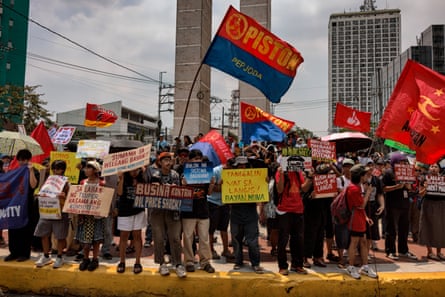
But anger at the government is palpable. Last week, transport groups held two-day nationwide transport strikes to call for oil price rollbacks by scrapping fuel excise taxes and the oil deregulation law.
President of the transport group Piston, Mody Floranda said Marcos was “inutile.”
“Hardship persists not only for transport but for the entire public. How can workers survive on low wages while fuel prices keep climbing?” he said.

It is a human rights crisis as well as an economic crisis, said Edgardo Cabalitan, a NGO worker, who joined a noisy barrage in front of the country’s largest gas station on Friday. Passing jeepneys and motorcycle riders blared their horns in a show of solidarity.
“The oil crisis is not just an issue of rising costs. It is an issue that directly strikes at human rights. As oil prices rise, the cost of goods follows, affecting not only the livelihoods of drivers but also our very access to basic needs,” Cabalitan said.
Jan Carlo Punongbayan, an assistant professor at the University of the Philippines School of Economics, said the crisis will only get worse, with estimations that the global price of crude oil could reach as much as $200 dollars per barrel.
“It’s going to be quite bad, especially the indirect effects of inflation. The [government] is looking at double digit inflation rates by May. We haven’t seen that level of inflation for many many years, not even during the pandemic,” said Punongbayan.
Food price pain on the horizon
Food prices are next. Punongbayan said the current harvest season has so far tempered the impacts, but he expects food prices to start going up rapidly in the coming weeks, after the harvest season and with higher transport costs.
While crowds in malls have thinned, the grocery stores are packed. Shoppers are filling baskets with basic necessities, in a manner reminiscent of pandemic-era panic buying. On social media, users are discussing solar panel installations and the viability of electric vehicles.The desperate situation has brought out the worst in people. At a gas station in Quezon City, a pump attendant had to shoulder a nearly $100 bill after a driver of an SUV sped away without paying for his full tank. Local police promised to search CCTV footage to trace the perpetrators.
But back on Maginhawa street in Quezon City, donations of food packs from members of the public began arriving last week at the corner where drivers like Naga and Ruben wait for passengers. On Sunday, they each grabbed a pack of rice, some eggs, noodles, canned goods, and a sandwich.
The community pantries are back, a community-led project which the Maginhawa neighbourhood initiated during the pandemic, this time offering a lifeline to transport workers. More than a dozen similar community pantries have popped up nationwide.
“When we saw that the community pantry was back, it gave us drivers a sense of hope again,” said Naga.