.png) 3 months ago
84
3 months ago
84
Mary, Queen of Scots is one of those perennial figures trotted out as a universal signifier, often for femininity itself, an image of rectitude and self-sacrifice in the face of unimaginable deprivation. The problem is that the historical record doesn’t quite support this narrative: Mary possibly conspired to murder her second husband in order to marry her third, and despite protestations to the contrary, remained a serious threat to the reign of Elizabeth I until the moment she was executed. She was a political player who lost, not an ingenue caught in the crossfire of history.
Famed French stage and screen actor Isabelle Huppert has worked with equally famed (and now sadly late) American theatre maker Robert Wilson twice before this collaboration, and it’s easy to see why she would come back a third time, like Mary to the matrimonial bed. Wilson’s artistic rigour was legendary, and his uncompromising aesthetic – so absolute it seems almost brutalist – frames Huppert’s singular talent superbly. She shimmers on stage, a regal pride emanating from her body and the precision of her movements. This is undeniably Huppert’s show.
Mary Said What She Said opens with Huppert in a tightly held silhouette, like a delicate glass figurine poised at a table’s edge. She speaks, although we don’t see her face for a long time; sentences tumble out, but the words feel disembodied, maybe even pre-recorded. Wilson’s formalism seems deliberately designed to place us at a remove, to dissociate us somehow. Several lapses in memory from Huppert give the performance a halting, hesitant quality.
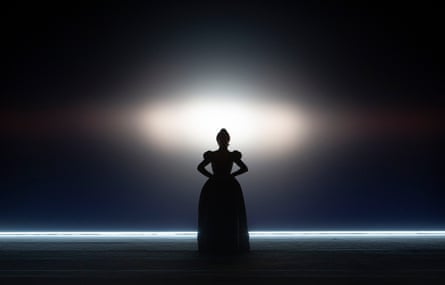
If this weren’t enough, Darryl Pinckney’s densely packed text – spoken in French with surtitles in English – unspools so rapidly, full of poetic imagery and reams of repeated non-sequiturs, that the audience finds themselves desperately trying to keep up. The first half hour in particular feels like a competition for the fastest reader, giving us no time to even look at the actor, let alone gather context or contemplate meaning. It evokes Artaud’s Theatre of Cruelty, hostile in its aggressive minimalism.
Eventually, when Huppert’s face is finally lit, a portrait emerges, albeit still fractured and obscure. Political details – crownings, royal weddings, reversals of fortune – crash into personal ones with an intensity that becomes almost comical, then exhausting. Pinckney makes much of the fact that Mary’s four ladies-in-waiting were also named Mary (as was her mother, Mary of Guise, but Pinckney makes far less of that), and allows for odd diversions, including an apocryphal story of Scottish cannibals led by a man called Sawney Bean. Much of this is simply recondite and confusing.
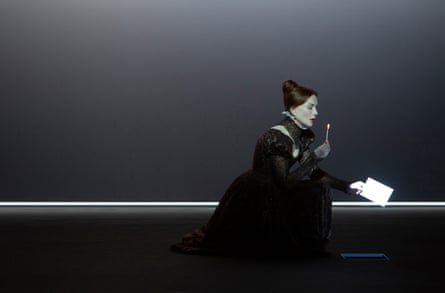
Wilson, however, was a master of mood and register, and while Pinckney’s verbiage cascades around us, Ludovico Einaudi’s looping, modular score combines with Wilson’s sparse set and lighting design to induce a swirling, hypnotic fugue. Huppert’s exacting performance seems to grow in stature and meaning, the more fiendish the physical and vocal demands become; eventually, you find you can’t take your eyes off her. Whether or not this is a fully realised depiction of a historical figure seems beside the point.
Just as Wilson’s legendary collaboration with Philip Glass, Einstein on the Beach, had very little to do with Einstein, Huppert’s Mary has a tenuous relationship with the historical Mary, apart from a handful of biographical details that spill out like a dropped pack of cards. Standing against a backdrop, variously sky blue, misty white and pitch black, this Mary starts off like a music box ballerina, fixed and mechanical. As the music intensifies and we move away from Mary’s childhood recollections, the play becomes more charged and incantatory. Eventually, it holds an almost eldritch power.
This kind of formalism won’t be everyone’s cup of tea. The stream-of-consciousness text, with its increasingly deranged repetitions, works more like a symphony than a conventional play script. Wilson’s austere staging, his James Turrell-like strips of light and rigid stage pictures, tilt toward pure aestheticism, best categorised as living sculpture rather than theatre. And Huppert isn’t playing a character in a traditional sense; she’s embodying an idea or series of ideas, about women and power, mothers, daughters and sisters handed about in the whirligig of time.
One thing Mary Said What She Said doesn’t have, the thing that might have bonded the material more cogently to its source, is a scrap of politics. For a character who married a king, gave birth to a king and was executed by a queen, pummelled by factions and overwhelmed by court intrigues, this Queen of Scots remains staunchly, ludicrously nonpartisan. While Pinckney flirts momentarily with an image of Mary as sexually and politically potent, an Artemis of Tudor England, he ultimately falls back on the image of her as hallowed and pristine, a cliche of the doomed martyr of Catholicism. Plus ça change, Mary, is what you could have said.
-
Mary Said What She Said is on at the Adelaide Festival Theatre until 8 March.