.png) 2 hours ago
4
2 hours ago
4
At about 8.47pm on the evening of 15 August, while tens of thousands of worshippers filled the streets of central Messina for a religious festival, at least two men cut through the fencing surrounding the regional museum, located a few miles to the north on the outskirts of the Sicilian harbour city.
Capitalising on the fact that the streets around the museum were unusually quiet, the men forced open a side door with a crowbar, gaining direct access to a display case containing the five surviving panels of the Renaissance master Antonello da Messina’s polyptych Polittico di San Gregorio, his most important work, and a small double-sided painting. Undisturbed, they removed the works from the building and fled.
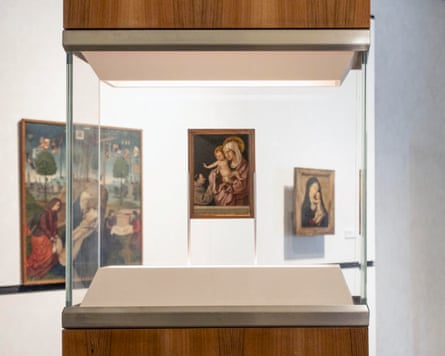
The heist – one of a series of high-profile thefts from European institutions in recent years – has left investigators baffled. Investigative authorities have said very little on the record, but sources speaking anonymously to the Guardian and local media, as well as art historians who know the building intimately, say lots of elements don’t add up, except one: the date chosen by the thieves.
“If there is one day out of the 365 in the year that a thief would choose to carry out a robbery in Messina, it would be 15 August, the day of the Vara procession,” said an investigator close to the inquiry. Founded in 1535, the religious event takes place in Messina on 15 August, the day of Italy’s national Ferragosto public holiday. At its centre is a 14-metre pyramidal float depicting the Assumption of the Virgin Mary. More than 150,000 people pack into the city centre, hundreds of police are deployed, and major roads and squares are closed.
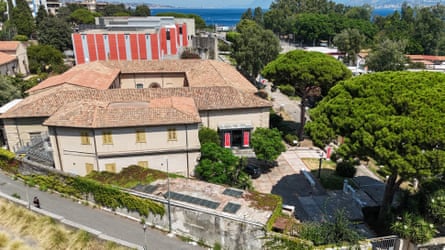
“The city’s outskirts are almost deserted that day,” said Lelio Bonaccorso, a graphic novelist, illustrator and Messina-based art expert who has collaborated with the regional museum. “Those who stay home are mostly elderly people, for whom the August heat and huge crowds can pose a health risk.”
According to investigative sources speaking to local media, two masked men entered the museum wearing motorcycle helmets, possibly aided by two accomplices who remained outside as lookouts.
The exact point of entry into the museum’s grounds remains under investigation, but one line of inquiry is that the thieves came in via an adjacent apartment block.
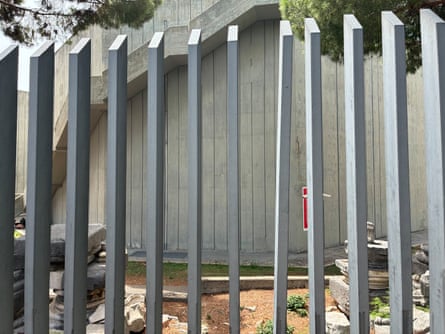
After cutting through the fence, the thieves are believed to have headed straight for a side door, one of the few entrances that, according to investigative sources, was not fitted with an alarm system.
“This is where one of the first mysteries emerges,” said Valentina Certo, an art historian affiliated with the University of Messina. “CCTV shows the raid lasted just two to three minutes. How did the thieves remove all five panels so quickly, and know the door was not alarmed?”
Investigators suspect the thieves may have had inside help. The Ansa news agency reported that a museum employee was under investigation over alleged inconsistencies about the alarm system, though police sources dismissed the report.
“Law enforcement always looks for an insider connection when it comes to museum thefts,” said Christopher Marinello, a lawyer and the chief executive of Art Recovery International. ‘‘It’s just a sign of good investigative work. How did the criminals get past the guards, the alarms, the cameras? There is always an assumption that the thieves must have had inside help, even if it is eventually proven otherwise.”
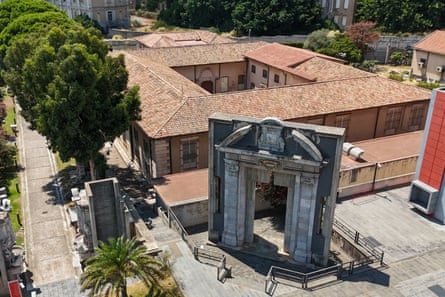
While the door used by the thieves may not have been alarmed, Antonello’s polyptych was protected by a security system designed to trigger an alert at the slightest movement.
Investigative sources told La Sicilia that the alarm sounded as expected. According to police sources speaking to the TG La7 news programme, one guard allegedly told investigators he heard it and switched it off, believing it was a false alarm.
The theft was discovered by a woman who noticed something unusual on a low wall outside the museum about 10 minutes after the theft.
In a recording shared with the Guardian, she told police: “There are museum paintings in the street, as if someone stole them and left them here. They’re large and worth a lot of money.”
Inexplicably, two panels from the polyptych were left on the wall. “They had not been thrown to the ground, but carefully propped up,” said Bonaccorso. ‘‘Why go to the trouble of dismantling a five-panel work and then abandon two of them outside the building?’’
after newsletter promotion
The Museo Regionale Interdisciplinare, often shortened to MuMe, houses some of Sicily’s finest archaeological and Renaissance and baroque treasures, including two Caravaggios. The Italian painter spent several months in Messina in 1609, painting The Raising of Lazarus and The Adoration of the Shepherds before moving to Palermo, where he painted the Nativity with St Francis and St Lawrence.
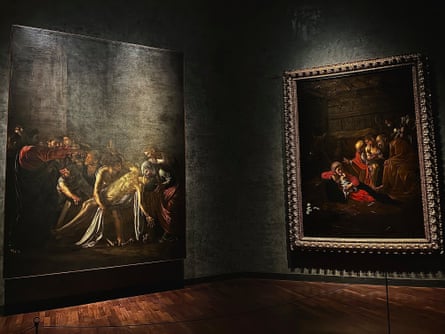
That work was stolen from the Oratory of San Lorenzo in 1969 and has never been recovered. Investigators have long suspected mafia involvement, and it remains on the FBI’s list of most wanted stolen artworks.
Shortly after the Antonello theft, Messina’s chief prosecutor told Rai that mafia involvement could not be ruled out – a familiar line in Sicily in investigations into major art thefts.
‘‘Given the location of theft and Hollywood stereotypes, I can understand why people are considering mafia involvement,” said Marinello. “However, in my view, even the most hardened local mafioso would never desecrate Messina in this way.”
The stolen work is no ordinary painting. Originally composed of six panels and created for the Monastero di San Gregorio, it is the only work by the Sicilian painter never to have left his home city, and it survived the 1908 earthquake that devastated Messina, killing about half its population. Some local people saw it as embodying a kind of rebirth in a city repeatedly scarred over the centuries by earthquakes and then by the bombs of the second world war.
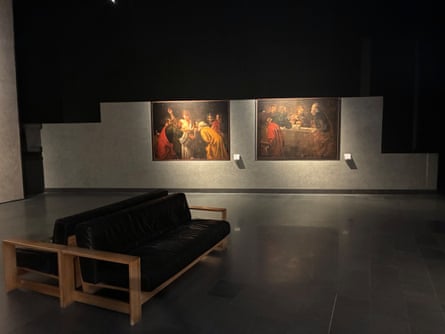
Opposite the artwork’s display case is an emergency exit that investigators believe the thieves may have used to leave the building. It leads towards the wall where two panels were abandoned and, beyond that, the strait dividing Sicily from Calabria on the Italian mainland.
Investigators have not ruled out an escape by speedboat, a theft to order or a ransom demand. But selling such a famous, incomplete work would be extremely difficult.
“How would an evil collector display it?” asked Marinello. “It would have to remain hidden. These thieves will soon discover the paintings are ‘radioactive’ – and will never bring them the millions they expected.”
For now black panels cover the space where the polyptych sat, as if mourning the loss.
“Here we have a saying,” said Bonaccorso. “We are like the phoenix. We always rise from the ashes of the catastrophes that have struck our city. This theft is not a tragedy like an earthquake, but another wound for Messina. Yet we will rise again this time too.”