.png) 2 months ago
65
2 months ago
65
In a frozen laboratory full of cryogenically suspended experimental life forms, metal boots disturb the frost. A lone bounty hunter in a familiar orange exosuit points her blaster ahead. Making my way towards the facility’s power generator, scanning doors and hunting for secret entrances, broken hatches and hidden keys, I suspect that I know exactly what’s going to happen when this place begins to thaw; every clank and creak sounds sounds as if it could be a long-dormant beast busting out of one of those pods. And yet Samus Aran delves deeper, because she has never been afraid of anything.
This section of Prime 4 is classic Metroid: atmospheric, eerie, lonely, dangerous and cryptic. Samus, Nintendo’s coolest hero, is impeccably awesome, equipped here with new psychic powers that accent her suit with pulsing purple light. (I have taken many screenshots of her looking identically badass all over the game’s planet.) She is controlled with dual sticks, or – much better, much more intuitive – by pointing one of the Switch 2’s remotes at the screen to aim. Or even by using it as a mouse on a table or your knee, though this made my wrist hurt after a while. She transforms into a rolling ball, moves statues into place with her mind, and rides a futuristic shape-shifting motorcycle across lava and sand between this distant planet’s abandoned facilities, unlocking its dead civilisation’s lost knowledge.
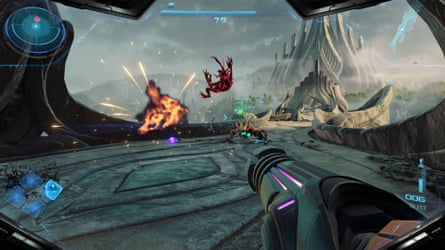
In fact there is a lot of classic Metroid Prime in here. Things that I’ve been missing since these atmospheric adventures went on hiatus in 2007: the gradual unfurling of new powers and gadgets; the Giger-esque visual design; patiently scanning everything with Samus’s visor for clues; the sedate pace of exploration, interrupted by sudden bursts of frenetic blasting when robots or aliens show up. It has some spectacular sights and moments: enormous boss creatures, the desert that stretches across the planet under unforgiving foreign sun, wolves that emerge from a blizzard like spectres.
Alongside the Metroid series’ own ghosts, I was surprised to find echoes of other abandoned Nintendo sci-fi series in here, too. If you are still waiting for long-lost sequels to F-Zero or Star Fox, well, improbably, they’re in here: in the floaty controls of Samus’s motorcyle and its cyberspace training courses; in the way that flying creatures will sometimes arrange themselves in formation ahead of you, allowing you to paint them with your reticule and fire off a laser-fizzing disc to explode them.
But there is also a lot that does not feel like Metroid, and usually for the worse. Someone at either Retro Studios or its parent Nintendo was clearly worried that players may get lost wondering what on earth to do next, so Samus now has a companion who offers up suggestions for where she should go. Rescued engineer Myles MacKenzie caught a lot of flack during Metroid Prime 4’s preview period – justifiably, because he truly is spectacularly irritating, firing off Joss Whedon-esque quips to himself as Samus looks on in what I can only assume is silent judgement. Thankfully, he is present for all of 15 minutes before he confines himself to a basecamp at the end of the game’s first area, leaving Samus (and the player) to explore in peace.
Aside from offering a few unwelcome directions when I’d spent too long wandering the desert, Myles never turned up again unless I asked for his help. (In the abandoned facilities that make up the bulk of the game, his radio signal is scrambled so you couldn’t summon his voice even if you wanted to.) But Samus encounters more stranded soldiers over the course of the game, and unfortunately they are all annoying when they’re around, interrupting your exploration far too often with soundbites and unnecessary advice. The desert that connects all the different areas, meanwhile, is disappointingly empty. Especially in the later hours of the game, there is a lot of tedious zipping to and fro across this expanse, which feels distinctly un-Metroid (and unenjoyable), compared to the tight corridors and tense space-station fights that can be found elsewhere.
Metroid Prime 4 feels, often, like an experimental game from 15 years ago. I cannot stress enough that this is mostly a good thing. It is wonderfully untroubled by the conventions of modern game design. Ironically, the wait for Prime 4 has been so long that what would have felt tedious or archaic in the past now feels comfortingly retro: things such as walking everywhere instead of using fast travel; or the slow, methodical cadence; or the predictable structure which has you fighting five different boss monsters in five different obvious arenas to collect five different keys. Other things are less forgivable, such as the spotty autosaving. Having to replay a full half-hour’s worth of exploration in a lava-encrusted weapons facility after an accidental death is not fun.
after newsletter promotion
I might have been disappointed by Metroid Prime 4 if it had come out in 2010. But now, after such a long break, I’m happy to return to this anachronistic way of playing: slow, laborious, sometimes annoying. It’s a reunion tour rather than a revival for the Metroid Prime series: some of the new material doesn’t hit but the classic stuff is still just as great as ever.
-
Metroid Prime 4: Beyond is out 4 December; £58.99