.png) 3 months ago
71
3 months ago
71
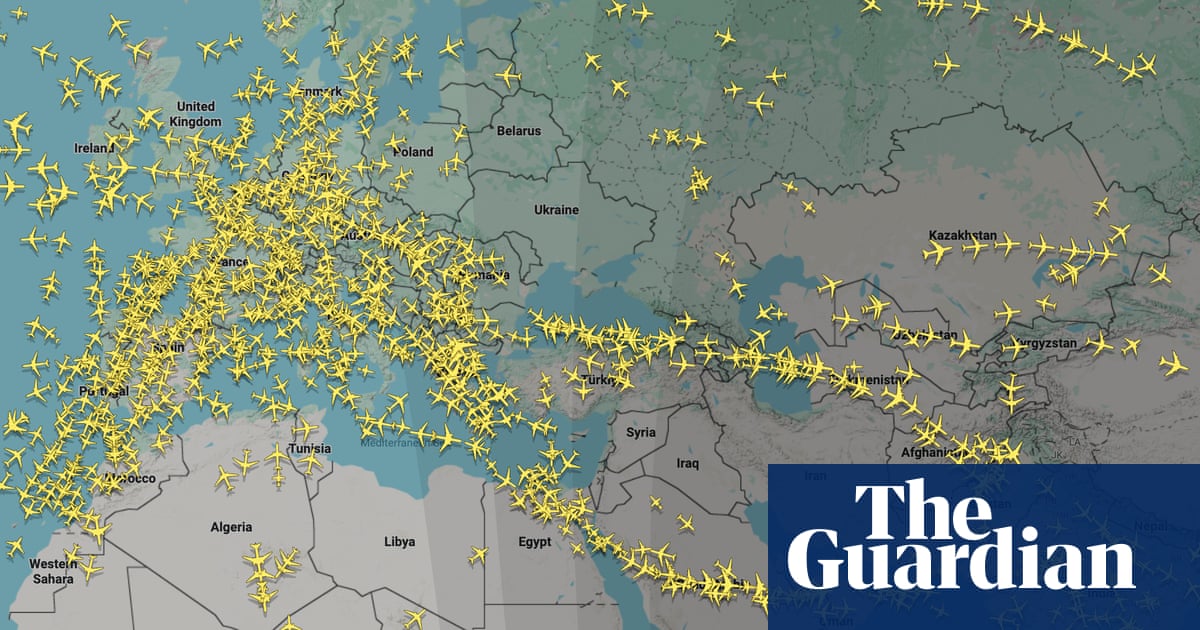
More than 100,000 Britons were stranded in the Gulf on Monday, with airspace in the region still closed to most flights and overland evacuation regarded as risky while Iran continues to launch missile and drone strikes across the region.
Downing Street said UK officials were considering all options to get citizens home safely, including using commercial, charter and military flights and bussing evacuees across land borders into Saudi Arabia and Turkey.
“The increasingly reckless strikes from the Iranian regime targeting Gulf allies, including strikes on bases, airports and on hotels, directly put British lives at risk,” Keir Starmer’s spokesperson said.
“The safety and security of those British nationals remains this government’s top priority.
“We know people right across the country will be deeply concerned by the scale of this crisis, in particular the British nationals, including holidaymakers and transit passengers who are currently in the region and being told to shelter in place.
“We always recommend they follow FCDO [Foreign, Commonwealth & Development Office] advice but want people to get back home as quickly as possible, and we are looking at all options.”
The Foreign Office has set up 24/7 consular support to assist Britons in the region to manage the fast-evolving situation, including deploying teams of extra staff to work with the travel industry and governments.
Given the huge numbers involved – with more than 200,000 Britons believed to be in the region, half whom have “registered their presence” with the Foreign Office – the quickest route to get them out would be for commercial flights to resume.
A few, selected passenger planes were due to lift off from Abu Dhabi and Dubai’s international airports on Monday evening, with thousands of passengers understood to be stuck there in transit after their flights were grounded.
However, with Iranian airstrikes on the wider Gulf – where the majority of Britons in the region are based – expected to continue this week and potentially beyond, passenger jets remain a risky option, while military-run evacuations could be even more dangerous.
The UK government has been drawing up contingency plans to bus people to Saudi Arabia to enable them to fly home if airspace in the UAE remains largely closed because of strikes. A more limited evacuation route for those in other parts of the Middle East could potentially go through Turkey.
The UAE government is currently covering the cost of hotels and meals for people who are stranded there but it is unclear if it will continue to do so if flights remain grounded longer term.
The Foreign Office has advised against travel to Iran, Israel and Palestine, and against all but essential travel to Bahrain, Kuwait, Qatar and the UAE, with further instructions to avoid travel to some parts of Pakistan.
Even if most of the long-term residents in the Gulf intend to stay put for now, hoping that hostilities remain relatively contained, a potential evacuation of Britons could dwarf the numbers rescued from abroad in other crises.
The UK government has recent form in mass repatriation, from the early days of the Covid-19 pandemic to the failure of travel firms Monarch and Thomas Cook and a supporting role in the US evacuation of nationals from Kabul.
It also organised a small number of charter flights out of Israel when Benjamin Netanyahu’s government launched strikes on Iran nine months ago.
Sir Simon Fraser, chair of the Chatham House thinktank, said on social media: “Having run the Foreign Office during the Arab spring, I can say from experience that any attempt to evacuate all British nationals from the Gulf states if commercial carriers were not flying would be extraordinarily hard and complex.”
In crises with a different geography, Britain’s own airlines might have transported the bulk of UK citizens: but the Gulf airlines, Emirates, Etihad and Qatar, now collectively dominate their skies as much as their logos cover Britain’s stadiums and teams.
The home of Emirates alone, Dubai, welcomed a million Britons in the last year, the biggest source of Gulf tourists in Western Europe. Emirates operates the world’s largest fleet of superjumbos, the Airbus A380s capable of carrying 500 passengers at a time, with multiple flights daily to London Heathrow, and other services to UK airports including Birmingham, Manchester and Edinburgh.
Compared to Covid, any UK rescue flights would be from a comparatively compact geographical area, but one at the crossroads of global aviation.
Aviation analyst John Strickland said: “The numbers are so vast. It affects people who are not caught up directly in the situation but are stuck elsewhere in the world, due to be transiting. The capacity elsewhere to move people who would be going through the Gulf is limited.”
In terms of absolute numbers, the UK’s Civil Aviation Authority can point to having brought more than 110,000 passengers back to the UK in 2017 after the collapse of Monarch airlines, chartering planes from airlines including easyJet and Qatar at a cost of £60m to the taxpayer.
What ministers boasted was the UK’s largest peacetime repatriation was superseded two years later when Thomas Cook similarly went bust, with 150,000 people brought home at a cost of £83m.
“It’s one thing to put rescue flights in when an airline goes bust, but this is a military situation,” said Strickland.
Although the US commandeered some passenger aircraft for the evacuation of Kabul in 2021, it also crammed many people on to military transporters, flying via the Gulf.
“The UK could put military aircraft in but we don’t have many transporters – and it’s a drop in the ocean compared to what is normally operated by Emirates and the others,” Strickland added.