.png) 1 month ago
29
1 month ago
29
There was birdsong in the Queen Elizabeth Hall foyer. In the hall itself, hanging from the ceiling, were ropes and ropes displaying many thousands of walnut-sized LEDs, lined in huge blocks above the heads of the players and front half of the audience, promising to light the place up as if it were Harrods in December. This was Echoes of Hill and Horizon, an unlikely and delightful coming together of technology and English pastoral music at this year’s Multitudes festival.
Just over an hour of Vaughan Williams, Warlock and Elgar was played by the Orchestra of the Age of Enlightenment – who don’t usually play this stuff, but who drew on their experience in the earlier music that inspired it. Their agile playing, at once lean and sonorous, was filtered through the dozens of speakers that make up the QEH’s hidden surround-sound system, which occasionally blunted the orchestral blend but allowed for intriguing spatial effects or cathedral-like reverb.
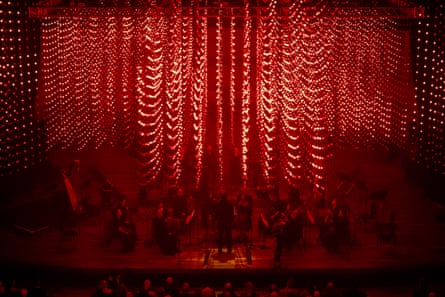
These effects were all but eclipsed by the intricate lightshow happening above us, courtesy of Squidsoup. It was at its magical best in Vaughan Williams’s The Lark Ascending: the bird represented by Kati Debretzeni’s solo violin took abstract visual form as a small cluster of ice-blue lights with a narrow aura of red, never still, swooping above us as each light came alive. At first we could only hear Debretzeni, her lyrical playing seeming to come from wherever the lights led our eye. Then, stepping out from the darkness, she moved around the stage as patches of the lights turned the colours of sunlight and harvest – yellow, ochre, russet – followed by leaf-green and deep sky-blue.
The other pieces were more abstract, a feast of synaesthesia. Peter Warlock’s courtly Capriol Suite had indigo splodges moving as if with stately dance steps, or little red explosions like fireworks, or a twirling ribbon of turquoise. No prizes for guessing the leading colour in Vaughan Williams’s Fantasia on Greensleeves. Elgar’s Serenade for Strings brought clusters of poster-paint shades, Vaughan Williams’s Fantasia on a Theme by Thomas Tallis showers of stained-glass blues and reds. Thanks to the vitality of the playing and the paciness of Evan Rogister’s conducting, it all came together to create an immersive audiovisual experience that felt weightless and enchanting.