.png) 1 month ago
51
1 month ago
51
For the first hour, this production of Lerner and Loewe’s musical glides along smoothly enough; the cockney flower girl sings of rain in Spain, the elocution professor rails at her for murdering the English language with her guttersnipe vowels, and the whirligig of Eliza Doolittle’s transformation from “squashed cabbage leaf” into lady carries you along.
Set against Dickensian lanterns and Henry Higgins’ hardwood bachelor study, its lovable songs (Wouldn’t It Be Loverly?, With a Little Bit o’ Luck, I Could Have Danced All Night and so on …) seem to emanate from a generic Musical Theatre Land – an anodyne setting entirely dissociated from the world of today. The intention, it seems, is safe, nostalgic entertainment.
But something happens after Higgins (Hadley Fraser) and Colonel Pickering (Tony Jayawardena) have laid their wager about turning Eliza into a society lady with an intensive course in elocution, and Eliza (Keziah Ibe) has duly transformed: the relationship between Eliza and Henry takes on emotional truth. It happens in a moment, perhaps when they make eye contact in his study and you realise they are more than teacher and pupil.
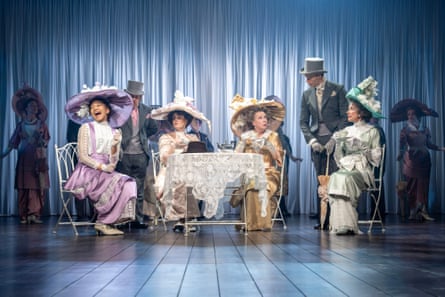
After this, the musical comes alive. Much of it is down to the leads: Fraser plays a sulky, tyrannical, overgrown schoolboy but steers away from cardboard characterisation. So does Ibe, who makes a thoroughly impressive professional debut in the role.
It is also exuberantly directed by Rachel Kavanaugh, and the mobile set, designed by Peter McKintosh, moves forward in some scenes to heighten intimacies between Eliza and Henry.
You find yourself gunning for them by the end when there is not exactly romance in the air but something more tender and valuable, perhaps: friendship. Her final movements show this, alongside her regard of herself as an equal to him.
Inspired by George Bernard Shaw’s Pygmalion, and Gabriel Pascal’s film of the same name, its commentaries on class and social hypocrisy take on great clarity. Eliza’s dustman dad, Alfred Doolittle (Gary Milner), drives home his message about the scourge of middle-class morality and the “undeserving poor” with less caricatured humour than usual. Eliza scrubs up from her screechy cockney mucker self into a woman with bearing, intelligence and self-respect. These features have always been there but are visible to polite society, now that she speaks like them and wears an elegant dress.
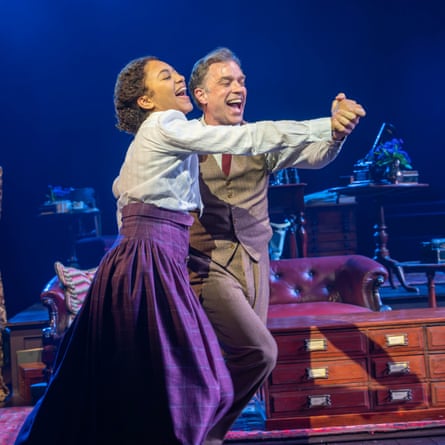
There is still smoothness, particularly in Stephen Mear’s choreography which becomes more marvellous, the ensemble becoming church bells during Get Me to the Church on Time, which hails in Alfred Doolittle’s dreaded wedding. In Higgins’ song, A Hymn to Him, movement aids irony – he sings his words (“why can’t a woman be more like a man”) even as the housekeeper – a woman – buttons his shirts and serves him egg and soldiers alongside three smarting maids. There is humour in the infatuated Freddy (Ben Culleton) too and his infernal letter-writing, and the singing is top notch across the board.
A convincing transformation of an old show, not into something new, exactly, but living. It is taken out of its aspic, divested of its music-hall panto spirit and given a lovely beating (h)’eart.