.png) 3 hours ago
5
3 hours ago
5
Your phone pings and it’s a message from your bank about a new payment being set up on your account. If you do not recognise the transaction, it says, you should get in touch. There’s a number for you to call.
The person on the other end of the line tells you that your account has been compromised by scammers. They need details from you so they can help protect your money. Before you know it, they are giving you details of a safe account to transfer your savings to, or asking you to hand over your debit card so it can be replaced.
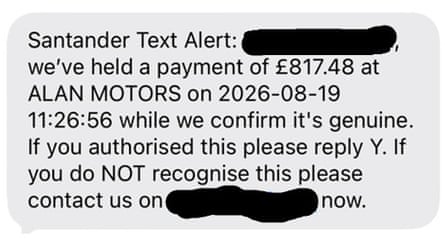
Impersonation scams suh as this are rife - and costly. Figures from Lloyds bank show that fraudsters posing as representatives of trusted organisations – including the police, banks, HM Revenue & Customs and phone providers – stole 10% more from its customers in the year to the end of June than in the previous 12 months.
While the number of its customers reporting a scam has fallen by 3% this year, the average sum taken rose by 10% to £3,516.
Meanwhile, Santander says more than £3m has been stolen from its customers through bank impersonation scams so far this year, with an average loss of £6,000.
Because the messages are being sent out randomly, the scammer could claim to be from a company you have no financial relationship with. But if a text or phone message does include your bank’s name, it is likely to stop you in your tracks.
What it looks like
It might be a call or email, but it usually starts with a text, says Elaine Ross, head of fraud analytics at Nationwide building society. “A lot of people are more sceptical about people calling them than they are about getting a message,” she says.
The text says that a payment has been set up to someone from your account and asks you to take action if you don’t recognise, or did not make, the transaction. Recent messages seen by Guardian Money show criminals saying that people have paid a specific person or business.
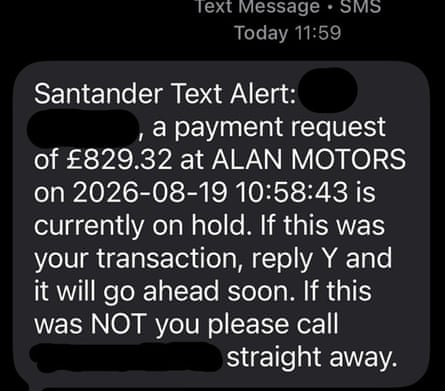
“The value will be a high value, and it will be a person the victim doesn’t know,” Ross says.
In some cases the message will give you a number to call, in others it will ask you to reply ‘Y’ if it was you, and ‘N’ if it wasn’t. “As soon as you press ‘N,’ they will call you back and say they are from Nationwide’s security team or the police. That puts people into a panic,” she says.
Once they have you on the phone, they will attempt to persuade you to move cash or hand over your cards - or both – for your own protection.
What to do
Ignore any message that is from a mobile phone number and not your bank.
Chris Ainsley, head of fraud risk management at Santander UK, says: “If something doesn’t look or sound right, trust your instincts. Stop, check and contact your bank directly using a trusted number.”
Use the number on the back of your card to contact your bank if you are concerned.
Hang up and call back if you are on a call that you become suspicious about. Ross says that when Nationwide contacts people to warn them about scams, “we expect customers to say ‘I’m going to call you back’ – if they are worried during a call, we would absolutely encourage them to do that”. That might mean joining a queue to get through, she says, but it will be worthwhile.
Find out what tools your bank or building society has in place to help you detect and avoid scams. At Nationwide, for example, if you are speaking to someone claiming to be from the building society, you can now check via its app that it is a genuine call: open and go to the “more” section, then tap “call checker”.