.png) 3 months ago
90
3 months ago
90
North Korea launched multiple ballistic missiles towards the sea on Sunday, its neighbours said, just hours before South Korea’s president was due to leave for China for talks expected to cover North Korea’s nuclear program.
South Korea’s joint chiefs of staff said in a statement that it detected several ballistic missile launches from North Korea’s capital region about 7.50am. It said the missiles flew about 900km (560 miles) and that South Korea and US authorities were analysing details of the launches.
The joint chiefs of staff said that South Korea maintained a readiness to repel any provocations by North Korea and was closely exchanging information with the US and Japan on the North’s missile launches.
The missiles “flew approximately 900 kilometres”, the military said, adding that South Korea and the US were “closely analysing the specifications” while “maintaining a full readiness posture”.
The national security council in Seoul convened an emergency meeting after the launch, which a presidential office statement said “constitutes a provocative act in violation of UN security council resolutions”.
Japan’s defence ministry also said it had detected a possible ballistic missile, noting that two missiles reached an altitude of 50km and flew distances of 900 and 950 kilometres respectively.
“North Korea’s nuclear and missile development threatens the peace and stability of our country and the international society, and is absolutely intolerable,” Japan’s defence minister, Shinjiro Koizumi, told reporters.
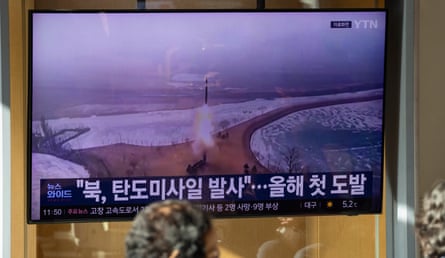
It is Pyongyang’s first ballistic missile launch since November, when it staged a test after the US president, Donald Trump, approved South Korea’s plan to build a nuclear-powered submarine.
One analyst said Trump’s military operation against Venezuela on Saturday likely played a role in the decision to carry out the launch.
Pyongyang has for decades argued it needs its nuclear and missile programmes as a deterrent against alleged regime change efforts by Washington. The US has offered Pyongyang repeated assurances that it has no such plans.
“They likely fear that if the United States so chooses, it could launch a precision strike at any moment, threatening the regime’s survival,” said Hong Min, an analyst at the Korea Institute for National Unification.
The test came just hours before the South Korean president, Lee Jae Myung, was due to depart for Beijing for talks with his counterpart Xi Jinping, whose government is a key economic backer of North Korea.
Lee hopes to possibly harness China’s clout over North Korea to support his bid to improve ties with Pyongyang.
Pyongyang is also set to hold a landmark congress of its ruling party in the coming weeks, its first in five years.
Economic policy, as well as defence and military planning, are likely to be high on the agenda.
Ahead of that conclave, leader Kim Jong-un ordered the “expansion” and modernisation of the country’s missile production and the construction of more factories to meet growing demand.
State media reported on Sunday that Kim had visited a facility involved in making tactical guided weapons.
He ordered them to expand current production capacity by 250%, the state-run Korean Central News Agency said.