.png) 2 months ago
62
2 months ago
62
Even on a wet, wintry day in Málaga, the Mediterranean looks benign. But only 25 miles (40km) south-west of its port, where half a million tourists disembark from cruise ships into the Costa del Sol each year, lies a system of tectonic plates and faults that fracture the seabed between Spain and north Africa.
Earthquakes are routine here. They are mostly too small to notice but sometimes strong enough to rattle glasses in cafes on the seafront. In December, a tremor with a magnitude of 4.9 off the coast of Fuengirola triggered more than 40 calls to Andalucía’s 112 emergency line.
No damage was done, but it was a reminder that southern Spain is what scientists call a place of “continuous seismicity”. The Alborán Sea fault system marks the boundary between the African and Eurasian plates. Displacement is slow, but energy accumulates over centuries and, eventually, it is released.
The risk of tsunamis is rarely discussed among residents and tourists in the Costa del Sol. Yet only a three-hour drive west of Málaga in the Atlantic-facing town of Chipiona, near Cádiz, the possibility of a tsunami is not whispered but signposted.
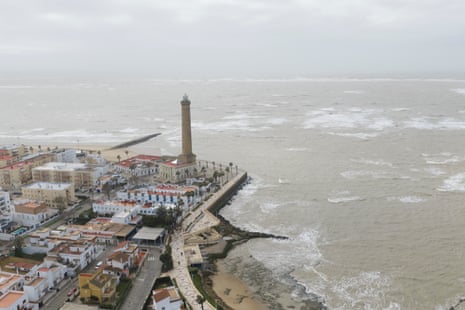
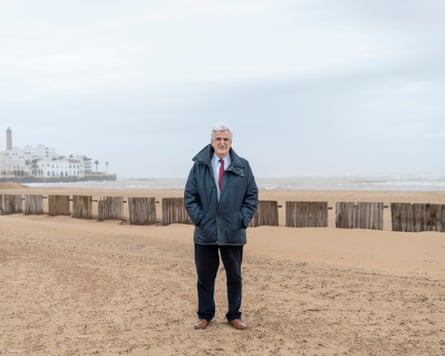
Chipiona is a low-key seaside town popular in the summer with holidaymakers from Seville. On Regla beach, Luis Mario Aparcero Fernández, the mayor, points to information boards explaining what a tsunami is and what to do if one is coming.
“In the early days, other mayors in our province were not in favour of talking about tsunamis, because we are tourist municipalities,” he says. “But I was able to convince them that we could achieve more tourism through greater safety.”
Evacuation routes are marked. Sirens are installed. And each November, at the hour that the huge Lisbon earthquake struck in 1755, schoolchildren calmly walk designated routes inland in a town-wide drill.
As a result, Chipiona became Spain’s first “tsunami ready” community in 2024, one of only a handful in the north-east Atlantic and Mediterranean region. Cannes, Alexandria and Minturno are the others. This recognition by the Intergovernmental Oceanographic Commission (IOC) of Unesco forms part of a regional goal to establish 25 tsunami-ready communities by the end of this year and prepare all communities at risk by 2030.
Francisco Castro, Chipiona’s tsunami-ready coordinator, chooses his words carefully. “Certification does not mean there is no risk,” he says. Instead, it recognises preparation, awareness and planning. “What we are doing here is no different to hotels preparing guests with fire drills and maps of escape routes.”
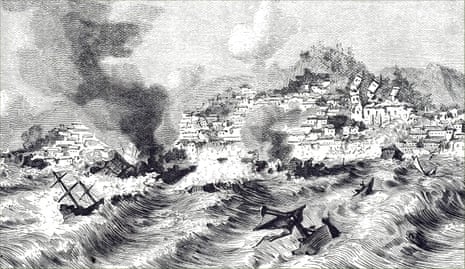
At the Cruz del Mar monument on the seafront promenade, a plaque commemorates 1 November 1755, when an earthquake with a magnitude of between 7.7 and nine, 150 miles (240km) off the coast of Portugal, generated waves with an estimated height of 10 metres (33ft) along Cádiz and Huelva. Across Iberia and north Africa, tens of thousands of people were killed.
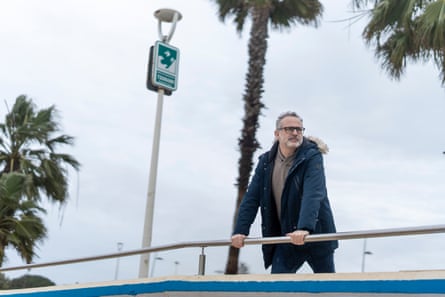
Recent seismic swarms in the Gulf of Cádiz, including five quakes in one day in March last year, prompted headlines asking whether a bigger one was imminent. Small quakes do not necessarily herald a larger one, but geologists are cautious. The return period for a major Atlantic or Mediterranean rupture is estimated at between 450 and 1,500 years. That does not mean tomorrow. Nor does it mean never.
Chipiona assumes that its citizens will have roughly an hour after an earthquake begins before the resulting tsunami arrives. Meeting points are placed within a 20-minute walk. The instruction is simple: do not drive. “We can’t evacuate the whole population in vehicles without gridlocking the streets,” says the mayor, who has maps setting out his plan to relocate police and other municipal buildings beyond probable flood zones.
Last year, Cádiz staged what authorities called Spain’s largest tsunami drill, with more than 20,000 participants, 1,000 operatives, sirens, ES-Alert mobile broadcasts and vertical evacuations in hotels. It simulated a Lisbon-scale earthquake and tested evacuation timing, building vulnerability maps and coastal inundation modelling.
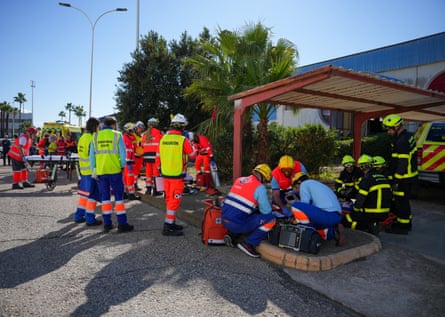
In Málaga harbour, nothing signals urgency. There are no siren towers visible from the promenade. No evacuation maps posted beside churros kiosks. The potential size of a tsunami along the Mediterranean coast is smaller, but earthquakes are more frequent and closer to shore. Jorge Macías, a tsunami modeller at the University of Málaga, describes the risk as “low probability but high impact”. Were an earthquake to begin in the Alborán Sea, a tsunami could reach Málaga about 20 minutes later.
Spain’s national tsunami warning system can detect an offshore earthquake and compute an initial assessment within three to five minutes. In the Atlantic, that leaves plenty of evacuation time. In the Mediterranean, it may leave only minutes. “If you feel something really strong near the coast, don’t wait for the alert,” says Macías. “Move inland or up. Even a first floor can be enough.”
The Andalusian regional government approved its emergency plan for tsunami risk in 2023, mapping flood zones across 500 miles (800km) of coastline and more than 500 beaches. The plan models scenarios in which waves could strike parts of the Costa del Sol, with potential inundation hundreds of metres inland. Those are worst-case projections, not predictions.
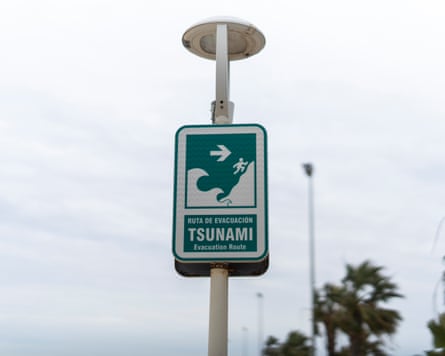
The IOC has warned with “100% certainty” that the Mediterranean will experience a tsunami of at least a metre in height in the next 30 to 50 years. Juan Vicente Cantavella, the director of the National Tsunami Warning System in Spain, says tsunami wave height is often underestimated.
“We tend to assume that a half-metre tsunami wave is harmless just because wind-generated waves of similar or higher amplitude are common,” he says. “However, tsunami waves carry far more energy, and even tsunami waves only 30 or 40 centimetres high can cause flooding and move heavy objects such as cars.”
Begoña Pérez Gómez, a physical oceanographer and head of the prediction department at Puertos del Estado, says the port authority feeds real-time sea level data into the national warning system. “Visible preparedness raises public awareness and fosters a culture of risk prevention,” she says.
Yet while Chipiona holds annual drills, much of the Costa del Sol remains in the earlier stages of planning. Some municipalities have local plans; others are developing them. Public signage is sparse. Evacuation routes are not obvious to the casual visitor.
Part of the vulnerability lies in how Spain’s Mediterranean coast was built. Miriam García, a geomorphologist and urban planner, describes decades of development driven by the ideal of the “house on the beach”. Dune systems that once absorbed storm energy were urbanised. Promenades fixed shorelines in place.
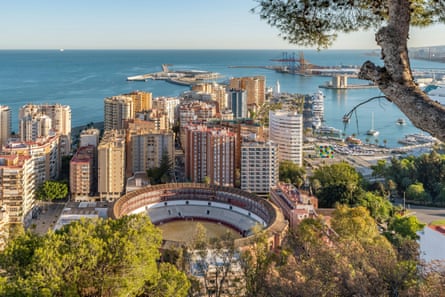
Dunes, wetlands and reefs act as natural buffers, she says, mitigating gradual sea level rise and sudden hazards. Without them, the coast loses resilience. “If the relationship between urban development and coastal dynamics is not reconsidered,” she says, “we risk no longer having houses by the sea, but quite literally, houses in the sea.”
Spain’s building codes include seismic resistance standards but not specific tsunami load requirements. Hotels on Málaga’s seafront are not designed with vertical evacuation as a formal architectural principle, as they are in parts of Japan.
For years, Macías recalls, discussing tsunami risk in Andalucía was politically uncomfortable. Tourism economies feared alarmism. But he senses a change in attitudes coming from the west, where drills in Cádiz are now televised. ES-Alert messages ring simultaneously across provinces. And what was once unspeakable is now rehearsed.
Preparedness, say the scientists, is not about predicting the day and time. It is about choosing not to be surprised when nature eventually repeats what history and geology say it will.