.png) 3 months ago
74
3 months ago
74
Mohammed Suleman, a self-described “straight-talking Geordie”, doesn’t love politics. The taxi driver and businessman prefers to focus on community initiatives. But when the time came, he voted Labour as the lesser of two evils.
Then came the war in Gaza.
A month into the war, which a UN committee would later describe as a genocide, Suleman, and others at his local mosque, began a petition calling on their Newcastle upon Tyne Central and West Labour MP, Chi Onwurah, to vote for a ceasefire. He knew it was largely symbolic, but it represented something important: that the children of Palestine, who looked like his and were raised in the same faith, mattered.
“And the best she could do was abstain,” Suleman said. “That’s when I blew my top.”
Suleman was speaking before heading out canvassing in Arthur’s Hill, to the west of Newcastle. The city is often described as segregated: a white working-class east and a more diverse west, both long central to Labour’s base. But while Labour has spent years trying to win over “hero voters” in the east, it has been slower to reckon with a tectonic shift among Muslim voters.
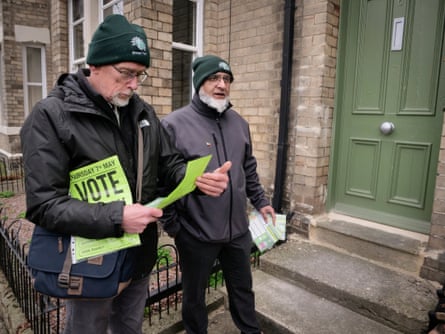
In interviews last week, Suleman and a dozen other Muslim campaigners and voters across Newcastle described a profound sense that Labour has long abandoned communities like theirs. The council has been Labour-run for decades, but voters and campaigners point to graffitied, shuttered shopfronts, diminishing local services and a Labour leadership’s tepid response to the rise of the far right as evidence that the party no longer speaks for them.
This shift is not unique to Newcastle. From Gorton and Denton, where Hannah Spencer won the Greens’ first ever byelection victory, to contests in Birmingham, Leicester and east London, Labour is haemorrhaging Muslim support. The trend is so stark that the health secretary, Wes Streeting, who came within 500 votes of losing his seat in Ilford North, has spoken of his alarm that even previously safe council wards are at risk. The upcoming local elections will show whether these results were simply a protest vote or emblematic of a deeper, more permanent shift.
For Suleman, Onwurah’s abstention was a telling moment – but also part of a much longer process of disillusionment. It was the rise of the far right that helped him make the jump from simply hating politics to standing as a Green councillor. The 2024 summer racist riots, where mosques were attacked, asylum hotels burned down, hijab-wearing women assaulted, and men dragged out of their car by baying mobs, reminded him of his bleakest days at school.
“They had special days to beat up people like me. They called it ‘Paki bashing’,” he said. He was angry to see that same “poison” being fed into their communities as the cost of living takes a deeper toll.
So why the Greens? Suleman believes it is the best party to fight the far right. He also points to Khaled Musharraf, who was unexpectedly elected as a Green councillor in his ward in 2024, as one of the reasons he joined the party. Like Hannah “the plumber” Spencer, Musharraf is a well-known local personality who has built a reputation as a tireless advocate for his community.
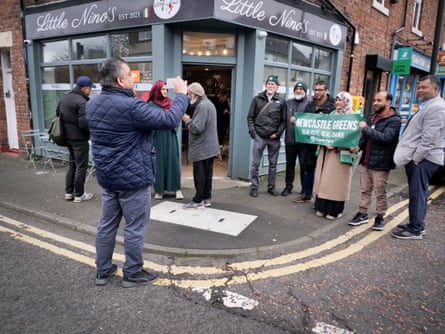
Musharraf, who has voted Green for a decade, migrated to the UK from Bangladesh, where he remembers, as a child, floods that would bring the country to a standstill. “Many Muslims are from countries on the frontlines of climate change,” he said, adding that the Muslim community’s interest in the Greens is wrongly portrayed as being solely due to Gaza. Mosques are increasingly running sermons on the climate crisis, as the issue is taken up by a new generation of British Muslim activists.
Polling by More in Common UK shows Muslim voters are most concerned about bread-and-butter issues such as the cost of living, crime and local services. Its executive director, Luke Tryl, likened the impact of the war in Gaza on Muslim voters to Brexit’s effect on Labour’s red wall base. “It crystallised a much deeper feeling of being taken for granted, neglected, overlooked, and that is what caused the rupture,” said Tryl.
Sharmen Rahman, the Green party’s national spokesperson for equalities and diversity, pointed to surveys from Labour Muslim Network as evidence of a deeper, longer-term trend. In 2020, 46.8% disagreed that Labour represented the Muslim community effectively. By 2022, that had risen to 63%.
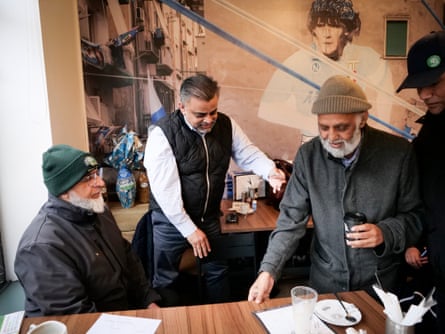
Suleman is having coffee with his “dream team” – a group of councillors, friends and family – in an Italian cafe in Elswick ward in Newcastle’s West End before heading out canvassing.
Among them is Halimah Begum, who was encouraged to stand because of her work in counselling and youth services. She left Labour after watching an interview in which Keir Starmer discussed immigration and suggested people could be “sent back” to Bangladesh.
Begum said the comment painted all British-Bangladeshis as illegal immigrants. “I identify as Bangladeshi, British and Muslim, and they all play simultaneously,” she said. “So hearing that was quite hard.”
Begum isn’t alone. Tryl said a sense that racism had become “legitimised” after the riots, and anger that the prime minister had not done more to challenge it, had become a key driver of Labour’s break with Muslim voters since 2024.
“Some of our work with young Muslims was really heartbreaking,” he added. “They told us it was becoming harder to feel proud of being British because of the racism they were experiencing.”
But as support for the Greens among Muslim voters has grown across the country, so too has suspicion. After the party’s win in the Gorton and Denton byelection there was widespread media coverage of allegations of “family voting”, which suggested Muslim women were being pressured to vote Green by their husbands. A police investigation found no evidence for the allegations.
Rahman, who campaigned there, described the claims as racist nonsense. “In the houses where there were split voters between Green and Labour, it was the man usually saying that they’re going to vote for Labour and the women and the children saying they’re voting Green.”
For Begum, the claims were laughable. “I think my husband would enjoy that, finding a man I’d actually listen to.”
Shaista Aziz, one of the first Labour councillors to resign after Starmer claimed Israel had a right to cut off water and electricity in Gaza, understood the appeal of the Greens, but argued the party still had work to do to be more representative. “The challenge for the Green party is that traditionally its voter base is middle class and very white. That’s changing in cities like Manchester and other parts of the country,” said Aziz.
That shift is visible in the Elswick ward in west Newcastle. Begum hurried the group out of the cafe, joking that her male colleagues looked like “green gnomes” in their fluorescent Green party hats. On this street, green posters are dotted in windows. At each door, they ask residents what issues matter most. The same answers crop up over again: potholes, graffiti, a lack of community services, Gaza, and the fear of the far right.
In the West End, community life among the diverse population often centres around shared institutions such as mosques, popular cafes, and restaurants.
But in the East End, in wards such as Walker, there isn’t a similar sense of gravity pulling households in. The social fabric that once held together this historically white, working-class area, such as trade unions, working men’s clubs and the shipbuilding industry, have largely disappeared. On the doorsteps, residents spoke movingly of no longer feeling part of a strong community. British and English flags hung from lampposts along the street.
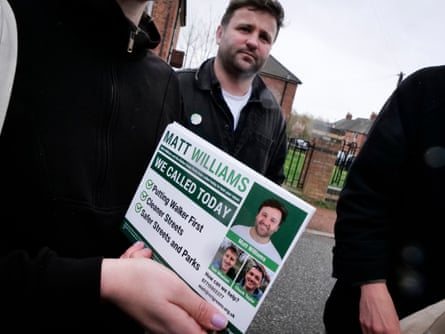
Matt Williams, a Green candidate in Walker, said it was wrong to write these areas off as Reform UK territory. “They have been abandoned by Labour and are crying out for real change,” he said.
Williams knocks on dozens of doors. About a third say they will vote Green, a third lean to Reform, and the rest remain undecided between Green and Reform. They all bemoan Labour. For Williams, it shows there is all to play for.
While Green canvassers knock and chat in Walker, a few doors down, two Reform volunteers move quickly along the street, slipping leaflets with Nigel Farage’s face through letterboxes without stopping.
For Begum, the difference reflects a wider vision. She has had difficult, yet necessary conversations with white, working-class households. Some voters, she said, will look at her wearing a hijab and claim women are oppressed or forced to wear it. Begum always pushes back.
When asked why, she points to her faith. “When certain things happen in front of the prophet, peace be upon him, and he did not comment on it, it was understood by his companions that he accepted it. If it wasn’t right, he protested,” she said. “So when someone is being prejudiced or discriminated, then I would challenge that.”