.png) 3 hours ago
5
3 hours ago
5
One day, as a 16-year-old in the late 2000s, I received an AOL instant message from my friend Kenyon. He wanted to know whether I had heard of Esperanto, the universal language. Kenyon was several years older than me, and something of a mentor. Like me, he was a musician – he engineered my teenage band’s first record – but unlike me, he had a head full of trivia that made him the confidently nerdy star of any Saturday-night gathering of outcasts. His pitch: Esperanto was invented in the late 19th century by a Polish-Jewish ophthalmologist named LL Zamenhof, who aimed to create a language so irresistibly easy to learn that it would be adopted as a shared second tongue by people the world over. From a position of mutual understanding, world peace would surely follow. Yes, the language had been around for well over 100 years and, yes, universal fellowship had yet to be achieved. But the internet had inaugurated a new era of global connectivity, and users could learn through an abundance of online classes. Perhaps we were on the verge of an Esperanto renaissance. Kenyon had been practising for a few years and was practically flua.
As a typical adolescent, I was in the midst of my own social awakening. I had begun to travel the US playing music, relying on nothing but the hospitality of friends of friends of friends. I was finding communion and what felt like boundless possibility in mass bike rides and sweaty dance parties in derelict churches. I was also dabbling in the world of hitchhiking and freight-train-hopping, visiting new places by exploiting the only slightly off-limits mechanisms of our industrialised society. Goods needed to move, and I could move with them, thanks to the kindness of those who showed me the ropes just because I wanted to learn. Esperanto seemed comparable: another disparate social club with a baked-in rejection of the forces, writ large and ill-defined, that sought to divide us. But even then, its goals felt redundant: the internet had already given me new tools to communicate across distance and difference. Simple as it might be to learn the language, why bother?
Eventually, the collective optimism of the early internet dissipated, and I forgot about Esperanto. Then, a few years ago, I acquired a shortwave radio, capable of picking up analogue broadcasts from around the world. Browsing the schedules of international programmes – which, to this day, are transmitted by national governments and large missionary organisations – I learned that both the state-run China Radio International and, until recently, the Vatican ran regular shortwave broadcasts in Esperanto.
Reminded of my youthful brush with the language, I decided to join the estimated million-plus people who have taken to Duolingo to try it out since Esperanto debuted on the platform a decade ago. Soon I was climbing the ranks of the app’s prestigious leaderboard, reading aloud what sounded like a dream-warped version of Spanish. Egged on by the company’s signature green owl, I translated sentence after sentence that seemed pulled from the index of a modern-day Little Red Songbook (“Who is that worker?”, “Is the thief guilty?”, “Do the police help us?”), lofty one-liners reflecting peacenik aspirations (“There are too many wars in the world”), and sentiments betraying a delusional sense of the language’s reach (“Learn Esperanto to talk to the world”).
For a satirist or a cynic, Esperantists are easy fodder. Many of its enthusiasts are undeniably eccentric: longhairs, train enthusiasts, nudists and Brazilian spiritists (who believe that Esperanto is the language of the vastly more peaceable spirit world, and that it was sent to Earth from God, via Zamenhof, to bring about universal harmony). But Esperanto was once a force in global politics. Before facing heavy persecution during the second world war, it gained serious traction in international labour, anticolonial and anarchist movements. And most of today’s Esperanto adherents are neither naive nor even particularly batty. They include European social democrats and elder anarchists, Chinese communists, central African youth pacifists and Ukrainian-independence advocates. There are Esperantist gay-rights advocates, Bible translators, lawyers and Go players. Why, against all evidence to the contrary, would this motley group – many of whom are no strangers to global conflict – still believe that the widespread adoption of a century-and-a-half-old invented language may yet overpower the world’s divisions, particularly as the global order, by any reasonable account, appears to be rapidly disintegrating?
Besides, even more so than during the AOL years, international communication can now be mediated by technology, translated instantaneously via app and aided by the ascendancy of English as a de facto lingua franca. But for Esperantists, none of this comes close to solving the fundamental problem of human disconnection. “If our aim is only to buy a hamburger, then [those tools] are enough,” Petro Baláž, a prominent Slovakian Esperanto publisher and educator, told me. “But it’s something totally different … to speak about the meaning of life, to travel through the world, to have really deep conversations.”
Baláž’s portrayal of Esperanto as a nontransactional, humanistic alternative to industry-specific language crash courses and tourist-friendly pocket guides appealed to me. I wondered whether this optimistic coterie of devotees may be on to something after all – and what the rest of us could salvage from what might otherwise seem like an ill-fated, bittersweet experiment.
So, last summer, after months of solitary, gamified study, I registered for the 110th annual World Esperanto Congress, a gathering hosted by the Universal Esperanto Association. For eight days, I would join more than 1,000 paying attenders from more than 60 countries in the sterile classrooms of a university in Brno, Czechia, to speak nothing but Esperanto, ponder the status of the language and pull a series of surprisingly late, raucous nights. I didn’t expect to leave a convert, but hoped that the congress may at least offer a chance to shed some of my cinikismo.
Saluton!” Greetings rang out through the halls of Brno’s Mendel University. It was the opening evening of the congress, and a decidedly back-to-school energy was in the air as reunions between distant associates clogged the already packed corridors. The Movada Foiro, or Movement Fair, is the first major event of every global Esperanto meeting – and, I had been told, the beating heart of the convention, where Esperantist organisations of all stripes gather to promote their particular pet causes. Representatives sat two to a folding table, each stacked high with literature. At one, Catholic Esperantists handed out prayer cards. At the next, a pan-European organisation working to make Esperanto the official language of the EU attracted a number of visitors, but far fewer than the International Federation of Esperanto Railwaymen, whose table was so crowded that I had to stand on tiptoe just to catch a glimpse of their display. Esperantist doctors rubbed shoulders with members of the International League of Blind Esperantists, and the World Association of Esperantist Non-Smokers edged in on the Ukrainian Esperanto Association. The International Esperanto Naturist Organisation showered passersby with pamphlets featuring stock photos of aspirationally fit, naked bodies. One of its representatives attempted to sign me up for a swimming excursion. “Senpaga!” she said excitedly. Free!
All week, these and other clubs would host lectures and activities. Some sessions would focus explicitly on how to promote the language’s use, discussing what Zamenhof called Esperanto’s interna ideo: the notion that a simple, neutral language could promote global peace. Other seminars had no outright connection to Esperanto beyond the fact of being held in the language: there were talks on the history of space travel and the James Webb telescope; the intersection of behaviourism and brutalist architecture; and China’s spring festival.
I had been studying the language for only a few months and felt a bit shaky in my ability to comprehend some of these lectures. I couldn’t, for example, provide the word for “brutalism” off the top of my head. But I still managed to grasp about half of what was said to me at the Movada Foiro – and significantly more after reciting my go-to line: “Mi estas komencanto. Bonvolu paroli malrapide.” I am a beginner. Please speak slowly.
Esperanto is indeed pretty simple. Designed with formulaic, surgical clarity, its rules have few exceptions. For a given word, the suffix always indicates the part of speech: -o for nouns, -a for adjectives, -e for adverbs, -i for verbs (plus -as for present tense verbs, –is for past, –os for future) etc. “Amiko.” Friend. “Amika.” Friendly. The stress is always on the second-to-last syllable, giving the language a swinging, singsongy quality. Words are strung out like mathematical equations: a root, plus any of a few dozen affixes that can modify its meaning. Take the word “malsanulo”. Its root word, “sano”, means health. “Mal” indicates the opposite: un-health or sickness. The suffix “ulo” indicates a person; “malsanulo”, then, means a sick person or a patient. Esperanto boosters like to boast that about 95% of the language can be understood by knowing fewer than 500 common plug-and-play roots and affixes.
Zamenhof never intended his language to evolve wholly organically. Instead, its rules are governed by the Akademio de Esperanto, a body founded at the first World Esperanto Congress (in Boulogne-sur-Mer, France, in 1905) with the mandate to “preserve and protect the fundamental principles of the Esperanto language” and “control its development”. That mission makes sense: the survival of a made-up language demands a tight ship, since dialectical differences and patois often birth entire new “natural languages”. Esperantists cannot have “rizz”, and the acceptance of malleable, unregulated internet slang such as “six seven” would threaten the entire social contract upon which the experiment is predicated.
Esperanto must nevertheless keep up with the times. So the academy – a panel of 45 linguists, scientists, philosophers and others – makes formal recommendations about how the language can and cannot change. It fields comments and queries from Esperanto speakers year-round, but perhaps most notably in a public forum at the annual congress. (In Brno, questions from attenders concerned gender-fluid pronouns and the paucity of technical terms relating to stringed instruments.) The academy then takes these requests under advisement and, very occasionally, updates the Esperanto dictionary. (It last released a new “official supplement” in 2023, only the 10th since the language’s inception.)
This rigid, top-down process can seem incongruous with Esperanto’s democratic principles. In some ways, this level of control is not so different from that governing certain national languages: the Académie Française decides and disseminates linguistic standards; Italy’s Accademia della Crusca is devoted to “purifying” the Italian language; and Spain’s Real Academia Española fulfils a similar purpose. But whereas these other bodies seek to entrench national identity by enforcing linguistic rules, Zamenhof wanted to police language in order to transcend those very boundaries. It was all there in Esperanto’s interna ideo: neutrality required standardised simplicity.
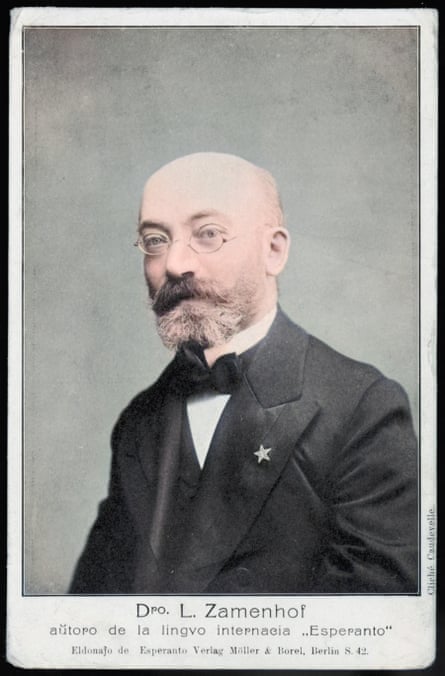
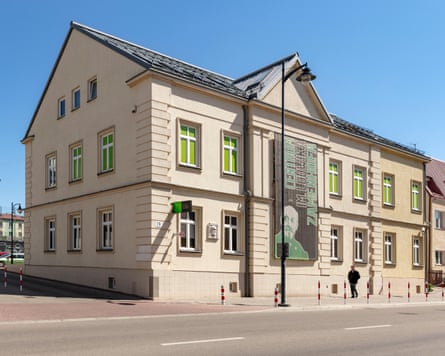
Zamenhof was born in 1859 in Białystok, in what is now Poland and was then part of the Russian Empire. The city’s population was diverse and fractious, with religious and ethnic groups who spoke Russian, Polish, Belarusian, German, Yiddish and Hebrew, and often came to blows with one another. Zamenhof spoke each of these languages and also studied Latin, Italian, Greek, English, Aramaic and French. When he was 10, he wrote a play called The Tower of Babel, or a Białystok Tragedy in Five Acts, in which the scriptural citadel is recast as Białystok’s town hall. Zamenhof believed that the constant clashes in his home town and beyond were, above all, the product of semantic heterogeneity. He decided to devise a new language, one that would strive for what Esperantists call finvenkismo (“fin” meaning final, “venko” meaning victory): Esperanto would become nothing short of the world’s salvific second language, unifying all individuals and governments.
In 1887, before his 30th birthday, Zamenhof published a plainly bound Russian volume titled, simply, International Language, laying out a system of root words, modifiers and grammar, and outlining the project’s political ambitions. Per his own linguistic conventions, Zamenhof wrote under the pen name Doktoro Esperanto: one who hopes. Almost immediately, early enthusiasts began to refer to the language as Esperanto.
This was hardly the first attempt at a shared, constructed tongue. There was Solresol, an early-19th-century language based on musical notation, and the largely monosyllabic Volapük, invented by a German Catholic priest who believed himself to be divinely inspired. But while most of these predecessors quickly sputtered out, the avowedly internationalist Esperanto took off, particularly among a growing cadre of anarcho-syndicalists, socialists and “anationalists”, a term popularised by the Esperantist labour organiser Eugène Lanti to describe those who rejected the idea of nationhood tout court. These early Esperantists circulated self-published books on how to speak the language and periodicals written in Esperanto that sought to introduce their political movements to a global audience. The language was sometimes referred to as the “Latin of democracy”.
In the early 20th century, one follower created an international currency with coins featuring Zamenhof in profile; at one point, the tender was accepted by multiple European banks and had account holders in 43 countries. Esperanto speakers included Leo Tolstoy, Ho Chi Minh and George Soros’s father, who was born Tivadar Schwartz in 1893 but later changed his family’s last name to an Esperanto word meaning “will soar” to avoid antisemitic persecution in his native Hungary.
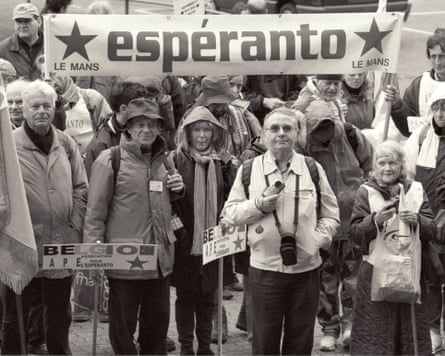
Zamenhof died in 1917, but his burgeoning movement exploded after the first world war. In the shadow of the war to end all wars, people desperately hoped that the human race would never again tolerate such fevered violence, and Esperanto grew hand in hand with the pacifist movement. In 1920, the newly formed League of Nations considered the introduction of Esperanto to schools in member states. Thirteen countries, including India and Japan, endorsed the proposal. But representatives from Brazil and France dissented – worried, respectively, that it was a language for “ne’er-do-wells and communists” and that it would corrupt the “French genius”. Not long after, the proposal was abandoned entirely.
Esperantists were undeterred. In the early 1920s, the novelist and Esperantist dilettante Upton Sinclair predicted that, by midcentury, “9,995 persons out of every 10,000” would be listening to the radio in Esperanto or a similar universal language. By the late 1920s, there were more than 40 regular Esperanto radio shows, ranging from language instruction to national news, broadcast from well over a dozen countries.
But Esperanto’s political roots eventually caught up with it. In 1937, Joseph Stalin, himself a former dabbler in the language, reversed course on Esperanto and herded its speakers into gulags on account of its internationalist appeal. During and shortly after the Spanish civil war, General Francisco Franco’s regime, too, persecuted Esperantists for the language’s association with anti-nationalism and anarchism. In Mein Kampf, Adolf Hitler cast Esperanto as a Jewish conspiracy. The Nazis would go on to ban the instruction of Esperanto in schools, dissolve all Esperantist organisations and murder all three of Zamenhof’s children.
Though Esperanto would never again occupy the mainstream, the movement refused to die. During the cold war, it flourished in the Soviet Union among jeans-clad youths looking to connect with speakers on the other side of the iron curtain, as well as among those wanting to resist western hegemony. It also grew in Asian countries such as China, which was in the midst of a romanisation effort intended to combat illiteracy and the challenge of typing characters in an increasingly digitised world. The roman characters of Esperanto were easier to read than Chinese characters, and had the added benefit of combating the accelerating reach of English. (The man behind pinyin, China’s official romanisation system, was an Esperanto scholar.)
Then came the internet. Less than a year after Wikipedia debuted, it launched a network featuring articles written originally in Esperanto; today, there are nearly 400,000 articles in the language, more than those written in Danish, Urdu, Uzbek, Greek, Thai or Bulgarian. There are online classes in Esperanto, subreddits in Esperanto and Esperantist YouTubers. In the UK, as Brexit saw many remainers grasping at vestiges of internationalism, Esperanto classes saw a noted uptick in registration. Crowds of new learners trekked to language intensives at a stately Tudor home known as the Esperanto House in the village of Barlaston, near Stoke-on-Trent, the hub of England’s post-second-world-war Esperantist activity. Up the road in nearby Smallthorne, Britain’s first Esperantist pub, the Green Star – founded in the 1960s and named for the once widely recognised insignia that Esperantists across the world wore on their shirt collars – received a fresh smattering of media attention.
There’s a pattern here: whenever the global order enters a new state of disarray, the movement sees a resurgence of interest, just enough to keep the crusade from dying out. Its historic proximity to success is a legitimising anchor for the movement. But it can also function as a bit of an excuse – allowing believers to attribute its failures to repression or bad luck, a fluke of history, rather than consider the possibility that language alone may be insufficient to foster world peace. Compelling as Esperanto’s interna ideo may be, I found it hard to imagine mere mutual comprehension overcoming the worst of human politics.
Making my way through Mendel University’s campus buildings en route to one of dozens of available breakout sessions, I was approached by Seyed “Amir” Javadi, an Iranian hotelier who now lives in Germany. “Come to my hotel!” he shouted in Esperanto, waving brochures at me. “Free for Esperantists! I cook! I teach dance classes!” To prove this last point, he grabbed me by the waist and led me firmly through a basic German waltz, counting – “unu, du, tri” – before breaking into an a cappella rendition of My Bonnie Lies Over the Ocean with tweaked lyrics: “Esperanto estas la lingvo por ni, por ni!” Esperanto is the language for us!
Amir’s hotel was in Esperanto City, otherwise known as the village of Herzberg am Harz, in Lower Saxony. At the urging of several resident Esperantists, the town council decided to formally embrace the language in 2006. Local officials began posting translations on street signs and offering classes in schools. Today, the municipality doesn’t seem too eager to promote its affinity with the international language (its tourism office tends to focus more on local castles and caves), but Herzberg has achieved near-mythic status among some Esperantists. And it’s not the only port of call for speakers of the language: 80 miles east of Nantes, in France, the 44-acre estate of Kastelo Greziljono (Grésillon Castle) hosts regular Esperantist events and has been owned by the nonprofit Kulturdomo de Esperanto (Culture House of Esperanto) since 1951. When I spoke with one of the French leaders of the Esperanto Naturist Organisation, he informed me that members would soon be gathering there for a whole week of “teaching Esperanto in the nude”.

Destinations such as Herzberg and Greziljono are evidence of one of the modern Esperantist movement’s central enticements: the promise of travelling the world on the cheap. In the 1970s, the World Esperanto Youth Organisation began compiling a global contact list of Esperantists willing to host other speakers for free homestays. Self-published as a booklet they dubbed Pasporta Servo, or Passport Service, it functioned like a predecessor to the web’s Couchsurfing or Warmshowers, and today persists online as a fully fledged travel network for Esperantists.
Many of the younger millennial and Gen Z kongresanoj (“ano” means a member of a group, and the suffix -j is used to make any noun plural) I met at the congress were there largely thanks to the Pasporta Servo. Some were drawn first to the language and its interna ideo, only to later realise the travel benefits involved; others had learned the language specifically to bum around. (On the Pasporta Servo website, the requirement to learn Esperanto isn’t mentioned until the final paragraph of its About Us page, under the heading “This can’t be true. What’s the catch?”.) At one language class in Brno, I asked a young German woman seated next to me why she was learning Esperanto. Her cousin was fluent, she said, and together they had already crossed Europe using the Pasporta Servo. They planned to do Asia next.
Some Esperantists have embraced the tramp lifestyle full-time. Among them is a 33-year-old Brazilian named Georgos Jurobola, whom I met upon arriving at the congress. “Kiel vi fartas?” (How are you?) he had asked me with a high five as I approached the check-in desk. Tall, assured and just a tad unkempt, he had a breezy, hippy-ish style and a disarming smile that comforted me as I plodded through my first Esperanto conversations, wherein far more experienced speakers than I expressed surprise that I had come all the way from the US, and then recounted fond memories of their own travels through the country.
I came to learn that charming and calming attenders was Jurobola’s formal role. In exchange for volunteering as a greeter at these gatherings, he received free lodging and connections to Esperantists abroad. He had been travelling nonstop since 2019. Last year, he travelled through Africa after volunteering at the congress in Tanzania, and after Brno he was planning to hitchhike around Europe, staying with other speakers. “I am completely nomadic,” he told me. “When I arrive to a new place, I write to Esperantists, and immediately I have friends.”
It would have struck me as unrealistic if not for the fact that I, too, spent a formative phase of my young life as a voluntary vagabond, and saw first-hand how willing strangers were to put me up on the basis of nothing more than a shared dedication to a style of music, or to particularly dangerous modes of transportation. But whereas that world could be characterised, at times, by macho one-upmanship that felt almost bloodthirsty, Esperantists like Jurobola were committed to a hazy vision of peace. “Let’s use Esperanto as a tool for prosperity, for hope,” he told me. “And also to change this idea that there are certain people that are superior to others. This is a shit idea.”
Though they rarely articulate it as such, enthusiasts such as Jurobola are essentially embracing a strain of Esperantist thought known as Raŭmismo. The ideology emerged at a 1980 youth congress in the Finnish city of Rauma, where a faction of just under 100 signatories ratified the Rauma Manifesto. It declared that Esperanto was having an “identity crisis”, and that it was time to abandon efforts to officially enshrine the language anywhere. The signatories went so far as to deride many of what they saw as finvenkismo’s principal tenets – among them that “the English language is our enemy”, and that “the UN must adopt Esperanto” – as “myths”. They suggested instead that the language be considered a community-building tool and declared that they “conceive[d] of Esperanto as belonging to a self-chosen diaspora linguistic minority” – in essence, as a subculture.
Those who believed in finvenkismo scorned Raŭmismo. But at last year’s congress, it seemed its followers had won the day. Among the most packed sessions I attended were those given by the Philatelic Esperanto League and the International Federation of Esperanto Railwaymen (the latter complete with a PowerPoint presentation about historical Czech train routes and architectural renderings of Brno’s future rail station). Other lighthearted events – such as a football match that pitted young Esperanto speakers against a Brno club team, and an excursion to a local winery – were buzzing as well. And though I didn’t take my would-be naturist recruiter up on the swimming excursion pitched at the Movement Fair, about 20 Esperantist nudists briefly ditched the congress, crammed into a tram car, and journeyed half an hour to a nude beach. The once-militant politicking of the anational anarchists and militant trade unionists, it appeared, had largely given way to niche hobbyists and feelgood social practitioners.
One of the Esperanto Naturist Organisation’s leaders was a sprightly Frenchman named Thierry Spanjaard. Recently retired from the cybersecurity industry, he had first learned about Esperanto from his first world war veteran turned pacifist grandfather, and began learning it about two decades ago, after taking a class in Marseille. I asked him what, if anything, Esperanto had to do with naturism. “The official definition of ‘naturism’ is respect for oneself, respect for others, and respect for nature, thanks to practising nudity with other people,” he said, almost pitying me for my obliviousness. “What is Esperanto? Respect for other people and other cultures thanks to a common, neutral language.”
I wondered what the movement’s self-publishing, labour-striking, Nazi-fighting forebears would have made of his definition. But when I asked Spanjaard about the criticisms levelled against the movement, he all but rolled his eyes. He wasn’t too worried about finvenkismo, he said. In fact, he didn’t think many people really believed it would be achieved, at least in their lifetimes. He had far more modest, realistic expectations of what the language had to offer: “It’s fun. I meet interesting people. It’s a means to travel.” If that’s the endgame, he said, “I’m perfectly happy.”
After the third day, I considered the way in which Esperantists seemed to regard joy as non-negotiable, a necessary counterweight to the movement’s more politicised elements, which can sometimes come across as holier-than-thou. Humphrey Tonkin, the former president of the Universal Esperanto Association and something of a celebrity in this world, put it more concisely to me: “If you are into the English-speaking peace movement, what are you doing there?” he asked. “You talk about peace. You talk about it really seriously. In fact, you probably talk about it so seriously that you bore the hell out of people.”
I was beginning to see the appeal of this position. I could appreciate that fighting for a cause should not, as the Russian anarchist Emma Goldman once said, “demand the denial of life and joy”. But even as an outsider, I felt frustrated, almost aggrieved, by Esperanto’s apparent forfeiture of its once-grand, lucid political ambitions.
Yet I managed to find vestiges of the older ethos. Late one morning, a large group of us piled into a classroom for a presentation on the Esperantist pacifist movement in the civil-war-torn Democratic Republic of the Congo (DRC). A last-minute visa issue had kept the presenter out of Czechia, so Espoir Ngoma Kasati, a 28-year-old Esperanto activist and instructor from the DRC, stepped in to take his place.
Esperanto has deep roots in Africa. The language first reached the continent in the early 20th century and gained popularity during the postcolonial era as a politically neutral replacement for the still-persistent languages of European colonisers. An Esperantist from Germany who dropped in on the gathering noted that none of the African attenders were “more than 35 years old”. The language, it seemed, had a special resonance among the first generation of post-independence Africans, who hoped for an end to linguistic division and factionalism across the continent.
In the DRC, local Esperantists had partnered with Catholic missionaries and international aid workers to help bring relief to orphaned children. Their use of Esperanto was practical: the DRC is one of the world’s most linguistically diverse nations. International volunteers didn’t share a language, either, and Esperanto was relatively quick and easy to learn.
“Esperanto is good for Africa because it is not a colonial language,” Kasati told me. “Esperanto is everyone’s property. That is the gift that Zamenhof gave to all humankind.” Esperanto was a necessary precondition for the kind of “mutual understanding” that might some day beget peace, Kasati believed.
A few powerful institutions have been playing the long game with the language’s potential for soft power. The Chinese government, which once promoted Esperanto heartily, still makes an appearance at each year’s congress. A cheery display called Mutual Learning Between Civilizations: Cultural Exchanges Between China and the Czech Republic lined the major artery of the congress’s main building.
The Catholic church, similarly, has maintained a certain interest in Esperanto. The Vatican authorised Esperanto for liturgical use decades ago, and Radio Vaticana still publishes news and papal updates in Esperanto online three times a week. Priests adopted the language early on, in the hope that it could help reach potential believers in a tongue easier than Latin. The International Union of Catholic Esperantists (Internacia Katolika Unuiĝo Esperantista, or IKUE) was formed in 1910, receiving support from the Vatican. Among the IKUE’s earliest members was Titus Brandsma, a Dutch friar who helped write an ecclesiastical Esperanto dictionary. A member of the resistance during the second world war, he was captured by the Nazis in 1941 and transferred to Dachau, where he was the victim of medical experiments before being murdered by lethal injection. Four years ago, the church canonised him.
The IKUE’s main event at the congress was a mass, held on Brandsma’s feast day in a small yet magnificent 18th-century chapel attached to a 13th-century monastery, tucked into the old, tangly city centre. Inside, the arched ceiling was painted with faded heavenly landscapes. As a non-practising Catholic, I sheepishly took a seat in the back.
From the altar, the priest – whom a fellow clergyman introduced as being el Ĉinio, or from China – delivered the readings, blessed the eucharist, and invited us to interŝanĝi the sign of the paco. I understood that the whole experience – fumbling through hymns in a centuries-old Czech church, at a mass given in Esperanto by a Chinese priest on the feast day of a Nazi-fighting Esperantist saint – was likely to be counted among my life’s strangest. But in the moment, what most impressed me was its normality. The mass, by design, was familiar to everyone in the room. Like the language in which it was given, the ritual was formulaic, even staid. And in this rote, dutiful steadiness, I was struck by the patient sincerity of it all – and by a sense that these believers were already fomenting, in admittedly small numbers, the kind of unity the language was invented to facilitate. As an impostor – a fake Catholic and fake Esperantist – I felt a pang of jealousy.

This article first appeared in Harper’s magazine and was supported by the Matthew Power Literary Reporting Award
The Long Read magazine summer edition
AI in the classroom, vending machines in the canteen, homeless people in the library, no one in the pub. Surprising stories from our strange new world in the new edition of the Long Read magazine. Buy your copy here