.png) 3 months ago
54
3 months ago
54
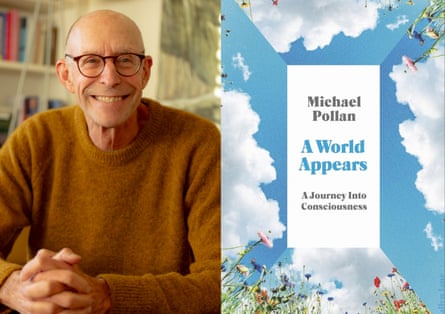
Each day when you wake up, you come back to yourself. You see the room around you, feel your body brush against your clothes and think about your plans, worries and hopes for the day. This daily internal experience is miraculous and mysterious, and the subject of Michael Pollan’s new book, A World Appears.
It also may be under siege, Pollan said. He recently suggested that people need a “consciousness hygiene” to defend our internal world against invaders that are trying to move in. Our ability to sit with our thoughts and perceive the world, he argues, is increasingly disrupted by algorithms engineered to tickle our dopamine receptors and capture our attention. Meanwhile, people are forming attachments to non-human chatbots, projecting consciousness on to entities that do not possess it.
I spoke with Pollan over the phone about what consciousness hygiene looks like in practice. Our conversation has been edited for length and clarity.
You have said that consciousness is a “precious realm” and that we should adopt a “consciousness hygiene”. That idea is intriguing – can you first tell me what we’re developing a hygiene around?
In this case, I’m referring specifically to human consciousness – this private space of interiority where we enjoy a very high degree of mental freedom. It’s the space in which we daydream, mind wander, talk to ourselves, and it is this very precious thing.
In the course of writing the book, I realized that our consciousness is under siege, and that it’s being polluted by several different things.
What things?
One is our president, who manages to dominate our headspace to a remarkable degree. I don’t remember another time when politics and the actions and expressions of one person got into our heads in quite the same way.
There’s also social media. We’re all living with algorithms designed to seize our attention. Attention is consciousness. It’s a part of consciousness. It’s how we direct our consciousness where we want to – but we’re losing the want to piece. The algorithms are so good at hooking us and driving our attention, not where we want to take it, but where they want to take it, because they’re monetizing it. They’re selling our attention.
Another, newer wrinkle: we have chatbots, and these are hacking not just our attention, but our ability to form emotional attachments. I read a pretty striking statistic in the New York Times, that 72% of teenagers are turning to AI for companionship. We’re reading about people falling in love with chatbots, people using them as therapists, people using them as friends, kids who come home from school and they want to tell their chatbot about what happened during the day before they tell their parents.
These chatbots are not conscious, but they claim to be, and people treat them that way. That, too, is an assault on our consciousness, and a deeper and more meaningful part of it than just engagement.
You and I share an affinity with the psychologist William James, who once described consciousness like this: “Now we are seeing, now hearing; now reasoning, now willing; now recollecting, now expecting; now loving, now hating; and in a hundred other ways we know our minds to be alternately engaged.” I like this ping-ponging of thoughts because it captures how busy our minds are. When you talk about these assaults on our consciousness, is consciousness hygiene the goal of totally quieting the noise – all of it?
It’s not an emptying by any means. It’s about owning the noise. It’s about making it your noise.
The hygiene is really an effort to reclaim sovereignty. I’m still developing these ideas, but so far, I see meditation is an important part of it. It’s a way to draw a fence around your consciousness. When you’re meditating, you put down your phone and you’re not taking in any kind of technological media, you’re alone with your thoughts and getting in touch with just what you described in James – how little control you have, how much is going on at any one time. Things are bubbling up from the unconscious. You’re taking in information from the environment, but it’s all yours. It’s not being manipulated by someone else to make a buck.
It’s not that people on social media or engaging with chatbots are not conscious. It’s just that the space of their consciousness is being manipulated on purpose.
I’m a writer and you’re a writer, and we manipulate people’s consciousness too with our words, and try to change their minds in certain ways. I’ve been struggling with: how is that different? One is, it’s voluntary. As a reader or someone watching a movie, you agree for a period of time to turn over a big chunk of your consciousness to someone else, because you’re going to get something you want from it. In reading, there’s a real collaboration that goes on. All you have are black marks on a page, and you are conspiring with the author to create imaginary spaces and ideas and characters.
A few years ago, I was at a cafe that made blueberry compote for each order of oatmeal individually, and I remember thinking, this is so inefficient, they should just make a big pot of this stuff. As I sat there waiting for it, however, I had the feeling that it was good for me to wait for the blueberry compote.
You have to turn it into a practice. Turn these moments of everyday life into a deliberate practice, rather than have it be passive and turn over your mind to TikTok or Meta, just because you don’t know what to do with it.
It should be said that for some people, being alone with your thoughts is really hard, and your own mind can be a scary place to be. For people who have trauma and a tendency to ruminate, I get why they might want a dull mental experience. That’s really just an analgesic. It’s not going to solve any problems.
There’s a line at the end of the book from a poem by Jorie Graham, which had a huge effect on me: “This is what is wrong: we, only we, the humans, can retreat from ourselves and not be altogether here.”
When she puts it in that context – “only we, the humans” – you realize: what animal can afford to be anything less than completely conscious? They’d get eaten. You realize it’s our technology, and this elaborate structure of civilization, that gives us the freedom not to be present, which is to say conscious. We normally think we’re more conscious than animals, but there’s a sense in which they’re more conscious than we are. It’s a luxury to check out on consciousness.
You don’t think AI is conscious. Is part of consciousness hygiene who or what we ascribe consciousness to? From plants to animals to chatbots?
It’s very interesting to compare AI to animals, because the thing about AI is they speak to us in our language, in the first person. It’s an astonishing fact we now already all take for granted.
We get excited when whales communicate with each other, but we don’t know what they’re saying. But surely whales are more conscious than a chatbot. We’re easily fooled.
We anthropomorphize everything, so it’s not surprising. I do worry that we will think all these machines are conscious. When you form these relationships with them, they’re not real relationships. They’re sycophantic, there’s no friction. In every human relationship, even a loving relationship, there’s friction. That friction is what helps us define our identities and realize what we think. You don’t get that with a chatbot; they suck up to you.
When I consider AI therapists, I think about the psychoanalyst I saw for years, and how important the possibility of her disappointment was. I cared so much about what she thought.
That transference relationship is so central to making therapy work. I have read accounts that suggest chatbots would be good for certain kinds of therapy, like cognitive behavioral therapy, where there isn’t that kind of deep emotional attachment at the heart of it. I can see that point, but for the kind of therapy where the relationship is central to the work, it seems like a very risky thing to do.
We’re just walking into this blind. I’m hoping that if people think in terms of hygiene, and that there’s work to be done to protect your consciousness, that people will be a little more self-conscious about these things.
I would also say that a radical form of hygiene is the use of psychedelics. Psychedelic experiences and meditation have a lot in common. It draws a line around your consciousness for you to be with it and see where it wants to go on its own. In those periods, you obviously don’t use technology. I would add that to the list of things that involve taking back control of our minds, even though it is an experience with very little mental control.
Consciousness has become a secular substitute for the soul. Should we think about consciousness more sacredly as a result? Should we tend to it the way that religions tend to the soul?
Souls are different from consciousness. Souls are indestructible – although some people believe consciousness is indestructible. I think the best guess is that it vanishes when you die. But who can say for sure? We don’t know. The big takeaway from the book is we have to keep an open mind.
The attention paid to the condition of your soul, which is central to Christianity, sort of had the right idea. Part of that was just to help you not go to hell. I don’t think that part applies. But the care, the care of the soul, is a lot like consciousness hygiene.