.png) 3 months ago
75
3 months ago
75
Jonny Bairstow
With the emphasis on favourite rather than best, Jonny Bairstow. The Ashes sums up the ups and downs of his England career, starting with the 2013 series when he sacrificed his natural game to hang in there with Ian Bell. That winter he stepped up to replace Matt Prior, facing Mitchell Johnson having not played a first-class game for three months.
He had an Ashes-winning return to the side in 2015 and is the only England player to have made two away Ashes centuries since 2011, in spite of the local press doing their worst. He had a poor series in 2019, although there was an important cameo at Headingley that helped Ben Stokes and Jack Leach on their run chase. Post-injury in 2023, his 99* at Old Trafford would have been a match-winning knock but for the local weather.
He must be gutted not to be playing in Australia this winter but, like Jimmy Anderson across the Pennines, he has shown his love for cricket and his home county, signing a three-year contract with Yorkshire just before Christmas. In contrast to the modern vogue for retiring from international cricket, he seems to take the view that your country retires you. Tim Sanders
Syd Barnes
The wonderful, inimitable and terrifying Syd Barnes who took 13 wickets for 163 run in 80 overs during the second Test in the 1901-02 Ashes. Who knows what he would have achieved had he been an easier man to handle. His 6,229 wickets at 8.33 make him the greatest bowler of them all. I remember poring over books of stats and scorecards as a lad. The more I read about Barnes, the more enthralled I became. What a bastard, but a glorious bastard. Incomparable. As Billy Griffith, the secretary of MCC said: “The extraordinary thing about him was that all his contemporaries considered him the greatest bowler. There was never any doubts in their minds.” David Taylor
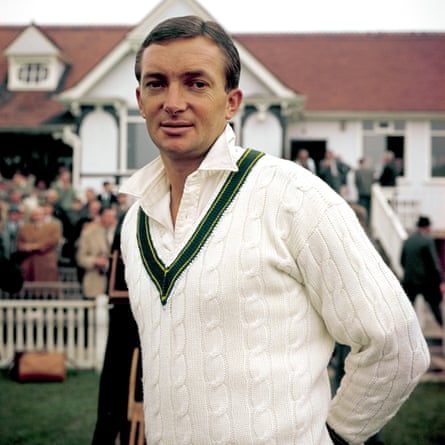
Richie Benaud
My favourite cricketer in Ashes history is Richie Benaud. My move to secondary school in 1961 coincided with the Ashes series of that year and the magic was conjured by the glamorous Australian captain. Benaud didn’t look like other cricketers; he had style and daring, such a contrast to our seemingly sedate tea-and-cake game. He was articulate, charismatic and arrived as a captain with a reputation for attacking, exciting cricket having recently won one of the great Test series against the West Indies.
My memories of that summer, the one during which cricket and I formed a lifelong love affair, are focused upon the last day of the fourth Test at Old Trafford. I am glued to my grandmother’s television. With 256 required to win, England begin well, reaching a brisk 40 before the fall of the first wicket. Enter Ted Dexter, our most dashing player, who goes on to play what many consider one of the great Ashes innings. However he is out for 76, caught Wally Grout, bowled Benaud.
Still confident of an English victory this 11-year-old is heartened at the sight of the captain, Peter May, coming to the wicket. Benaud bowls and May steers the ball away to the leg side. Benaud bowls again, the ball pitches outside May’s legs, spins in from the rough and bowls him. The captain is out for a duck, the silence deafening. Richie wins the match with six for 70 and Australia retain the Ashes. I was torn. I desperately wanted England to win but my hero was unsurpassed on that field, on that day. Richie continued as an astute observer and commentator on the game and for ever remains my Ashes favourite. Howard Barnett
Ian Botham
He is the greatest England cricketer. Indefatigable, heroic, brilliant. For Headingley 1981, Old Trafford 1981, Australia 1986-87, and his comment about Merv Hughes. A hero for his charity work and his strength of character. Geoffrey
Harry Boyle
Harry Boyle should certainly be in the top 100 most important cricketers in the history of the Ashes. Boyle was Fred Spofforth’s partner for Australia in the famous 1882 Kennington Oval game and his bowling was as important as Spofforth’s in winning the match. Boyle bowled Edmund Peate to win that game. Of course, there is no denying Spofforth is the father of modern fast bowling, but it is equally true that while Spofforth was not shy in creating his own legend, Boyle was modest and retiring and always put the team first. The result of this is that Boyle has been forgotten, even though he was widely recognised as an important figure in the history of the game at the time of his passing in 1907. Peter MacIver
Don Bradman
It has to be Don Bradman for me. Don’t get me wrong, Shane Warne is an absolute legend of the game. But, with the sheer wealth of runs he scored against the old foe, combined with his tactical nous as captain, Bradman has to be remembered not just as a legend of cricket itself but as the only answer to this question. An Ashes average just shy of 90, two triple hundreds and a magnificent double after reversing the batting order to protect the experienced batters from a wet wicket in Melbourne in 1937. He’ll always be the best.
I never lived in the time of Bradman but you can’t be bitten by the cricket bug without having read about his escapades in the early 1930s, and particularly the Invincibles tour in the late 1940s. While everyone will remember the duck that prevented him from obtaining a 100+ average in Test cricket, I will always remember watching him bat against that water tank for hours on end, plus watching him take blow after blow in the infamous Bodyline series and still walk away with little injury and a 56 average in an absolutely treacherous Ashes for the Australian batters. He’ll go down as the greatest Ashes batter for me. Alex W
Mike Brearley
He took the art of captaincy, with the critical role it plays in cricket, to a higher level. He defined his era by showing that it takes more than sheer hard work or brute force to bring success in the Ashes, particularly in Australia. He inspired so many with his thoughtful, intelligent leadership, which allowed his teams’ true qualities and skills to flourish. His reading of the game, the match state and players’ psyches excelled in the moments when a change of momentum was needed.
A beautifully subtle, nuanced view to captaincy that challenged the more modern view that a captain can inspire through their actions; that a batter and captain must score runs to be a successful leader. He could excel in his captaincy alone, making it a core skill set. Not only did Brearley inspire the stars to hit ever higher levels, but he galvanised the likes of Derek Randall to feats he could only dream of. Particularly extolling the virtues of fielding in a period not noted for this critical skill, but making a difference when the margins were tight or the team needed a lift. John Powell
Andrew Flintoff
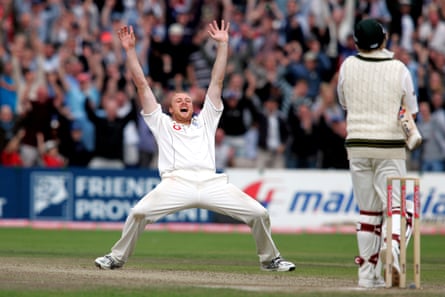
While there were better players, I cannot choose anyone but Andrew Flintoff. To watch him bowl was to watch somebody confront – and then go beyond – his own limitations. Every delivery seemed to strain against the body’s instincts, like two positive magnets being forced to touch. And then he would hit the top of off stump, or slam the ball into the pads, and his roar was, somehow, the sound of all of us. Then there was his batting, which could shift a game and throw everything back at the opposition. He was always a little humble at the crease, but God he hit it hard. A gentleman, a ferocious athlete with an enormous heart, and an all-night partier. He was everything the Ashes should be about. Pete
Adam Gilchrist
I’ve never seen a more exciting batter and that wasn’t even his primary role in the team. As a cricket lover it’s a pretty safe bet I was watching but, if for some reason I wasn’t, I’d always try to find a screen whenever Adam Gilchrist came in to bat. I didn’t want to miss a ball because anything could happen. What a player.
The 57-ball century in Perth in 2006 is my favourite Ashes moment. I had a newborn daughter at the time and I remember that she fortuitously went to sleep just as he came in to bat that day. I started the innings making dinner in the kitchen and listening on the radio, but once he got going I knew dinner had to wait. I still remember how happy I felt watching that knock. He very nearly made the fastest Test hundred ever that day. Damian Lynch
David Gower
I have always been drawn to the elegant batsmen such as Carl Hooper, Martin Crowe and David Gower. Gower was elegance personified. Every boundary was almost a work of art, with balls dispatched with ease and grace. Of all the batters I have seen grace the Ashes, I would choose to watch an innings of Gower’s over any other. He was worth the entrance fee alone. His 123 at Sydney in 1991 was a display of shotmaking to behold. Marcus
Kim Hughes
Without much statistical backing, my biased view is of Kim Hughes being my favourite cricketer in the history of the men’s Ashes. Mostly because of his performance in the 1980 Centenary Test. He was a flamboyant, exciting, brilliant batter who was not treated kindly by circumstance. Jeremy Smyth
Merv Hughes
A one-man army; the brawn to Shane Warne’s brain. As a young English cricket fan, I thought no one else personified the fearsomeness of the early 1990s Australian team more than big Merv. He was terrifying looking, with the malevolent aura of a hungover Tasmanian devil. My formative Ashes memories are from the early 90s and seem to involve watching a succession of Australian moustaches grinding Englishmen into the dust. It’s a period of character-building I associate entirely with Hughes in my mind’s eye. Andy Palmer
Gilbert Jessop
In modern times it has to be Shane Warne, but I would sell my soul to see Gilbert Jessop’s 76-ball match-winning hundred against Australia at the Oval in 1902. They set us 263 and we were 40-odd for five when he came in. His fastest England ton record still stands. I hope it’s never beaten. I may be ancient, but sadly I never saw Jessop! Richard Davies
Simon Jones
The way Simon Jones came back from a horrific injury in 2003 and showed his mastery of reverse swing in 2005 makes him my favourite cricketer in the history of men’s Ashes. The iconic ball that nipped back in to send Michael Clarke’s off stump cartwheeling will be one of those unforgettable moments. His five for 44 in the fourth Test set up what would prove to be a decisive victory. Jonathan Banks
Jim Laker
I am 81 years old and a working-class lad from Balham, a few stops along the Northern line from the Oval. My earliest memory of watching cricket was seeing Jim Laker take 19 wickets in the Old Trafford Test in 1956. Although my clearest and most vivid memory of that game was one of the Australian batters (I can’t remember who) complaining about his own shadow distracting him. Later that year my dad took me to the Oval for the first time. I went many times after that, seeing some great players. It was in the great era of Surrey cricket and it made me want to be an off-spin bowler. I never came anywhere near succeeding, but it made me a lifelong fan of cricket in general and Surrey in particular. Bob Rice
Dennis Lillee
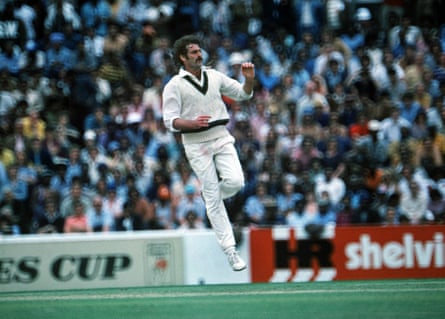
I saw him first in the 1972 Ashes, the first series I followed closely. Dennis Lillee was young, athletic and he seemed to run from the sightscreen to bowl. Over after over at the speed of sound. Apart from Tony Greig, all the English players were plainly terrified of him. I wanted to be like him. In the winter of 1974-75 he wasn’t expected to be a factor after two years of serious injury. He did not do much in the first Test but after that he was again very fast. There was more to him than pace; he was as canny as any fox and in the years to come he thought out many batters. He was a flawed guy with his aluminium bats and fights with Javed Miandad. But he was great and Australia seemed a plainer team for years after he retired. Jim Payne
Bob Massie
I think it is always going to be who captured your imagination when you were 13 or 14 years old. For me that was the 1972 tour of England. Bob Massie on debut took eight wickets in each innings at Lord’s. Watching it on the news at night, every wicket seemed to be a replay of the previous one: an outswinger, perfectly pitched, caught in the slips. It was mesmerising to watch, as it must have been for the hapless English batsmen who had to face him. It seemed that the whole team had moustaches, inspiring a generation of Australian men who have a moustache to this day. But Massie didn’t have a moustache. He had the biggest mutton chops, not seen since the 1800s. Peter Rees
Monty Panesar
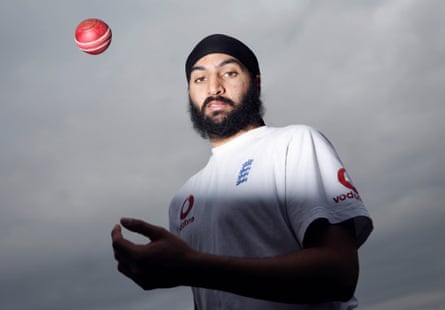
Monty Panesar is the epitome of Ashes cricket. One hundred percent commitment from a British Asian player representing England, confounding Norman Tebbit and the other racist idiots. He may not have been brilliant at everything he tried to do but my goodness, he tried.
When I think of him, Cardiff in 2009 comes to mind. Jimmy Anderson could bat a bit but Monty was hopelessly out of his depth. Nonetheless, he dug in, survived and broke the Aussies’ spirit to set up a famous series win. They knew they should have beaten him but he believed he could bat for England and, by God, he did. Proper bulldog spirit from a “lad from Luton”. James
Kevin Pietersen
This is bound up with emotion. I am 48, so witnessed all 18 of those long horrible barren years without England winning the Ashes. My whole childhood, adolescence and young adulthood was a ceaseless, joyless trudge of foregone conclusions. When Duncan Fletcher and Michael Vaughan linked up to build something to break that cycle, it was the best thing I have seen in sport. And they picked someone who could dominate the Australian bowlers, someone unafraid and someone who was serious about maximising his talent (take note, Harry Brook). Kevin Pietersen was a breath of fresh air. As well as his influence in the Ashes in 2005 and 2010-11, he was instrumental in England winning their first limited-overs trophy: the Twenty20 World Cup in 2010. He was obviously a challenging character, but he should be way more respected by the English cricket establishment than he is. Richard Coyle
Derek Randall
I’d have Derek Randall up there. The Centenary Test at MCG in 1977 was fought with honour and belligerence. However, standing above it all was Randall doffing his cap to a fuming Dennis Lillee on the way to his 174. He was also a wonderful cover fielder when fielding wasn’t really a core skill. As a spectator you could see that cricket was still a game of fun to Randall. Brian Fisher
Steve Smith
Nobody has faced such pressure and fired back with such brilliance. His idiosyncrasies make him the best batter to watch in world cricket, and he has dominated England. I find myself copying his ticks in all walks of life. The way people talk about David Gower is how I feel about Steve Smith. I’m an Australian convert when he’s their captain; that’s how good he is. Oliver Inwards
David Steele
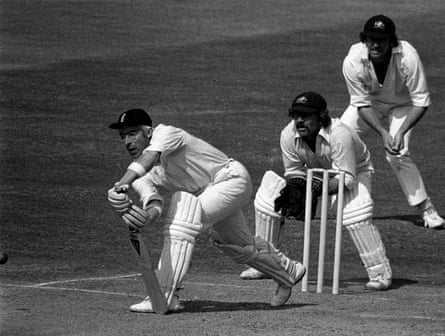
It’s an eccentric choice, I know, as David Steele only played three Test matches against Australia in the summer of 1975, but his story is a compelling one. Called up by England for the second Test at Lord’s at the age of 33, grey-haired and sporting metal-rimmed glasses, he seemed an unlikely figure to impose himself upon the consciences of the likes of Dennis Lillee, Jeff Thomson and Max Walker. But, from the moment he came out to bat in the first innings, he showed himself to be equal to the task, hooking Lillee with aplomb and restoring England’s fortunes by sharing in a partnership of over 100 with the exuberant Tony Greig (the juxtaposition of the two was memorable).
His average of over 60 in six innings and the heroic, determined manner in which he went about his task endeared him hugely to the public, who voted him Sports Personality of the Year, only the second cricketer at that time to have attained such an honour and surely the only one with grey hair. Seen against the long history of the Ashes, his appearance is fleeting but the unexpectedness of his selection (perhaps the most inspired in Ashes history) and the remarkable nature of his performance make his story one of the most arresting and heartening in a sporting rivalry littered with striking achievements. James Carleton Paget
Graham Thorpe
He never played in an Ashes-winning side, but he was that most Australian of English cricketers: compact, flint-hard (on the surface at least) with a marvellous array of attacking strokes. He was a rare world-class talent in an otherwise grim 15 years for England. We shared a birthday and every 1 August I raise a glass. His loss still hurts. Peter Williams
Frank Tyson
As an 11-year-old, my brother, father and I woke up and tuned into BBC long-wave broadcasts of the 1954-55 Ashes tests. Expecting defeat in Melbourne, we listened with a mixture of excitement and disbelief as Frank Tyson blew the Aussies away with seven for 27. He was my hero and the fastest I’ve ever seen, including all the quicks since 1953. Watching him at Trent Bridge against South Africa was a revelation, with the wicketkeeper Keith Andrew standing about 30 yards back and taking them over his head like a goalie. Adrian Tuck
Shane Warne
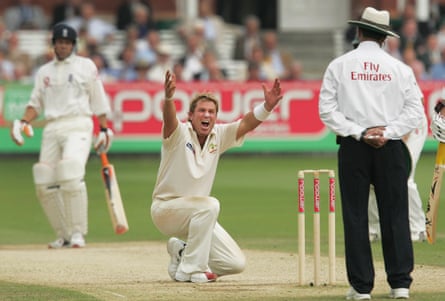
Shane Warne is head and shoulders above everyone I have seen. He just made you fizz with excitement. He made every young lad want to do what he did, but most of us gave up and carried on bowling military medium pace anyway after seeing his artistry was just too great to be emulated.
The odd thing was that his absolute peak, for me, wasn’t the ball of the century: it was the one time he was on the losing side, in 2005. Never before or since have I wanted to see an Australia player score a century as much as I did when Warne batted at No 8 at Old Trafford before picking out the one fielder on the leg-side boundary for 90. He was distraught, as were the rest of us watching that day. I don’t think anyone would have begrudged giving him just 10 more runs. The only man I know who was loved by both sides of the rivalry. God, how I wish he’d been English. Andy S
Steve Waugh
I grew up with the terrible post-Packer years, when Allan Border picked up the Australia team by the scruff of the neck and by sheer will turned them into something competitive. Steve Waugh came into this emerging side and had the same grit and, lo and behold, actual batting talent.
I remember watching him bat in an Ashes test at the Gabba. As university students we used to go to the last session of the day and almost always blag our way in for free. We saw a young prospect called Waugh showing some nice skills. He really stood out at a time when Australian batters rarely looked at home in the Test arena. He seemed like a ray of hope.
Fast forward to the 1989 Ashes series in England. When I returned home from work I could watch the Ashes on a tiny black and white TV. It was so exciting to see that wonderful series unfolded, with Australia winning after being dubbed the “worst team ever”. However I alway think back to the beginning of the revival and Waugh in that mid-1980s Ashes match. Stephen