.png) 2 months ago
63
2 months ago
63
A blinking fault light on Nasa’s Orion spacecraft signalled an unwelcome setback at the start of the historic Artemis II mission: the toilet was out of order.
Fortunately for the four astronauts on board for the 10-day mission, the issue was quickly resolved, with mission control confirming: “Happy to report that toilet is go for use. We do recommend letting the system get to operating speed before donating fluid, and then letting it run a little bit after donation.”
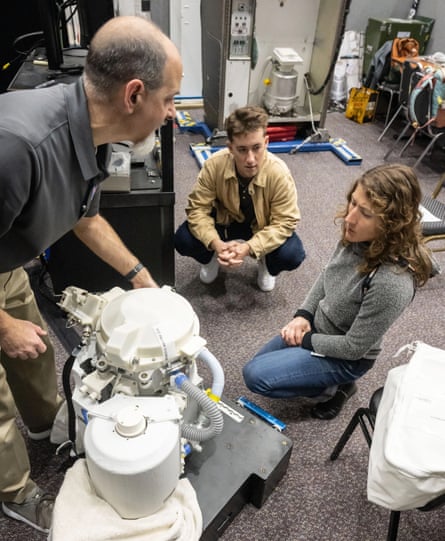
And despite the shaky start, the spacecraft’s $30m Universal Waste Management System (UMWS) has been hailed as a leap forward in deep space toilet technology. The system was years in development and designed to improve on longstanding complaints from astronauts about onboard facilities.
On the Apollo missions, astronauts were required to pee into a condom-like contraption placed under the spacesuit (all Apollo crew being male). Solid waste was collected into a bag taped to the astronaut’s buttocks. The setup was prone to leaks, with one mission transcript recording an alarmed crew member noticing “a turd floating through the air”. And while a Nasa report concluded that the primitive setup had broadly met its objectives from a purely engineering standpoint, it “must be given poor marks” for crew satisfaction.
The upgrade to the UWMS has seen Orion fitted with a private toilet cubicle – a first for a space shuttle – accessed through a door on the floor next to the hatch that astronauts use to enter the spacecraft. Handrails and foot tethers will allow the crew to remain secure while visiting the bathroom.
“We’re pretty fortunate as a crew to get a toilet with a door on this tiny spacecraft,” said Jeremy Hansen, a mission specialist on Artemis II from the Canadian Space Agency, in a video ahead of launch. “The one place during the mission where we can go and actually feel like we’re alone for a moment.”
The toilet has a funnel attached to a hose for urine and is fitted with a small seat. Since everything floats in space, the faeces are sucked down into a bag at the base of the toilet bowl, which is then squished down into a canister. The suction is so noisy that the cubical is lined with insulation and the crew must wear ear protection while inside.
During longer missions, such as visits to the International Space Station, astronauts now recycle almost all liquid waste, processing urine and sweat to turn it into drinkable water. But on a short mission such as Artemis II, the crew will vent urine out of the spacecraft every day, and faecal waste will be stored in a collection container that will be disposed of on return to Earth.
The toilet system goes beyond being a small luxury for the crew. A central objective of Nasa’s Artemis programme is establishing a permanent presence in space. This requires waste to be dealt with sustainably, without risks to astronaut health. Leaks also need to be avoided to prevent contamination of the pristine environment of space with microbes from Earth.
“Actually thinking about not only toilets but the entire life support systems is one of the foundations of long-term living in space,” said David Munns, professor of the history of science and technology at the City University of New York. “Having the ability to deal with waste is mission-critical.”