.png) 2 months ago
63
2 months ago
63
It’s a half-century-old film so darkly prophetic and viscerally relevant that even its makers are still unpacking it.
“It’s a sense of being isolated, it’s about being lonely and not being able to communicate or connect,” said Taxi Driver’s director, Martin Scorsese, last night. “For me, that’s universal. It’s always going to speak to young people.”
On the occasion of the 25th anniversary of New York’s Tribeca film festival, Taxi Driver’s main players, including Scorsese and Robert De Niro, as well as Jodie Foster and screenwriter Paul Schrader, gathered for a screening at the BMCC Tribeca Performing Arts Center to mark the 50th anniversary of the movie and examine its lasting legacy.
“Obviously there is something in this film that doesn’t die,” said Schrader. “If we marked [the 50th anniversary of a film] in 1976, we’d be talking about a 1926 movie. So it is very peculiar.”
Released in February 1976, Taxi Driver was an electrifying sensation from the moment it entered into the American consciousness. Making stars of its cast and crew, it was awarded the Palme d’Or at Cannes as well as receiving four Academy Award nominations, including for best picture, best actor for De Niro and best supporting actress for co-star Foster, who was just 12 when the film was shot.
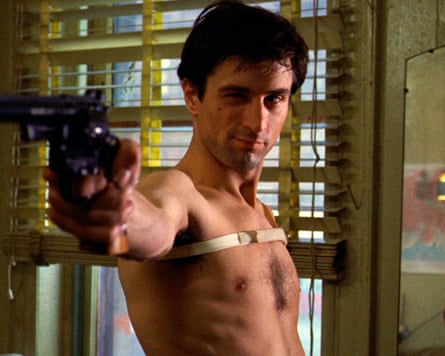
A theme of alienation echoes hopelessly throughout the movie they crafted, with De Niro’s insomniac character driving his cab around the streets of a grimy New York at night: traversing its then rough-and-tumble underbelly while also ruminating on his own sense of isolation as a 26-year-old who has trouble connecting with anybody around him. It subsequently leads to violent results, as meticulously detailed in Schrader’s script. “Each page was like a razor blade,” Scorsese said last night.
“When we all read the script, everybody felt really good about it because we identified with it in some way,” added De Niro. “Today, I do understand that people are still lonely, especially with the internet, and in light of the pandemic. People are getting more isolated and getting into worlds they shouldn’t get into, becoming obsessed with something negative.”
A milieu of future cultural woes were foretold by their crackling film: while the image of a disaffected young man with a warped mind and a gun was still decades away (Columbine wasn’t until 1999), the film was played at John Hinkley Jr’s trial for his 1981 assassination attempt of Ronald Reagan, with Hinkley famously on a quest to impress Foster. The archetype of the angry young man has only ramped up in intensity. Even the rise of extremist internet groups and the “alt-right” make an uneasy parallel to its pulsating story.
“When I first read the script, there was something absolutely 100% true and authentic about the character’s disaffection and loneliness that I didn’t really understand at the time,” said Foster. “There’s no real self-understanding; he allows the audience to witness his descent, unraveling and attempt to connect, but he doesn’t really understand himself. That’s the draw of the antihero.”

Perhaps the loneliness of De Niro’s Travis Bickle can be connected to the rise of the digital age as well. In the film, he pines for female companionship, including the beautiful Betsy (Cybill Shepherd), whom he effectively stalks. Today, Bickle could have turned to a chatbot girlfriend; something Schrader himself, only weeks ago, publicly admitted to procuring.
While the plot line of its main warped character mirrors the modern era, Scorsese’s film captures a period of New York City firmly in the rear view: an unimaginable cesspool of grim and crime in Manhattan that today is altogether glossed over and buffed out. “It’s different now, you say?” joked Scorsese, when asked by moderator W Kamau Bell about the changing city.
“I was born and bred in New York downtown on Elizabeth Street,” the director said before clarifying: “The old [pre-gentrification] Elizabeth Street, not the new one. I remember a couple friends of mine said, ‘Marty, did you realize something was really wrong when there were stacks of garbage piled in the streets?’ There was something during the shoot of the film where you could feel the temperature and a kind of violence all around you.”
When they were filming in 1975, crime was at its peak and the city was flat broke. (The iconic “Ford to City: Drop Dead” headline came out that October). Meanwhile, earlier this month the NYPD announced the lowest amount of gun violence in recorded history so far this year. Last night, Schrader bemoaned what was lost. “It was alive,” he said of New York at the time. “I came here in ’66 and I remember sitting on a curb on MacDougal Street listening to [the Lovin’ Spoonful’s song] Summer in the City, and I’m thinking: ‘This is the greatest fucking place on earth.’”
When it comes to the changing culture around film-making, Scorsese admits he came up in a different era. “I really don’t know much about how films are put together these days in terms of financing and that sort of thing,” he said. “I come from a time where I wanted to make films based in the Hollywood system, but independent films at the same time.” While Scorsese’s recent polarizing endorsement of an AI storyboarding company didn’t come up in conversation, the director says that now with technology, “You can do anything, really. There are no excuses any more [to not pursue film-making]. The key thing is your own will and not be shaken by any kind of hindrance at all.”
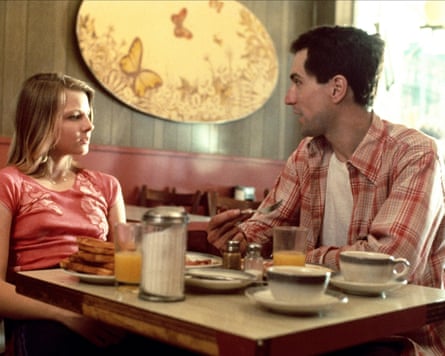
Schrader chimed in with a metaphor to evoke the challenges of getting a movie made. “Put me in a lion cage, and give me a whip and a chair. Sometimes you win, and sometimes the lions win.” The bottom line in general, according to De Niro, is to be original in your work and everything will fall into place. “You can never go wrong by making it your own, because no one can imitate what you can do or who you are.”
Ironically, Taxi Driver has been intimated ad nauseam, right down to De Niro’s iconic “You talkin’ to me?” line, which he said he came up with during an improvisation that Scorsese said was “trance-like”. (He said the line for the crowd last night, to raucous applause, after being egged on by moderator Bell.)
“Why are we [still] sitting here?” said Schrader, with what seemed like a mix of surprise and pride. “A lot of films were made 50 years ago, yet this one seems to redo its contract with young viewers every decade or so.”