.png) 1 month ago
51
1 month ago
51
Wrexham AFC, the football club part-owned by Hollywood stars Ryan Reynolds and Rob Mac, was given a £3.8m government grant without a contract or a finished state aid assessment in place, raising questions over whether the award was lawful.
The club has received £18m in taxpayer-funded grants – far more than any other in the UK – to help to redevelop its stadium, the Racecourse Ground (Y Cae Ras in Welsh).
However, responses to the Guardian’s freedom of information requests suggest Wrexham county borough council awarded the money before completing the usual steps.
Alexander Rose, a partner specialising in subsidy control at law firm Ward Hadaway, said that the lack of a final state aid assessment at the time the grant was awarded would have left it vulnerable to legal challenge by a rival.
However, there is little prospect of the Wrexham AFC being forced to repay the cash, as the one-month window for challenges to be filed has since closed.
The leader of Wrexham council, Mark Pritchard, said: “All due diligence and checks were in place ahead of the transfer of any funding and we refute any accusations to the contrary.”
Reynolds and Mac took over the club in 2021, bringing with them a wave of sponsorship and global interest via their Disney TV series Welcome to Wrexham, the fifth season of which will begin next month. Reynolds is the producer and star of the billion-dollar Deadpool film series, while Mac, who has changed his name from McElhenney, is the producer and star of comedy series It’s Always Sunny in Philadelphia.
The subsequent influx of money has allowed Wrexham to far outspend their lower-league rivals, transforming the club’s fortunes; while they were once struggling in the fifth tier of English football, the team are now hovering just outside the playoff spots for promotion to the Premier League.
Wrexham, which was granted city status in 2022, awarded the £18m to the star-studded club as part of its “Wrexham Gateway” urban improvement scheme. Most of the money went towards developing the stadium, despite the club having deep-pocketed owners.

The first £3.8m tranche of cash was awarded on 8 February 2022, less than a year after Reynolds and Mac’s takeover. Another £14m was awarded in September 2025, according to government state aid disclosures revealed by the Guardian.
Public authorities that give out grants are required by law to judge if they comply with the principles of subsidy control, to ensure taxpayer money is not misspent. Such assessments are meant to be integral to the decision-making process.
However, in response to a freedom of information request, Wrexham council said it only had “draft assessments” in place before the money was awarded. The council said the final assessment it provided was submitted nearly five months later, on 6 July 2022. In response to questions, the council shared a draft assessment it said dated from 7 September 2021.
Rose said: “At the time the £3.8m grant was awarded there was a duty to carry out a principles assessment. Evidence that this assessment wasn’t finalised when the grant was given would certainly have helped a challenger, for example a rival football club.”
“Subsidy control rules exist to ensure there’s a level playing field in which businesses can compete,” he added. “That includes in professional football. They’re also an important protection for the taxpayer, preventing wasteful and unnecessary subsidies from being awarded.”
Recipients of large grants almost always sign contracts to ensure taxpayer money is spent as promised. Yet the council said the grant was authorised by its executive board and “provided in advance of the finalisation of the grant funding agreement”.
The council said the grant funding agreement – apparently covering the whole £18m – was only created in July 2023.
The contract was then completed on 17 September 2025, when the £14m tranche was awarded.
The two-year delay between the creation of the contract and its signing also offered another potential benefit to Wrexham council: new subsidy control laws that came into force days earlier in August raised the threshold for mandatory scrutiny of the grant by the Competition and Markets Authority. Delaying the subsidy meant the award to Wrexham AFC was not subject to this scrutiny.
While it was tapping taxpayer money, the club was also able to raise huge amounts from private backers. In the year to June 2025 it raised £36m through share issues. Three months after the second grant, Reynolds and Mac announced the sale of a stake in the club to Apollo, one of the world’s largest private equity firms.
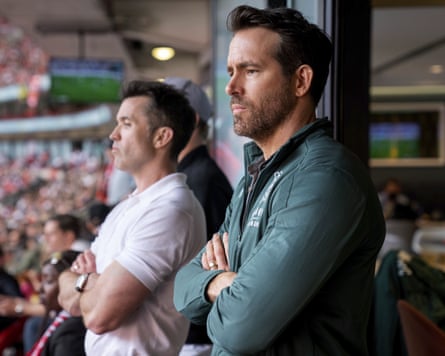
Bloomberg reported that Wrexham was valued as high as £350m. The club then raised another £47.8m in January, according to corporate filings.
In the year before it received the £14m grant, Wrexham was able to repay loans worth £10.6m to Ryan Reynolds’s company, according to accounts published last month. It also lost £3.8m from the collapse of Argentex, a currency brokerage that entered special administration in July 2025 because of failed foreign exchange trades.
Pritchard, the council leader, said: “The grant represents a small investment compared to what the club will be investing at the Racecourse … In fact, as the club has grown in both stature, ambition and from external investment, the percentage of public investment compared to that of the club has shrunk from roughly 68% of the project costs to around 25% currently.
“This demonstrates further value for money in regard to the initial investment from the public purse.”
Wrexham AFC said the club is itself making a “significant financial investment with the support of our ownership group and investors”. Accounts published last month show the club has signed a £69.2m contract to build a new stand.
The spokesperson said the “funding ensures the facility can be brought up to the required standard to host international sporting events, including international football and rugby matches (as opposed to just meeting domestic football criteria)”.