.png) 3 months ago
74
3 months ago
74
At the start of the season, clubs, fans and the media were told referees would be taking a proactive approach to holding in the penalty area, or grappling as some call it. We have since seen some really good examples of on-field referees making decisions where they have clearly identified holding offences and others where the VAR has recommended a review. But in the past six or eight weeks the issue seems to have intensified, with a change in tack in the Premier League, where clubs are loading the penalty area at every set piece.
During the game between Arsenal and Chelsea on Sunday there was one corner where Declan Rice was holding Jorrel Hato, David Raya was being held, Gabriel Magalhães’s shirt was being pulled and Viktor Gyökeres was having a tug at Enzo Fernández. It was very messy. The players have a real responsibility with this because a lot of histrionics go with it. Players are going to ground easily, obscured by a crowd of people in the penalty area, and offences can be difficult to detect.
So, what are you looking for as a referee? It’s what we call a “material impact”, where it’s clear a player is stopping an opponent from playing the ball. It could be a non-footballing action, such as where you’ve got your back to the kicker, you’ve got two arms out and you’re shepherding a player, which I liken to basketball, or where you get a hold of a shirt and you’re not letting go. Attackers can sometimes be as culpable as defenders because they want to make space and create space for themselves.
There are also situations where there is pushing and pulling, but at a level where it’s not an offence, and remember the ball has to be in play for a defensive foul or penalty to be given. Sometimes they are both having a little push and a pull; they call it mutual holding and the best outcome there, in my opinion, is to allow play to continue. It comes down to how the game feels about what we’re seeing.
We have had examples in the past two game weeks of the range of calls referees have to make. In the north London derby Spurs had a goal disallowed for a foul by Randal Kolo Muani on Gabriel. Muani had two outstretched hands in the lower back of the Arsenal defender and pushed him. The on-field referee, Peter Bankes, gave a foul and was very comfortable with that decision. People will look at the reaction of Gabriel, throwing his arms in the air, and not like that but there will be no intervention by the VAR because the referee has not made a clear and obvious error.
Then at Fulham v Tottenham on Sunday, there were complaints from Igor Tudor that Fulham’s opening goal should have been disallowed because Raúl Jiménez put his hands on Radu Dragusin. It is a similar complaint but a different incident because there was only slight contact. It was not a clear push like it was last week. The referee, Thomas Bramall, was happy with that, because the preference all season has been not to penalise minimal contact. The VAR, Craig Pawson, checked it and was in line with the referee. Some people will say the Gabriel and Jiménez incidents are the same, but they are not. Has the referee made a clear and obvious error in either instance? No. That’s VAR consistently staying in the background which is what the English game says it wants.
We had a compelling and competitive Premier League match at Turf Moor on Saturday but, unfortunately, the noise at the end was over a disallowed goal and the time it took to reach a decision. Ashley Barnes thought he had scored deep into stoppage time to give Burnley a 4-4 draw against Brentford. The first couple of angles I saw were inconclusive, but then an angle showed Barnes had handled and it was a handball offence, 100%.
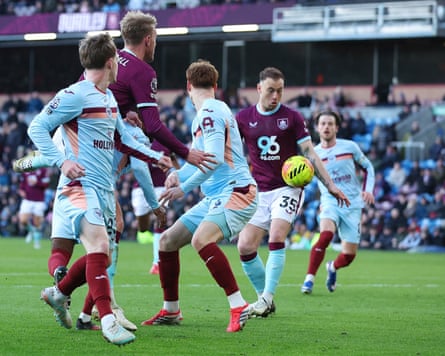
Accidental handball which immediately leads to a goal means the goal has to be disallowed as per the laws of the game – it’s a factual decision. The talking point really revolves around the time it took for the decision to be checked. It needed about four and a half minutes, but what people didn’t understand was there was a melee in the technical area which had to be looked at too. That was why it took longer than normal. Everybody wants it to be quick and accurate and if you went quickly here you could get the wrong decision. A wider question may be about whether the law is in the right place.
At Old Trafford on Sunday we saw a nice piece of teamwork between referee, assistant and VAR, in a call that ended with a red card for Crystal Palace’s Maxence Lacroix. The incident occurred in the second half, with Matheus Cunha in possession. He is driving towards the penalty area, being pulled by Lacroix and the holding continues into the penalty area. Holding in this regard is unique in the law because if it starts outside the box but continues inside, it becomes a penalty kick. So there’s a slight delay from the referee, Chris Kavanagh, as he communicates with his assistant who is side-on to the play.
Once the conversation is complete Kavanagh points to the spot and then there is a really good intervention by the VAR, Tony Harrington, for the denial of an obvious goalscoring opportunity. Cunha is in possession, inside the penalty area, there are no covering defenders and his direction of travel is taking him towards goal. So the foul by Lacroix becomes a sending off. I was really pleased that Harrington flagged this. The referee has the final judgment, meaning Kavanagh goes to the monitor and makes the on-field announcement of a red card.
So the referee identifies the offence, the assistant referee provides the location of the offence, and the VAR tops it off by recommending a review for the denial of a goalscoring opportunity. That was really smartly done.
Chris Foy is a former Premier League referee.