.png) 1 month ago
33
1 month ago
33
In the autumn of 1843, the influential journal Art-Union mourned “the late Richard Dadd”, an apparently kind and gentle man who a year or so earlier had been a rising star of London’s Royal Academy. Today, Dadd is known, if at all, for having murdered his father while in the grip of severe psychosis, for which he was committed to Bethlem hospital asylum where he passed his remaining 43 years. As Art-Union concluded: “although the grave has not actually closed over him, he must be classed among the dead.”
At Bethlem, Dadd began painting again. Scenes remembered from his trip around the Eastern Mediterranean – when he first began suffering mental distress – were followed by portraiture allegory, satire, biblical scenes and intricately detailed fantasies, among them the unfinished The Fairy Feller’s Master-Stroke, which he painted between 1855 and 1864. By now he was more patient than artist, and the prism of mental illness through which his work came to be understood has never fully shifted.
Richard Dadd: Beyond Bedlam at the Royal Academy is the first major exhibition to be dedicated to the artist in more than 50 years. Returning him to his alma mater places the emphasis on Dadd the artist, and in the same spirit his medical records will be omitted from the exhibition, his illness and crime referred to only briefly. Freed from the narrative of the asylum, Dadd’s career can be viewed as a coherent whole, explains co-curator Sylvie Broussine: “The before and after narrative is reductive: his style changes, but that happens with many different artists in all different circumstances. A number of his subjects remain the same.”
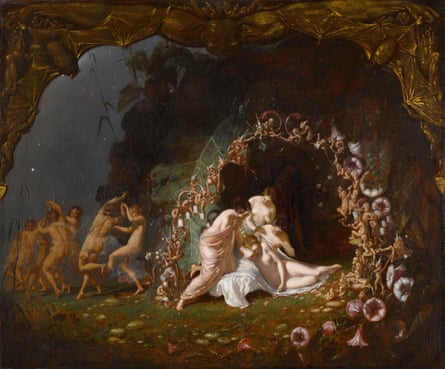
Broussine points to Dadd’s enduring interest in Shakespeare, whose stories he spun into highly wrought fantasies, consistent with his early decision to specialise in imaginative subjects. If Dadd’s retreat into fairyland has been understood as a symptom of his detachment from reality, a vista in the exhibition, Titania Sleeping, exhibited at the RA in 1841, shown with The Fairy Feller’s Master-Stroke, suggests that such a reading is overly simplistic.
Jennifer Higgie, author of Bedlam, a novel published to coincide with the exhibition agrees up to a point: “But his language intensified – you can’t look at The Fairy Feller’s Master-Stroke without noticing a certain mania in the way he painted it – in its incredible intricacy and focus on detail.” Bedlam is the latest in a substantial body of creative works inspired by Dadd, which include Angela Carter’s 1979 radio play Come Unto These Yellow Sands, and Queen’s 1974 song The Fairy Feller’s Master-Stroke. The urge to get inside Dadd’s mind is apparently irresistible.
No one has thought longer and harder on this subject than Nicholas Tromans, leading Dadd authority and the co-curator of the exhibition. When Dadd was first rediscovered in the mid 20th century, he was treated more as a medical case study than as an artist, as part of a fashionable belief that art was an effective diagnostic tool. Tromans distanced himself from this now discredited approach in the preface to his 2011 book Richard Dadd: The Artist and the Asylum, in which he wrote: “No more than were I writing about JMW Turner or Claude Monet have I pretended to know exactly what he thought and felt whilst making his pictures”.
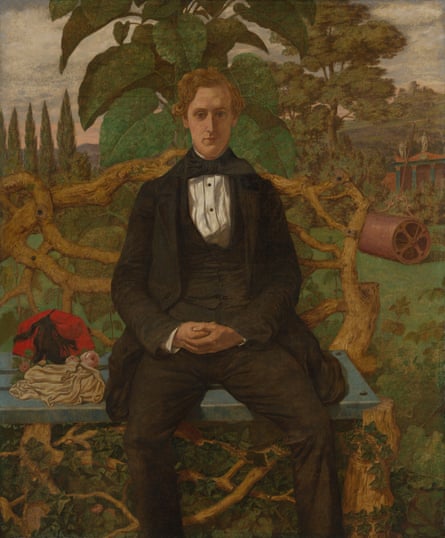
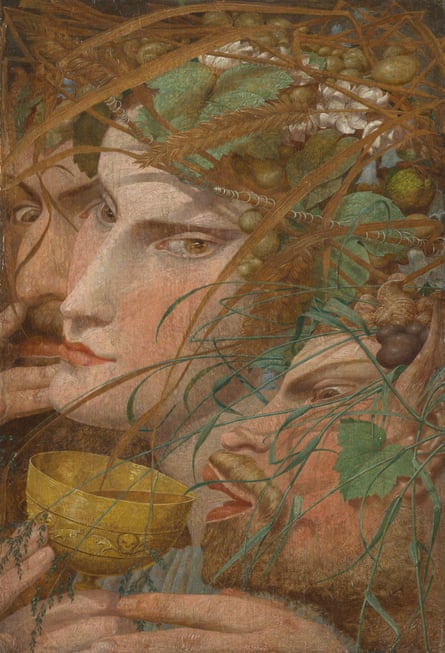
And yet, he says: “I like to point out that his characters never seem to interact, his figures never talk to each other or look at each other or say anything to each other. It’s impossible not to see in that a reflection of what we know about him, which was that he was very cut off and did not tend to talk to other people very much.”
Andrea Mindel, a member of Bethlem Artist Collective (BAC), based at Bethlem Gallery, in the grounds of the hospital in London, worries that underplaying Dadd’s illness does the artist a disservice, and perpetuates a wider reticence about mental illness: “It’s OK if you want to back off, but you have to explain yourself. The problem with institutional exhibitions like this is that they set the tone of how he’s perceived for the next 50 years – so I think it’s really important to own it, to say ‘this is a difficult thing to discuss’.”

Perhaps it is precisely in recognition of such tensions that in preparing the exhibition, the RA engaged a sensitivity panel comprising three BAC members including Mindel to feedback on its gallery texts. Further plans include signposting NHS support and providing a quiet space for reflection. If such measures seem very much of our time, that ought to be a good thing: staging an exhibition on Dadd has broader implications for the way that mental illness is framed, and will help to shape the reception of work by today’s artists.
Karim Sultan is responsible for exhibitions and artist development at the Bethlem Gallery which works with artists many of whom have experience of mental illness. He emphasises the “flattening effect” that the gallery promotes as a publicly accessible arts venue: “Nobody’s really sure who’s who until people start speaking to one another. At the end of the day, if you’re coming into the space and you’re working as an artist, then that’s what you are”.