.png) 9 hours ago
11
9 hours ago
11
Unveiled the same week in which tech company Anthropic admitted that its AI model Claude had gone rogue during testing, Bayreuth festival’s new AI-generated staging of Wagner’s four-part Ring of the Nibelungen is at least timely. But anyone who assumes that the cycle’s obsession with knowledge, power and possession might make it an ideal forum for reflection on AI as a major contemporary frontier will be disappointed, as will anyone hopeful about AI’s creative potential within opera.
Commissioned to mark the festival’s 150th anniversary, the production is “curated” – emphatically not “directed” – by a team led by German stage director Marcus Lobbes. He apparently spent weeks in dialogue with AI models about possible interpretations of the Ring. According to the programme book, “power structures, capitalism, mythology, gender roles, nationalism”, all came up. So far, so mainstream Wagner reception. But if these human-machine exchanges were revelatory, you wouldn’t know it from the resulting staging, which uses AI “as an extension of a cultural memory that is never complete”.
In plainer English: the AI system is allowed to roam archival materials from 150 years of Ring cycle productions at Bayreuth as the starting point for constantly spooling visuals projected on to a screen that is stretched the full width and height of the proscenium arch. Lobbes also asked the system to incorporate imagery chronologically, from a political or social event every year of the festival’s history as a plausible conversation topic for that season’s audience. Each scene begins with a source from the cycle’s 1876 premiere, but what happens next is determined by the system in real time during the performance.
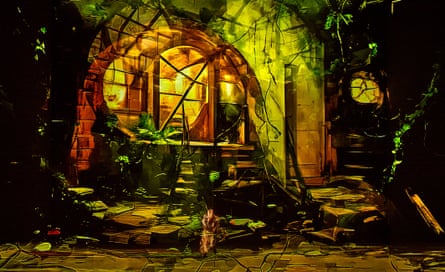
The good news is that anyone who attends another of this production’s outings definitely won’t see the same selection of visual bric-à-brac that I did. The bad news is that the principle of rapid machinic free-association will remain.
So, I assume, will the constant grotesque morph and flow of visual objects. Das Rheingold and Die Walküre involved countless hands that warped horribly, producing extra fingers and nails. (Did someone adjust the settings ahead of Siegfried and Götterdämmerung, I wonder? The visual tic disappeared mid-cycle as suddenly as it emerged.) Faces appeared, only to go instantly out of focus. Some were very famous (Adolf Hitler, Queen Elizabeth II, JFK) but I struggled to identify most. Watercolour rocks became bodies became other bodies. There were rapid swings between the entirely inscrutable and the totally obvious. Alberich’s transformation into a toad triggered various mutant amphibians, there were bears when Siegfried brought one in, a rainbow for the rainbow bridge to Valhalla.
But there were also endless picture-library bland photos of scrap metal, creeping greenery, water droplets, abandoned rooms. I spotted design elements from various past Bayreuth Ring productions but was mostly – inevitably – unable to keep pace with the AI system’s connection-making. One low point: the appearance of a historical photo of emaciated African youths – as unexplained as everything else, but picture the results of an image-search for “European colonialism” – which flashed past during Die Walküre. This is not engaging with the complex, problematic history of Bayreuth or the Ring. It’s just another form of mindless scrolling.
You’ll be wondering where the singers fitted in. Forget Wagner’s notion of the inescapably multimedia Gesamtkunstwerk: this Ring presents the sonic and the visual as separate tracks, with theatrical drama kept to a minimum. Over four nights, some of today’s leading Wagnerians stood behind – yes, behind – the vast projection screen, all wearing subtle variations on a single costume design like budget Star Trek monsters. Mostly they were rooted to the spot. Recently murdered characters simply walked off; at erotic climaxes, lovers held hands; Siegfried discovered Brünnhilde despite being alone on stage.
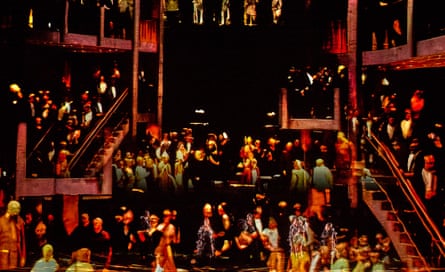
Michael Volle was a magnificent, stately Wotan and Wanderer, his power unforced. Klaus Florian Vogt was by turn Loge, Siegmund and Siegfried, in each case supple and darkly luminous with compelling diction. Elza van den Heever’s Sieglinde got better and better, blossoming in her love duet in Die Walküre. Camilla Nylund’s Brünnhilde was often wild and sometimes ungainly, but her impassioned lyricism and most intimate moments were deeply moving regardless. Mika Kares’s Hunding was all iron and velvet, his Hagen unleashing mighty, smooth torrents of sound – evil rarely sounds better. Gerhard Siegel (Mime) and Jochen Schmeckenbecher (Alberich) were more old-school baddies, respectively wheedling and raw. Peter Rose was a rather muddy Fafner and Christa Mayer wobbly but forceful as Erda and Waltraute. The Rhinemaidens, Valkyries and Norns were exquisitely balanced and as characterised as they could be without acting.
Conductor Christian Thielemann drew playing from the orchestra that was occasionally poorly tuned and even scrappy, but which at its best should have been captivating: details were finely balanced and tutti passages blistering, the brass rising like an immense wave from the pit or splatting nastily for the bad guys. Tempi were often brisk (only in Siegfried did this cause coordination problems, with Vogt left struggling to keep up) but there were also precious moments of spaciousness. Yet even the silence that Thielemann left in Wotan’s devastating monologue couldn’t stop the onscreen hyperactivity that instantly dispersed all dramatic tension.
There are numerous criticisms you could levy against this production from all manner of perspectives; there is, after all, something for everyone to dislike. But the most dismal was perhaps how unmoving it was – and how difficult it became to care.