.png) 1 month ago
57
1 month ago
57
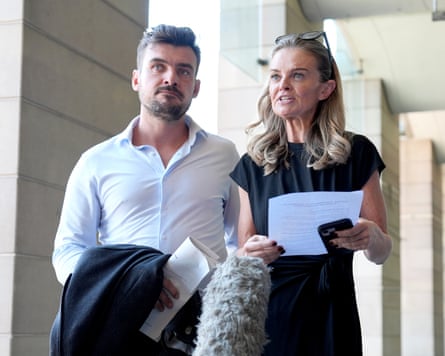
It has taken more than seven decades, but the grievous wrong done to Ruth Ellis has finally been recognised. Ellis was the last woman to be hanged for murder in the UK, the victim of a pitiless justice system that was uninterested in her history of horrific domestic abuse. The announcement of a posthumous conditional pardon is a tribute to the tireless campaigning of her family, including her granddaughter, Laura Enston. But it also highlights continuing shortcomings in how the criminal justice system deals with women who commit crimes after being treated horrendously by their partners.
In April 1955, Ellis shot and killed her lover, David Blakely, outside a pub in north London. The shock of a woman using a gun was so immense that she was portrayed as a cold-blooded killer, even though she had suffered a miscarriage – caused by a punch in the stomach from Blakely – only three months earlier. Her appearance worked against her, with her own lawyer worrying that her dyed blond hair and heavy makeup would prejudice the jury.
Even at the time, the death sentence caused misgivings. The novelist Raymond Chandler condemned the “medieval savagery of the law”, for instance. Over the following years, the case became symbolic of the way the law approached women who were themselves victims of serious and sustained violence. It never faded from public consciousness, becoming a cause célèbre for campaigners against capital punishment (which was effectively abolished in 1965) and feminists. In 1985, Miranda Richardson played Ellis in Dance With a Stranger; next month sees the publication of a novel based on the case, A Fatal Love by Louisa Treger.
The catalogue of crimes committed against Ellis – for which no one was ever prosecuted – included incest, child sexual abuse, rape and physical assaults. Ellis’s father began abusing her when she was 11. Her elder sister was impregnated by him and had a baby when she was 14. When Ellis got a job as a nightclub hostess in Soho, the manager of the establishment coerced her into sleeping with him. Ellis married a dentist she met at the club, a violent alcoholic with whom she had a daughter. There is very obviously a pattern here.
In 1953, while managing a club in Knightsbridge, she met Blakely, who was a racing driver, and became pregnant again. She had an abortion, which was illegal and dangerous at the time, but continued to see Blakely and another man, Desmond Cussen, who allegedly gave her the gun she used to kill his rival. The class difference between Ellis and Blakely, who had been to public school, was striking at a time when boundaries were entrenched.
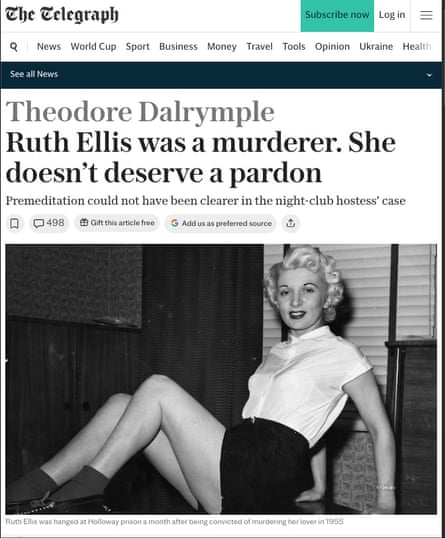
From a modern standpoint, Ellis is a classic example of a woman whose abuse in the family made her vulnerable to violent predators. Her story resembles that of the working-class girls trafficked by Jeffrey Epstein in the US, and some of the victims targeted by gangs of men in English towns and cities. The fact that such men seemed to operate with impunity for so many years raises questions about the way in which girls are still being let down – by the authorities, but also through the endurance of archaically misogynistic attitudes. Note the banner headline in Thursday’s Daily Telegraph: “Ruth Ellis doesn’t deserve a pardon”.
after newsletter promotion
Adult victims of domestic abuse are being let down too. In March this year, Women’s Aid reported that there is a severe shortage of specialist domestic-abuse services at a moment when demand is rising. Last year, almost two-thirds of women seeking a refuge place were turned away. One of the likely reasons is that the places are already filled by victims of abuse who have nowhere else to go. This is despite years of promises from politicians, who grandstand about supporting victims and punishing perpetrators.
As recently as 2011, judges were still imposing punitive sentences on women who were known to have suffered years of abuse. When Sally Challen was convicted of the murder of her abusive husband, Richard, she was jailed for life with a minimum tariff of 22 years – the same sentence, coincidentally, imposed on Shabir Ahmed when he was convicted of 30 child-rape offences in Rochdale. Challen’s sentence was later reduced to 18 years on appeal.
Her son, David, campaigned on her behalf, and in 2019 her conviction was quashed and a retrial ordered. The judge accepted that she had suffered “years of controlling, isolating and humiliating conduct” while her husband pursued multiple affairs. Prosecutors accepted a plea of manslaughter and Challen was sentenced to 14 years in prison, but released because of the time she had already served.
Ellis would now be seen as a victim of a series of violent, controlling men, but coercive control did not become a criminal offence until 2015, 60 years after her death. Her pardon should go some way towards easing the torment of her family, whose lives have understandably been overshadowed by the horror of her death sentence. However, 71 years later, the criminal justice system is still slow to take into account the crimes committed against women who end up accused of murder.
-
Joan Smith is an author, journalist and a former chair of the mayor of London’s violence against women and girls board
Do you have an opinion on the issues raised in this article? If you would like to submit a response of up to 300 words by email to be considered for publication in our letters section, please click here.