.png) 3 months ago
78
3 months ago
78
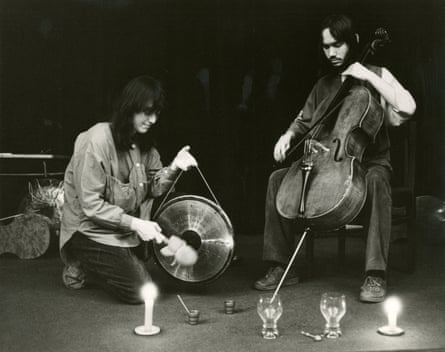
The Czech duo Irena and Vojtěch Havlovi often seemed out of time. From the mid-80s, the married couple filtered minimalist composition, ambient and folk through baroque instruments, honing their craft in Prague’s churches and monasteries to create a mysterious combination of modernism and old European music against a communist backdrop. After the Velvet Revolution in 1989, the Havels’ unhurried music didn’t rush to match the new pace of capitalism in the country. Instead, they would tour Europe by rail and bus, describing themselves as “pilgrims who wander and play”, as Vojtěch said in a 2009 documentary directed by Vincent Moon. Whether playing their string instruments or minimalist piano etudes for four hands, the pair merged into a symbiotic life-form.
The couple saw themselves as acting in service of the music, “of this energy between us and the audience”, said Irena. “Something that can only be shared together, going through us, when the ego is a little asleep.”
“They opened my mind to a different world of music, similarly to Steve Reich,” says the National’s Bryce Dessner, who became a tireless champion of the Havels: in 2013, he named a composition Little Blue Something, recorded with Kronos Quartet, in reference to their 1991 album Little Blue Nothing – a record that changed his life. “As a young musician, this music, which had elements of minimalism and aspects of medieval and Renaissance music but also an eastern sense of form and freedom, was very influential for me,” he says. “I often thought of their music as related to the music of Meredith Monk or even Moondog and Harry Partch, but there was something so individual and so mystical about it that it was hard to quantify.”
A 2021 archival collection, Melodies in the Sand, brought them much-deserved recognition in what would become the twilight of their career, but the couple retained their sense of mystery. In late March 2026, it was discovered that Irena had died in October, aged 66 – almost exactly a year after Vojtěch, who unexpectedly died of heart failure aged 62. The curator of the annual Anděl awards – the Czech Republic’s Grammys – checks the records of royalty collections agency OSA to see which musicians have died in order to prepare short tributes to them. When he saw Irena on the list despite there being no news of her death, he thought it was an error. He contacted Animal Music, the label behind the Havels’ last album; they called Irena’s brother, who confirmed the news. Her last wish, he said, “was to disappear in silence”, in service only to the music until the end.
The Havels met in 1983. Irena was a natural sciences student more inclined towards music who wanted to learn how to play cello; Vojtěch had just graduated from Prague’s conservatory for cello and piano. A few years later, they joined the experimental ensemble Capella Antiqua e Moderna, which led them through interpretations of European classical music to what would become their primary instrument, viola da gamba, and also schooled them in how the intertwined sound of Vojtěch’s tenor and Irena’s alto viol resonated in different spaces. They spent the later half of the decade in a trio with experimental folk musician Oldřich Janota, “learning to play tenderly, to do soft and silent things”, as Vojtěch once recalled.
The Havels, who continued as a duo after 1990, belonged to the loose scene of Czechoslovakia’s esoteric underground, which included their collaborator Janota, ambient musician Jaroslav Kořán and master of the Japanese shakuhachi flute Vlastislav Matoušek. The Velvet Revolution elevated this scene marginally further above ground. In the early 90s, these musicians would meet and perform in a newly founded national tearoom chain, Dobrá Čajovna, whose branches became hubs of alternative lifestyles and sound worlds in the new democratic state of the Czech Republic, established in 1993.
Spirituality had been restricted under communism; in the 80s, even perfumed leaf tea had been as rare a commodity as smuggled Brian Eno records. Now, the country was experiencing an influx of new age and meditative practices. The combination of ambient, minimalist loops and mysticism created a distinctly inward-facing sensibility, which was common for the esoteric underground the Havels were part of. Irena and Vojtěch were already yoga-practising vegetarians before the revolution, but once they could travel freely, the pair headed to ashrams in India and studied Hinduism. It translated into their music: Tibetan bowls and Indonesian gamelan featured on their 1992 album Mysterious Gamelanland, and on a collaboration with Indian-American trumpeter Rajesh Mehta in 1997.
The couple saw these sounds as intrinsically linked to their formative influences. “Bach and all those masters use minimalistic loops in their compositions,” Vojtěch told Rock & Pop magazine in 1995. “Early baroque music is slightly similar to Indian ragas; they are simple, all in one key. Similarly, gothic church choirs are close to Arvo Pärt. These are the roots of our music.”
It was around this time that the Havels accidentally entered Dessner’s life, after his sister Jessica heard them busking on the streets of Copenhagen in the early 1990s. The couple were trying to raise money for their first visit to India. Jessica “brought their album Little Blue Nothing home to Cincinnati, Ohio”, says Dessner. “They entered our house then and never left. Their delicate and deeply individual music became the soundtrack to our teenage years.” In 1996, Dessner, Jessica and their brother Aaron (also of the National) went to Prague in search of the Havels, but couldn’t find them. “After a few days of searching, we visited a jazz club where they often performed back then,” says Dessner. “We were told that they were often in India and, if not, that they lived outside the city and were rarely reachable. We were given a phone number and left a message, but years passed with no word.”
Dessner wasn’t the only one beguiled by the Havels. Jakub Juhás, who runs the Slovakian label Mappa, recalls watching them in the 2020s perform on “monumental, perfectly tuned organs, as well as on small, slightly worn-out instruments. In both cases I walked away equally awed.” Spencer Doran of Portland duo Visible Cloaks encountered their 1990 album Háta H at the legendary Sheyeye record store in Niigata, Japan, years later: “As you listen, you get the sense they were cordoning their practice off from the world, which allowed it to deepen and permeate into a very idiosyncratic space in a way that is quite uncommon in contemporary music,” he says.
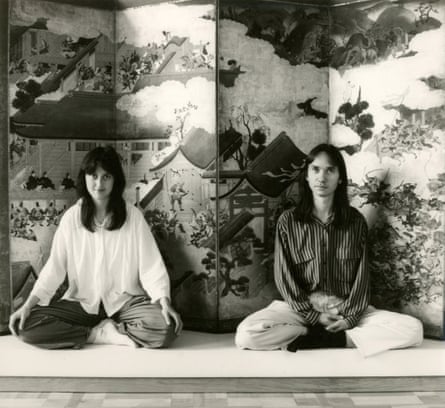
The mainstreaming of the internet suddenly opened up that space. When Dessner came across the duo’s website, he invited them to open for his friend Sufjan Stevens at MusicNow, the festival he co-founded back home in Cincinnati, in 2007. That year, Dessner introduced the Havels in the city’s 19th-century recital hall as his dearest inspiration. “It was an incredible moment to see the two of them with their transfixing music on stage, lit with candlelight only,” he says.
Dessner gave film-maker Vincent Moon a copy of Little Blue Nothing, and Moon remembers he “listened to it on repeat; it was impossible to know if it was recorded yesterday or 50 years ago”. In 2008, he made a film portrait of the Havels named after that album. “Through Bryce we found out their address outside Prague and they welcomed us into their universe,” Moon says about several days he spent with Vojtěch and Irena at their house near a forest. “They lived on the margins of society and were unique persons – very intense and pure, not a word I use very often.”
As their reputation slowly built abroad, the Havels remained relatively obscure at home. But the pair were always in service of music, not acclaim – they lived ascetically, cutting costs to a bare minimum. In the 2010s, they withdrew, mostly performing in Czech tea rooms, vicarages and countryside yoga retreats to small audiences, only occasionally at events in Berlin or Milan. They barely released new music and resisted uploading their work online, both being suspicious of technology.
The duo resurfaced with new compositions for the 2017 film Little Crusader, which earned them the prestigious Czech Lion film award for best music. “I’ve always searched for musicians who have a certain sense for the movement of characters or moments of silence rather than focus on narrative, and I found them in Vojtěch and Irena,” says the film’s director, Václav Kadrnka. He released the score – alongside the Havels’ music for another of his films – in 2022. “My movies are slow and contemplative, which is something their spiritual music helped to unfold.”
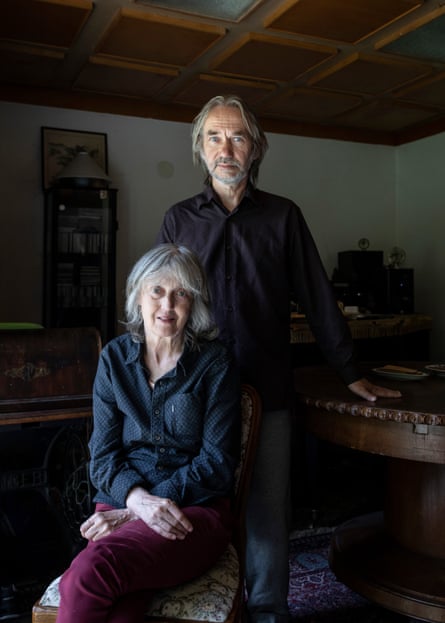
It was the start of a new phase: there were record reissues, celebratory broadcasts on online radio station NTS and, finally, the option of streaming their music. In 2024, they released their first album containing original material in more than a decade, in the shape of the gentle minimalist organ and piano cycles of Four Hands. “Young people really respond to our music. As if they need to open up, they often cry, and it stirs up their emotions,” Irena told Respekt magazine in 2022. The record became their last.
Czech singer-songwriter Václav Havelka was among their final collaborators, touring the Faroe Islands with Vojtěch in 2024 and releasing the collaboration Vanishing Mountain; Vojtěch’s cello parts are also featured on Havelka’s forthcoming album A Snake Crawling Up a Broken Ladder, arranged alongside guitar by Marisa Anderson and Ben Chasny of Six Organs of Admittance. Havelka counted Vojtěch as one of his closest friends. “His cello mirrored his inner life,” he says. “There was this tension, coming from deep concentration and attentiveness to the present moment. It wasn’t comforting, thus far away from so-called relaxation music.” In September 2025, he organised a memorial concert featuring like-minded musicians, in a Prague tearoom where the Havels played countless times.
Slovakian vocalist and composer Adela Mede is set to play at this year’s memorial. Mede discovered the Havels towards the end of their lives and was often booked for the same festivals. At a show organised by Mappa in 2024, she sang fragments of Hungarian folk songs along Vojtěch’s improvised cello and a broken organ, in a small gothic church “at the end of the world” in southern Slovakia. “The world stopped when Vojtěch played,” she says. “He carved space for Irena’s singing, who fostered tenderness with such courage.”
The Havels’ pilgrimage may have ended, but their unhurried, spiritual, humane music will continue to unmoor attentive listeners from time. Mede adds: “Playing music was for them like breathing.”