.png) 1 month ago
48
1 month ago
48
In many ways England should be grateful for small mercies. On an old‑style summer tour there would still be two more Tests to come against the formidable Springboks with scant prospect of a happy ending. As they prepare to regroup against Fiji this weekend, they have at least been spared a potentially grim 3-0 thrashing at the hands of the world’s strongest team.
Is it not reasonable, however, to expect the best resourced union in the world to be aiming significantly higher? On Saturday night there was hopeful talk of fine margins and South Africa being rattled in the second quarter. Given the final scoreline of 45-21 with England outclassed in many areas, it was not a conclusion universally shared back at home.
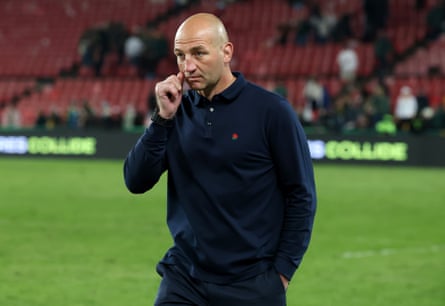
A fifth successive Test defeat certainly leaves the Steve Borthwick project under renewed pressure and mounting scrutiny. Lose in Liverpool this Saturday and the whole tower of Jenga will be in danger of collapsing. Senior officials at the Rugby Football Union, having backed the Borthwick regime to rebound positively from the fifth‑placed finish in the Six Nations, will certainly be praying the Fijians do not start strongly at Everton’s Hill Dickinson Stadium.
Because strip away all the top‑table platitudes and AI robot speak, and where is the evidence that England are steadily improving? In what aspects of the game are they consistently good? Why did it feel that South Africa were better organised, selected and coached – not to mention clearer‑eyed and better disciplined?
The Boks, let’s not forget, were lacking their inspirational captain, their star fly-half, a truckload of second-row forwards and a couple of key front-row bench options. England were without George Furbank and their absent captain, Maro Itoje, but could otherwise call on most of their key influencers. While all involved were frequently brave and dogged, they were down 17-0 inside the first 12 minutes. Few recover to beat South Africa from there.
To his credit the England fly‑half Fin Smith was among those to acknowledge as much. “For us to start as poorly as we did was frustrating. I thought we were soft defensively, missed a lot of tackles and ultimately they scored quickly when they got into our 22.”
There was also a dispiriting sense of deja vu about the late yellow cards shown to Tommy Freeman and Guy Pepper that took England’s tally to 10 this year. “It just got away from us,” Smith said, referencing England’s damaging ill discipline. “It is hard not to think that has happened a few times in the past couple of months.”
Composure and the aerial game will certainly be a focus this week but they feel symptomatic of a broader issue. How come Felix Jones was having so little fun with England that he jumped at the chance to rejoin South Africa’s brains trust? Why was Joe Lewis, England’s top analyst as recently as March, allowed to switch camps and take with him a significant amount of inside knowledge? No wonder South Africa had uncanny success in probing England’s weaknesses.
Throw in Tony Brown’s striking contribution to South Africa’s ever-improving attacking game and Rassie Erasmus’s magpie’s eye which is unquestionably adding to the shining talent at his disposal. England, by contrast, have a relatively inexperienced roster of coaches at the highest level and a head coach more comfortable with data than human chemistry. Which is all well and good until the time comes to press the kind of artful emotional buttons that are the stock in trade of, say, Andy Farrell or Shaun Edwards.
Borthwick’s record against the three biggest southern hemisphere sides since taking over from Eddie Jones at the end of 2022 also tells its own story: there have been six defeats in eight attempts with the two victories coming at home against a knackered Australia and a disaffected New Zealand respectively. With their other Six Nations rivals – France, Ireland, Scotland and maybe even Wales – on an upward trajectory, England are starting to look becalmed just over a year before the 2027 World Cup.
after newsletter promotion
In no particular order their best back-row and midfield combinations remain unclear – no pressure on Bristol’s Benhard Janse van Rensburg, who becomes eligible this week – several potential French-based gamechangers are off-limits because of RFU red tape, the deal with the Prem clubs allowing Borthwick greater control over his top players is yet to bear obvious fruit and public faith is ebbing away again.
Expectations of beating South Africa at Ellis Park were never massively high but the gripping 48-46 defeat against France in Paris in March looks increasingly like an outlier in England’s stumbling recent run. The confidence associated with the team’s previous 12-Test unbeaten sequence has begun to evaporate, with in-form club players operating in a system and environment that is not bringing the collective best out of them.
Apart from that everything else is fine and dandy. There remains every chance of England beating Fiji and then seeing off Argentina in Santiago del Estero to stem some of the bleeding from Ellis Park. But squinting into the southern African sun en route to the airport, it was harder to envisage a triumphant English World Cup campaign than when the squad touched down in Johannesburg 10 days earlier. That nagging truth alone should be focusing minds at the RFU.