.png) 3 months ago
82
3 months ago
82
Starmer warned of £28bn defence funding shortfall
Keir Starmer has been warned by the UK’s top military chief that the Ministry of Defence (MoD) could face a £28bn funding shortfall in the next four years, PA Media reports. PA says:
Air Chief Marshal Sir Richard Knighton reportedly told the prime minister that an MoD assessment made last year showed a £28bn shortfall between now and 2030.
The chancellor and defence secretary were also at the meeting in the run up to Christmas, as first reported by the Times and the Sun newspapers.
The news is thought to have prompted Starmer to order an overhaul of the defence investment plan (Dip), which has been delayed after first being expected in the autumn.
The Dip will set out how the strategic defence review is to be delivered.
A government source said the UK is “on track” to fulfil the commitments outlined in the review.
Knighton took over as chief of the defence staff in September and is responsible for the delivery of the strategic defence review published in June, as the UK has pledged to boost defence spending to 2.5% of GDP by 2027.
The review also set out a goal to raise spending to 3% in the next parliament “when fiscal and economic conditions allow”.
An MoD spokesperson said: “The UK defence budget is rising to record levels as this government delivers the biggest boost to defence spending since the Cold War, totalling £270bn this parliament alone.
“Demands on defence are rising, with growing Russian aggression, increasing operational requirements and preparations for a Ukraine deployment.
“We are working flat out on the defence investment plan, which will fix the outdated, overcommitted, and underfunded defence programme we inherited.”
Key events Show key events only Please turn on JavaScript to use this feature
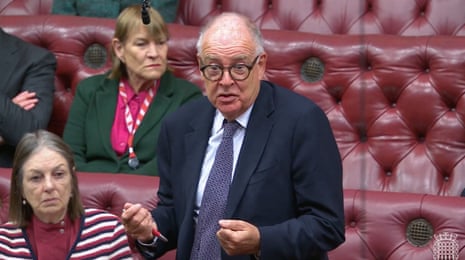
Peers urged to avoid long-winded speeches as they resume debate on assisted dying bill
Peers are this morning resuming their debate on the assisted dying bill, after last night approving a motion saying the Lords should devote “further time” for the bill so that it can return to the Commons “in reasonable time before the end of the current parliamentary session”.
Lord Falconer, the former Labour lord chancellor who is charge of the private member’s bill in the Lords, took the unusual step of tabling the motion yesterday because, at the current rate of progress, there seems very little chance of the Lords debating all the amendments to the bill in time for it return to the Commons and become law before this session of parliament ends in the spring.
Supporters of the bill believe that a small number of peers opposed to assisted dying are filibustering so that the bill fails due to lack of time. In the Lords, unlike in the Commons, the government cannot guillotine debates on legislation so they have to wrap up within a deadline, and this means timetabling arrangements in effect rely on cross-party consensus.
Today is the fifth committee stage debate in the Lords. In the debate last night, Falconer said:
Over 1,000 amendments in committee have been tabled, arranged into approximately 84 groups. So far, we have spent in total some 32 hours in this house scrutinising the bill, and we have another 50 hours scheduled.
However, in four days of committee – about 17 hours – we have considered only 10 groups. If we continue at the rate we are going, this house will fail to complete the process of scrutiny.
Falconer’s motion was approved without a vote. But it is not binding, it is not clear yet what practical impact it will have, and some Tory peers in the debate rejected claims that that the bill was being given too much time.
Michael Gove, the former Tory cabinet minister, said:
This house is more respected, not less, for giving extensive scrutiny to this bill. I think it would be a sad day if those of us who believe in exhaustive scrutiny and extensive debate were to be told that that was not in our best traditions.
And Lord Shinkwin, another Tory, ended his speech saying:
I am reminded of a wonderfully wise Scottish saying from the 16th century, which I believe this bill shows has stood the test of time: “You can’t make a silk purse out of a sow’s ear”. Our procedures are being followed appropriately and reasonably. If any bill is so poorly drafted and so unsafe, surely the question is not so much whether the bill deserves more time, but whether yet more time could transform it.
Friday debates on the bill have started at 10am and finished at around 3pm. That is the plan again for today, but, in the light of the motion agreed last night, some future committee stage debates could be extended.
At the start of proceedings this morning Lord Kennedy of Southwark, the government chief whip, urged peers not to make “long, second reading speeches going way beyond the substance of the amendments under debate”. He also said he said he hoped “substantial progress” on the bill would be made today.
There is a live feed of the Lords debate here.
Starmer warned of £28bn defence funding shortfall
Keir Starmer has been warned by the UK’s top military chief that the Ministry of Defence (MoD) could face a £28bn funding shortfall in the next four years, PA Media reports. PA says:
Air Chief Marshal Sir Richard Knighton reportedly told the prime minister that an MoD assessment made last year showed a £28bn shortfall between now and 2030.
The chancellor and defence secretary were also at the meeting in the run up to Christmas, as first reported by the Times and the Sun newspapers.
The news is thought to have prompted Starmer to order an overhaul of the defence investment plan (Dip), which has been delayed after first being expected in the autumn.
The Dip will set out how the strategic defence review is to be delivered.
A government source said the UK is “on track” to fulfil the commitments outlined in the review.
Knighton took over as chief of the defence staff in September and is responsible for the delivery of the strategic defence review published in June, as the UK has pledged to boost defence spending to 2.5% of GDP by 2027.
The review also set out a goal to raise spending to 3% in the next parliament “when fiscal and economic conditions allow”.
An MoD spokesperson said: “The UK defence budget is rising to record levels as this government delivers the biggest boost to defence spending since the Cold War, totalling £270bn this parliament alone.
“Demands on defence are rising, with growing Russian aggression, increasing operational requirements and preparations for a Ukraine deployment.
“We are working flat out on the defence investment plan, which will fix the outdated, overcommitted, and underfunded defence programme we inherited.”
Labour chair claims pub business rates rethink not a U-turn, but ‘sign of confident government’ that is listening
Good morning. Yesterday it emerged the government is going to significantly revise some of its budget plans with a financial support package to help the pub industry. Pubs say that, without extra help, they will be hammered by extra business rates costs contained in her budget. In her speech to MPs in November, Rachel Reeves, the chancellor, implied she was cutting business rate costs for this sector. She told the Commons:
For business rates, I will introduce permanently lower tax rates for over 750,000 retail, hospitality and leisure properties – the lowest tax rates since 1991 … paid for through higher rates on properties worth £500,000 or more, like the warehouses used by online giants.
But the gains for pubs from the reduction in headlines rates were more than wiped out by the reduction in Covid-era reliefs, and the impact of a three-yearly revaluation, coming into effect in April 2026, which has led to big increases in the rateable value of many pubs. As Kiran Stacey, Peter Walker and Rob Davies report, Reeves is responding to weeks of protest from the pub sector by revising her business rate plans.
The details have not been announced, but government sources have confirmed that a significant rescue package is coming soon.
Almost all media outlets have described this as a U-turn, and that is consistent with the usual meaning of the word. While Reeves is not implementing a 180-degree reversal of what she announced on business rates in November, this seems to be more than a minor tweak, and it sounds like a significant change from the policy she announced in her keynote annual announcement only six weeks ago.
But ministers don’t like this word, partly because it is pejorative, and partly because the government has now established a reputation for U-turning regularly on big, headline policy issues, like cutting winter fuel payments, cutting disability benefits, and subjecting farms to inheritance tax. Anna Turley, the Labour party chair, has been doing an interview round this morning and she has been claiming this isn’t a U-turn. She told Sky News:
I don’t buy this is a U-turn. This is actually about listening. I think it’s a sign of a government that is actually in touch with people, that is listening to people, and that is responding.
I think listening to constituents isn’t being bullied or lobbied – that’s what we’re here to do.
We’re here to represent the people that we live amongst and, if a policy isn’t right, I think it’s a sign of a confident government that says, ‘do you know what? we’ll step in, we’ll sort it out, we’ll make sure it works’.
This is a perfectly reasonable argument, although it might have made more sense for Turley to argue that, because responding to public concerns is a good thing, U-turns can be positive, and this is a good example, not that this isn’t one. All governments perform U-turns, and normally the pain from the short-term political embarrassment is offset by the gain from the long-term removal of a political problem.
But Keir Starmer is vulnerable to the charge that he is U-turning so often he looks weak.
There is not much on the agenda today. The Commons is not sitting. But peers are debating the assisted dying bill again (more on that soon), and Downing Street has a lobby briefing at 11.30am.
If you want to contact me, please post a message below the line when comments are open (normally between 10am and 3pm at the moment), or message me on social media. I can’t read all the messages BTL, but if you put “Andrew” in a message aimed at me, I am more likely to see it because I search for posts containing that word.
If you want to flag something up urgently, it is best to use social media. You can reach me on Bluesky at @andrewsparrowgdn.bsky.social. The Guardian has given up posting from its official accounts on X, but individual Guardian journalists are there, I still have my account, and if you message me there at @AndrewSparrow, I will see it and respond if necessary.
I find it very helpful when readers point out mistakes, even minor typos. No error is too small to correct. And I find your questions very interesting too. I can’t promise to reply to them all, but I will try to reply to as many as I can, either BTL or sometimes in the blog.