.png) 2 months ago
72
2 months ago
72
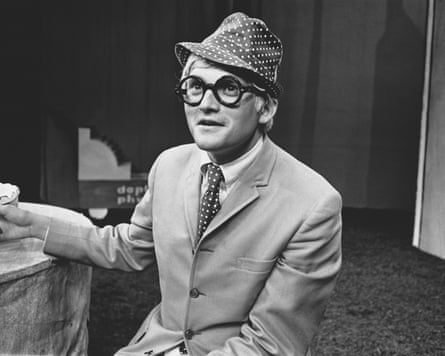
Tate Modern’s Turbine Hall will be transformed into an immersive opera house as it plays host to an exhibition featuring the sets David Hockney designed for productions of works by Mozart, Wagner and Stravinsky dating back to the 1970s.
The art form might be considered passé by Timothée Chalamet, but Tate is to use the sets as the centrepiece of its celebration of Hockney’s 90th birthday in 2027.
Better known for his landscapes and portraits, Hockney worked on several opera sets going back to his time in London before he moved to Los Angeles.
After trying set design at the Royal Court for a production of Alfred Jarry’s Ubu Roi, Hockney would go on to design others, including for Richard Strauss’s fantasy opera, Die Frau ohne Schatten – The Woman without a Shadow – that embraced a pop-art aesthetic.
He produced 11 opera sets in total over 17 years, starting in 1975.
When asked why he had decided to start working on set designs, his answer was characteristically matter of fact. “I wanted to design operas because I want to have something to look at,” he said.
The rest of Tate’s 2027 programme includes a retrospective of Sonia Boyce, who won the Golden Lion for Britain at the Venice Biennale in 2022, and an Edvard Munch show. Tate Liverpool will reopen with a career-spanning show by Chila Kumari Singh Burman, a contemporary of Boyce’s who hung neons outside Tate Britain in 2020.
There’s also a first-ever Monet show at Tate Modern, called Painting Time, which focuses on the artist’s “obsession with capturing the instant”, according to its curator, Catherine Wood.
The exhibition charts the lead-up to the artist’s famed Water Lillies cycle, which spanned a 30 years from the 1890s – when he was suffering with cataracts but still painting in his garden in Normandy – until his death in 1926 at the age of 86.
“What comes across is how embodied and how immersed he was in cultivating the garden and then capturing it,” she said. “Even as he’s going blind, he’s still trying to paint.”
Created in collaboration with Musée de l’Orangerie in Paris and using loans from individual and institutional collections, Wood said the show would be a fitting way to revisit Monet, whose painting was paired with a Richard Long piece when Tate Modern opened in 2000.
Other highlights from the season at Tate Britain include a 120-work Gainsborough exhibition to mark the 300th anniversary of the artist’s birth, and the first major presentation of Tudor art in 30 years.
At Tate Modern there are landmark shows for Baya, the female Algerian artist who influenced Picasso, India’s Nalini Malani and the US sculptor Lynda Benglis, who embraced latex and Day-Glo pigment in her work.
The announcement of the forthcoming season comes in the same month that Maria Balshaw departs Tate after nine years in charge of an institution in transition.
Karin Hindsbo will be in charge while the next director is recruited. Balshaw’s permanent successor is expected to be announced this summer, an appointment that needs to be signed off by the prime minister.
Hindsbo said: “This is an exhibition programme that only Tate could deliver. It spans the centuries, from the 1500s to the present day, and it spans the globe, from Europe to Asia, Africa and America.
“Even more importantly, the programme reflects a deep appreciation of artists themselves. All these exhibitions showcase the many different ways that artists think and work, and their unique ability to inspire and move us.”