.png) 3 months ago
74
3 months ago
74
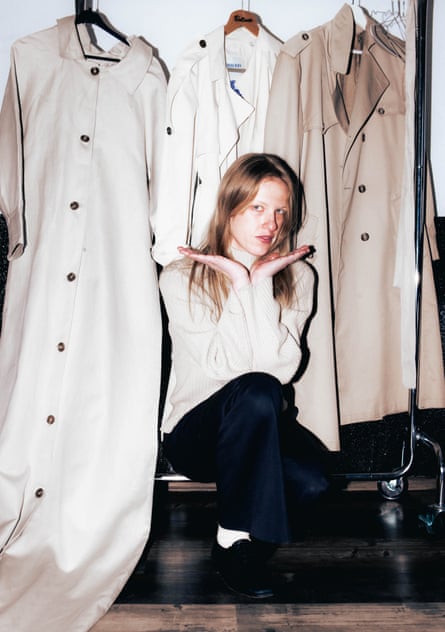
Backstage at the Berlin venue Huxleys Neue Welt, Audrey Hobert is showing me around her dressing room. On the 27-year-old pop star’s second time outside the US, the novelty of having local snacks on the rider hasn’t dimmed, although her enthusiasm for chocolate thins can’t distract from what’s going on across the room. A comically overlong beige trenchcoat hangs on a rail, the excess length puddling on the floor. Two sets of joke-shop Groucho Marx glasses sit on the dressing table, the original black brows and moustache replaced with orange fluff to blend with Hobert’s vivid strawberry blond. “Those glasses are not flattering,” says Hobert. Having matching hair under the giant plastic nose, she says, “makes it more flattering”.
In a few hours, Hobert will start her set standing on a ladder that is concealed by the coat, wearing the glasses, miming on a prop banjo and singing a peppy song about charming strangers called I Like to Touch People. After it ends, the lights dim, Hobert climbs down and swaps to a regular-sized trenchcoat. Despite the changeover being entirely visible, the lights come back up as if to say “Hey presto!” – the trompe l’oeil of high-budget pop stagecraft remade as slapstick.
Steve Martin walked away from standup in 1981, but the wild and crazy guy’s spirit is alive in an admiring US songwriter born in 1999. “I just wanna amuse people,” says Hobert, taking the sofa, a live wire of delight and total focus in a pink T-shirt, vintage brown coat and dregs of nail varnish.
The jokey presentation – the long coat suggests the classic “three kids pretending to be an adult” gag – might suggest this is just a lark. Hobert’s pop career happened by accident. She had never written songs before moving in with her childhood best friend and pop superstar Gracie Abrams. A collaboration they started on a whim ended up contributing six songs to Abrams’ platinum-certified second album, The Secret of Us. “It was complete kismet,” says Hobert. “Best time of my life.” Witnessing those songs blossom in the producer Aaron Dessner’s studio made Hobert – a screenwriting graduate who was then working on a Nickelodeon show – wonder about pursuing songwriting. “I’d never had this feeling before.”
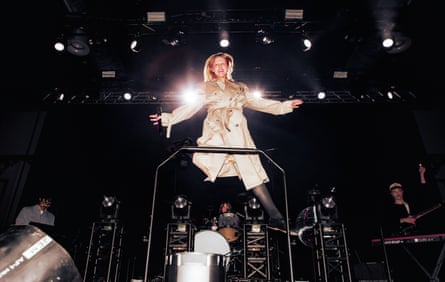
She tried and disliked session writing and started writing songs that she knew she had to sing. Unlike the indie-pop melodramas she wrote with Abrams, Hobert’s pop is breezy yet lyrically dense and funny, as if someone had unearthed a lost Stephen Sondheim musical set to the sounds of Y2K MTV. “I’m always trying to best myself,” Hobert says of her addictive delivery. “I have a lot to say and I’m very rhythmic. I like flow. Taylor Swift, that bitch has flow.” She signed to RCA for her debut solo album, last year’s Who’s the Clown?, in which Hobert lasers in on the absurdity of awkwardness and desire: “Touching my leg / You don’t have a headboard / Do that again / I think that I want more,” she sings on Sex and the City of a very un-Carrie hook-up in a classic male living space.
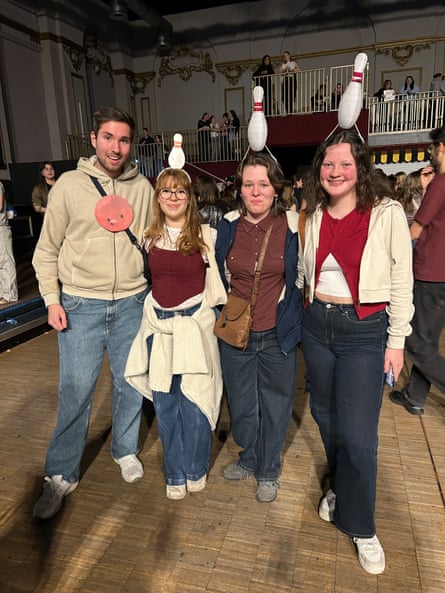
Her fandom is cultish: on Reddit, one girl wondered, endearingly, what she should wear, because “it’s hard when the vibe is so new”, although the queue outside the venue is full of young women in their own trenchcoats. One group have bowling pins on their heads, riffing on Hobert’s song Bowling Alley. But all signs point to Hobert blowing up as the next big pop star. She’s coolly pragmatic about how her career is exploding. “I feel lucky, because I’m in my mid-20s and so I’m way more fully developed than a lot of people are when they start out doing this,” she says. “I think it should be illegal for a 16-year-old to go into a label meeting and pitch themselves as an artist. But I’ve always felt with this that I have nothing to lose because I only wanted this career as of recently.”
But she’s also exactingly intentional, referring to herself more than once as a “good-natured control freak” with a complete vision: “What I have been working towards my whole life,” she continues, “is having a platform where I can express myself and inspire others.” She actively wants to be a role model for outcasts. “I think I’m well suited, because I do have insecurity and question myself, but I believe it is less than other people do.”
Growing up in Los Angeles, Hobert craved validation as a writer: her screenwriter dad worked on shows including Scrubs. She recognised that she had an ear for language. “I would listen to people try to express themselves and I could repeat it back to them in a sharper, articulate way,” she says. “It’s still my favourite thing to do.” She looked up to showrunners such as Lena Dunham, “writing, directing and starring in a fantastic show about what it’s like to be young in New York” – namely Girls, which inspired Hobert to move there to study screenwriting.
Hobert turned 21 in February 2020, weeks before lockdown hit, and had to finish her studies at home. At first, hanging out with her three younger siblings and parents was a dream. When that faded, “it was really suffocating”, she says. After two years at home, she spent a year moving around, also dealing with the trichotillomania – hair pulling – she developed in high school, so severe that it was only a year or two ago that she started to feel “normal about the state of my hair” again. Back then, she says, “I was dealing with bald spots, living next to a freeway and wishing life would improve. I would ask myself: how are you going to get smarter, push your life forward?” When she moved in with Abrams, she says, “I felt like I’d arrived”.
Despite starting out collaborating, Hobert never had to work to discover her own songwriting voice, happily writing songs alone in her flat for days at a time. “What came to me was knowing that it could be whatever I wanted, and that as long as I was tickled by what I was saying, that was all I needed,” she says. Idiosyncratic artists such as Steve Martin and the playwright Annie Baker showed Hobert her path. “Could anyone else do what Joe Pera does? What Nathan Fielder does?” she says of the offbeat US comedians. “That is what draws me to other artists – only this person can make this thing.”
There was, however, a gulf between writing her wordy lyrics and actually singing them: Hobert is still learning breath control. “The beast inside me wants to move, but I know that I have to pick and choose my battles,” she says. Taylor Swift famously prepped for the Eras tour by singing the three-hour set list running uphill on a treadmill. Hobert has not yet been able to do that, “because I go to a public gym”.
There’s a lot of dutch courage in Hobert’s songs as her introverted protagonists try to let life happen to them: “When I’m drunk at the club I wanna be felt up,” she sings on Shooting Star. It counters the image of the pandemic generation as phone-addled hermits in a sex drought. “The generalisation that people don’t go out, don’t talk to each other, is bullshit – and it’s also not,” she says. “It’s the thing that makes me most existentially worried for people my age and younger.” That’s why she curtails her phone usage. “I would rather stare at the wall, because I feel like it’s a better use of my time.”
Hobert says she has experienced social anxiety, but always forced herself to “conquer those feelings and go out. I think it’s kind of lame when you can’t do that. If you struggle with anything that might prohibit you from being alive in the world, the world’s not going to make things more comfortable for you, and you’re never gonna grow unless you throw yourself into something hard. How free are you gonna let yourself be? Doesn’t matter who you are.”
She seems to have an enviable ability not to limit herself. Her song Phoebe is about happily relating to the Friends lead who got the least romantic storylines. “From a young age, I didn’t feel desired in that way,” says Hobert. “My fix for that was never to change myself, but to figure out how to like myself more. It’s the one true mission of this career for me, to help others with that. It sounds corny, but you can be the best version of yourself, and you can live a life that feels free of suffering, by complete acceptance.”
I love how much Hobert sings about desire – “Sue me, I wanna be wanted,” she repeats endlessly on her breakout single, Sue Me – versus her total disregard for conventional portrayals of desirability, from the Groucho glasses to the fantastically leggy dancing and comic timing in her self-directed videos, worthy of the comedians John Wilson and Patti Harrison. Still, online, people called her “weird”, which got in Hobert’s otherwise steady head and prompted her to get off social media. The most “harrowing” thing about this career, she says, is being endlessly filmed and perceived. It says something about the limited perceptions of femininity that even a tall, blond, slim, striking pop star is considered odd for not trading on her sexuality. “If I wanted to get in some sort of class that would show me how to be more polished, I could do that tomorrow,” says Hobert emphatically. “I have all of the resources, but it’s not what I’m interested in in pop music right now.”
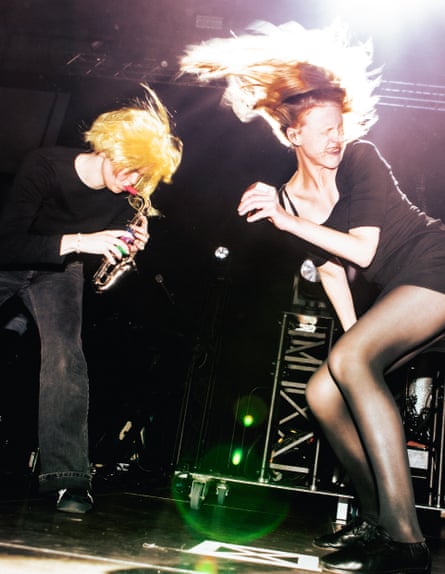
Some of her fellow female pop stars, she theorises, “would probably rather look robotic and perfect so as to spare themselves from how awful and scathing [online commentary] can be than to maybe try to have a visceral, insane experience on stage.” She worries, as a newbie, about talking out of line. “But what moves me when I watch a performance is when there’s none of that awareness of, like” – she makes her words staccato – “‘Huh, let me – move my – eyebrow – up – and then I’m – gonna blow – a kiss.’” She says she would rather be “perceived from the time I’m learning how to perform on stage” right through to the point in a few years “when I’m really dialled. But, like everything else in this career, I need to figure it out for myself and would like not to be told what to do.”
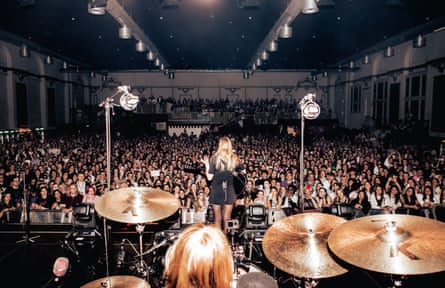
Tonight’s gig speaks as much to Hobert’s chops as a comedian as a pop star. For the encore, she does the addictive Sue Me twice, bouncing on a mini trampoline with the manic enthusiasm of a model in a panty liner ad, and demands that everyone pockets their phone the second time. At the end, she shrugs: “OK, I’m outta here,” and French-exits as the band finish the song.
Hobert is grappling with growth on her own terms. “Sometimes I wonder if I need to get bigger at all, if that would make me happy,” she says. “But I’ll probably try to.” Her song Chateau detailed her civilian distaste for the celebrity parties she tagged along to with Abrams. Now, she admits, “I’m less of a fly on the wall than I used to be. I’m hoping that I figure out how to write about that.” She’s relieved that musician friends have reassured her that the second album is the hardest – she “technically” has some new material in the green notebook in front of us, “but you would be seeing a very different, more excited reaction if I had anything that felt more concrete”, she says.
After her tour ends in Ireland next week, Hobert is staying on for a few days to write in much-needed solitude – something that’s disappearing now she has “way more important relationships”, including a newish boyfriend. “The tortured artist thing, that you can only write your best work when you’re in a state of suffering – I have been working tooth and nail to tell myself that’s not true, because I don’t want to sabotage anything good in my life for the sake of my art,” she says. Hobert and Abrams will continue writing together and she still wants to live her screenwriter dream. After Who’s the Clown? came out, she was invited to several meetings about writing for film. “I mean, what a dream. But I feel like the opportunities that I’ll have in the film and TV world will only be better if I just do this” – music – “really well at least one more time.”
Overall, Hobert likes that she’s “not worried” about her career. “I think a big engine of getting bigger comes from a worry that it’s gonna go away or that people are gonna forget about you. And I feel OK with whatever happens. None of this feels very serious. I just try to exist and have as much fun as I possibly can. It’s made this whole career, which can be very stressful and draining, very fun and exciting and not draining at all.”