.png) 3 months ago
77
3 months ago
77
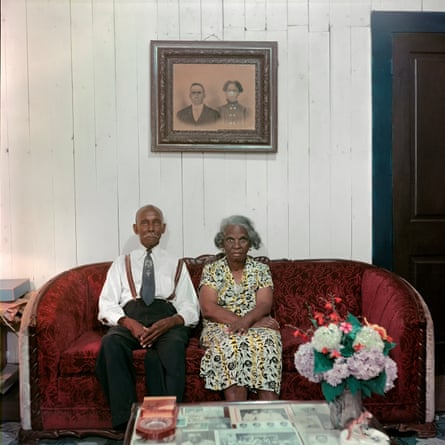
In the summer of 1956, the American news magazine Life dispatched its first Black staff photographer, Gordon Parks, to Alabama, with a brief to document racial segregation in the wake of the Montgomery bus boycott. The trip was a perilous one, but Parks, then in his early 40s, was already on a career trajectory that would mark him out as one of the most consequential artists of his generation. The images he returned with were remarkable: intimate and vivid depictions of the daily disgrace of the Jim Crow south. They still feel prescient today.
The photographs form the backbone of a new survey of Parks’ work, opening this week at the Alison Jacques gallery in London and curated by Bryan Stevenson, the famed civil rights attorney. Stevenson is based in Montgomery where he founded a museum and memorial to commemorate Black victims of lynchings and where some of Parks’ work hangs on permanent display. He selected images taken between 1942 and 1967, the artist’s most active time as a photographer and an acute period of unrest in the American experiment.
For Stevenson, the new show resonates particularly as Donald Trump’s second presidency intensifies a renewed historical revisionism guided by forces of white nationalism and censorship. “We are living at a time where there’s tremendous retreat from the civil rights era,” Stevenson tells me. “In a moment when content is being removed from cultural institutions across the United States, when there is resistance, even contempt, for anyone who tries to talk honestly about this history, this exhibit is both timely and urgent. Because it speaks to the way Parks confronted these very same circumstances at a time when there was no precedent for this kind of art as a weapon for change.”
The images from Parks’ Alabama assignment partly followed a single extended family, the Thorntons, in the segregated coastal city of Mobile. Shot in colour, they capture the family’s dignity in the face of everyday brutality – at water fountains, department stores and restaurants all governed by the “separate but equal” doctrine. At a time when most of America was exposed to news photography in black and white, the striking, bright contrasts and soft pastels lifted the narrative to another level.
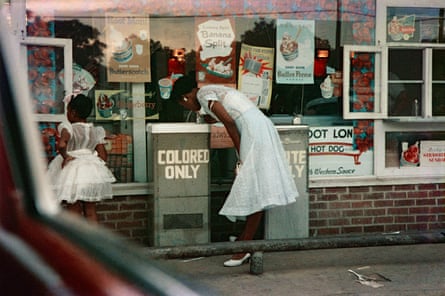
“Most people only saw this community fighting segregation in this very two-dimensional way,” Stevenson says. “And I think Parks understood that it was much more dynamic, much more artistic, much more interesting than those images could sometimes capture. The use of colour really animated the harm in ways that had been missed previously.”
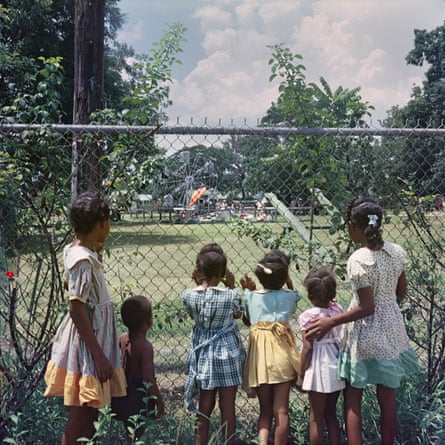
One image, titled Outside Looking In, depicts a group of Black children peering through a chain-link fence on to a manicured, whites-only playground in the distance. “It has deep resonance for me because I grew up in a community where there was segregation,” Stevenson says, recalling a childhood trip to South Carolina when he and his sister were racially abused for entering a motel swimming pool frequented by white children. “When I see those children staring, it brings back my own experience. It has a lot of power because it gets to the subtle harm of exclusion that I don’t always think we talk about.”
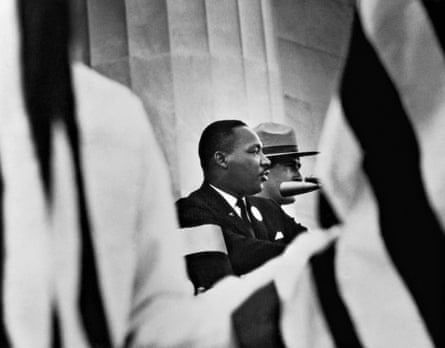
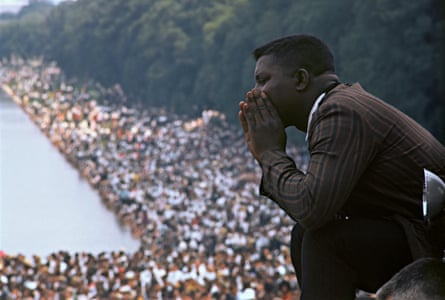
The new display extends well beyond Alabama, however, taking in work from Parks’ assignments documenting poverty in Harlem in New York, his time spent photographing Malcolm X and the Nation of Islam, his shots of jails across the country, and his images from the March on Washington in 1963. There remains something pertinent about Parks’ photographs from that day: despite the event’s sheer scale and widespread coverage, his images have a unique intimacy. Martin Luther King Jr – who delivered his famous I Have a Dream speech at the event – is captured from a distance standing at the lectern, framed by the outline of a rippling flag. In another shot, an onlooker sits above the crowd shouting out across the masses.
“Because Parks had experience of the bigotry being challenged during that march, he really looked for the human narrative,” Stevenson says. “People weren’t just participants, weren’t just ‘protesters’ or ‘marchers’ – he wanted to show people as mothers and fathers, sisters and brothers, as pastors and people who are trying to live their lives. I think he saw in Dr King, yes, an incredible leader, but he also saw a human being just wanting his children to be able to live in a world where they weren’t going to be presumed dangerous or guilty because of their race, where they weren’t going to be burdened in the same way he was.”
Parks was born in 1912 in Fort Scott, Kansas, in the era of segregation and mass lynchings. The youngest of 15 children, he attended segregated elementary school and recalled, at the age of 11, being attacked by three white boys who threw him into a river believing he could not swim. At the age of 14, after the deaths of his parents, he moved to St Paul in Minnesota (neighbouring Minneapolis) to live with his sister. He did not turn to photography until his late 20s, having taken an array of jobs, from a brothel pianist to a travelling railway waiter. His break came in 1942 when he was hired as a documentary photographer by the Farm Security Administration (FSA) in Washington DC.
It was here that Parks captured perhaps his most noted single image, a portrait of Ella Watson, the part-time cleaner he profiled for months in the nation’s capital as she raised her grandchildren alone in poverty. Watson’s father had been murdered by a lynch mob and her husband was shot dead two days before the birth of their second daughter. The image, titled American Gothic, is of Watson standing in the corridors of power, staring out while holding a broom and a mop in front of the US flag.
It was deemed too confronting to publish at the time. Stevenson has naturally included it in his curation, describing it as a manifestation of the themes in much of Parks’ canon. It is, he says, “a story of trial and tribulation, but also triumph and dignity”.
Parks would later become the first Black director to lead a major Hollywood production, a dramatisation of his semi-autobiographical novel The Learning Tree, released in 1969. Two years later, he directed the crime thriller Shaft, which helped take the blaxploitation genre into the mainstream. In 2007, a year after his death, a school in St Paul was renamed in his honour. The building is just a few miles from the neighbourhood where Renée Good and Alex Pretti were shot dead by immigration agents earlier this year, and where George Floyd was murdered by a white police officer in 2020.
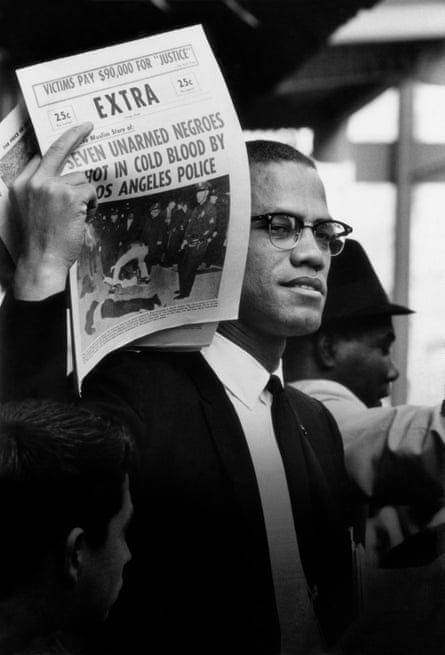
I ask Stevenson how, if he were alive today, Parks might have wanted to document this moment of violence and repression in the city where he came of age. “I think he would have wanted to remind people that this is not unfamiliar, this is not new,” he says. “He was in urban spaces after Dr King was assassinated. He saw the anger and frustration. He was around people asking all the time: ‘How do we change things? How do we confront a government that is so hostile to us?’ He spent time with members of the Nation of Islam, the Panthers – they were the targets of the FBI and the Justice Department, sometimes lethal victims of that targeting. He had a very keen eye for that. He understood that.”
Parks famously described his camera as his “weapon of choice” against the social injustices he encountered. It is a maxim that holds true in Minneapolis today; the killings of Good, Pretti and Floyd were all captured on camera by citizen observers, which helped propel the issues of extreme immigration enforcement and racially biased policing across the world. But the power of this weapon is being tested like never before. As the ability to manipulate images with AI becomes ubiquitous, used even by the White House to disseminate digitally altered propaganda photos of protesters, does Stevenson believe Parks’ worldview may be under threat?
“I think technology and social media create new challenges for truth telling,” he says. “But I still think a camera can be a powerful weapon – in the hands of a gifted storyteller, which is what I saw Gordon Parks as. He was an artist beyond his skill at taking a photograph. It was his vision – creating a story around the image – that allowed viewers to experience something they may never have experienced before. It will ring true in ways AI stuff won’t. That’s the power of storytelling with art.”