.png) 2 months ago
61
2 months ago
61
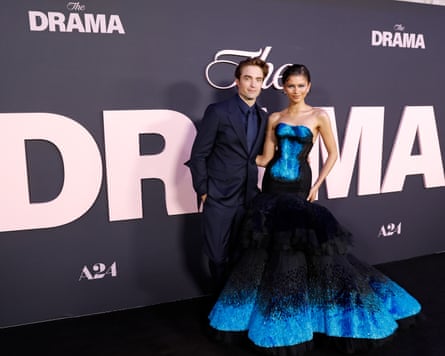
Ever since its first trailer dropped – and, on certain corners of Reddit, even before that – the internet has been abuzz with speculation over just what goes down in The Drama. The auteur production powerhouse A24 somewhat ingeniously pitched writer-director Kristoffer Borgli’s pitch-black film as a tart romantic comedy, with Zendaya and Robert Pattinson as a seemingly happy couple derailed by a disturbing revelation a week before their wedding. The actors, among a cohort of vanishingly few young movie stars, appeared as their characters in a fake wedding announcement in the Boston Globe; Zendaya’s rumored marriage to actor Tom Holland became a meta discussion point on a press tour that saw her method dressing in “something old, something new, something borrowed, something blue”, her wardrobe slowly darkening in a nod to something gone horribly awry.
The Norwegian film-maker’s second English-language film depicts what we could loosely call premarital jitters as a psychological unraveling with a surrealist touch. The Drama is lustrously filmed, virtuosically acted and crisply edited – but, inevitably, attention will focus on its very combustible, deliberately provocative premise, one somewhat spoiled by a pre-embargo TMZ headline citing a recent American tragedy. There’s no way to talk about this movie without talking about “the twist” – which plays out less as a dramatic turn of events than as an unsettling divulgence that, depending on your view, the film may or may not justify. Obviously, spoilers ahead, so tread carefully and, presuming you’ve seen it … let’s discuss.
The twist
We first meet Pattinson’s Charlie and Zendaya’s Emma in golden sunlight at a Boston cafe; she’s reading a novel, and he’s scheming how to approach her. (He checks the Goodreads page and fakes it, naturally.) When he does get up the nerve to speak to her, however, she can’t hear him; she’s listening to music in one ear, and deaf in the other. He fumbles; she realizes what’s happening and makes a proposition – “can we start over?” – in what will become an ominous motif for their relationship. It’s a movie-worthy meet-cute, a fact Charlie himself notes as he works on his wedding speech in a framework that provides many golden-hued flashbacks – first date, first kiss, first night spent together …
The couple are the picture of young love – successful, beautiful, having great sex, living in an enviable apartment with a spiral staircase. But all of this evaporates rather queasily, in what feels like slow motion, over wine with the couple’s two best friends/bridal party, Mike (Mamoudou Athie) and Rachel (Alana Haim). The latter talks the group into a game of “what’s the worst thing you’ve ever done?” Mike’s is a failure of chivalry, Rachel’s a bit of interpersonal childhood cruelty. Charlie cops to some light cyberbullying. Then Emma tipsily reveals that when she was a depressed, lonely teenager in Louisiana, she once planned a mass shooting, going so far as to bring her father’s rifle to school. She’s deaf, in fact, because she accidentally blew out her eardrum while taking practice shots in the woods. She was in a really bad place, she explains; she didn’t go through with it.
The fallout
In the film, Emma’s admission lands as poorly as one might expect. Mike is horrified. Rachel, who apparently has a cousin left paralyzed by a random act of gun violence, is righteously outraged. Charlie scrambles to wake up from what he hopes is a bad dream. Emma vomits, and tries to take back what can’t be unsaid. The secret divides the friend group, as Rachel essentially declares Emma unredeemable. Pattinson delivers some of the best work of his career as Charlie sputters, rationalizes, fantasizes and downplays the admission as a proxy for the audience and Borgli’s thought exercise: what if the love of your life admitted to violent thoughts? What could you forgive? Could you ever really trust them, and how much do you want to know? This makes for some bleak comedy – that poorly timed engagement photoshoot, oof! – and some compelling scenes, especially as Charlie stumbles toward transgressing against Emma with his colleague Misha (Hailey Benton Gates, a brilliant mix of empathetic concern and hard-earned cynicism). But it also leaves Zendaya with little room to run, as Emma remains in a state of anguished purgatory as she waits for her fiance to process. The bulk of The Drama is, controversially and I’d say unfortunately, about his journey with this past version of Emma, not hers.
Borgli, we should note, is a known provocateur; his prior film, 2023’s Dream Scenario, prodded the supposed excesses of cancel culture. His engagement with US gun culture here, and particularly the looming national trauma and preventable scourge of school shootings, is meant to court opprobrium and discussion. His choice to put the thought crime – again, Emma never did it, and the film depicts no actual act of gun violence – in the hands of a Black woman is another knowing transgression: more than half of mass shooters in the US are white, according to the Rockefeller Institute of Government, and a shocking 95% are male. Placing the specter of violence on Zendaya’s Emma and not her white male fiance is a provocative inversion that shifts the usual conversation about gun violence away from toxic masculinity and toward the more general thought exercise of “how much can people change?” It is also, as Chris Murphy argues in Vanity Fair, “ahistorical to a distracting degree”.
Borgli probably predicted that some media outlets would court outrage with the reactions of those touched by gun violence. Such as, say, that TMZ headline: “Zendaya’s ‘The Drama’ Condemned by Parent of Columbine Victim.” The parent, Tom Mauser, who lost his son, Daniel, in the 1999 mass shooting in Colorado, told TMZ he was “disgusted” by The Drama’s “awful” plot, and particularly Zendaya’s light-hearted appearance on Jimmy Kimmel Live! (Notably, he did not directly criticize Zendaya’s white, male counterparts – Borgli, Pattinson and producer Ari Aster.) Mia Tretta, who survived being shot in the stomach at school in 2019, told USA Today: “A character planning a school shooting isn’t something that should be joked about.” Speaking to the Hollywood Reporter, Jackie Corin, a Parkland school shooting survivor who co-founded the March for Our Lives movement, took a more even-handed approach: “What might read as satire or tonal contrast to one audience can feel very jarring to another,” she said.
“I hope that they use their platforms to talk about gun violence responsibly because they chose to play these characters,” she added of of Zendaya and Pattinson. “I don’t think that the question is: ‘Should someone like Zendaya or Robert Pattinson be in a project like this?’ But does the project actually rise to the level of care that her platform brings to it?”
The flashbacks
Perhaps more offensive – or, let’s say, off-putting – than Borgli’s plot device are his attempts to substantiate it, namely through glimpses to the teenage Emma (played by Jordyn Curet), steeped in the iconography of US gun culture and ubiquity of school shootings. These scenes, in which Emma skulks about her house in dark makeup with her dad’s rifle and records sociopathic videos, read at times as clumsy and borderline offensive – the numerous gangsta rap posters in young Emma’s room suggests a very tired, racist narrative of rap music causing real-world violence. Borgli seems keen on suggesting that near ubiquitous gun imagery can be as influential as actual gun violence, this great stain on the young American psyche. At one point, Charlie fantasizes about Emma holding an AR-15. At another, he imagines taking wedding photos with the teenage Emma (I won’t get into it, but given Borgli’s recently resurfaced 2012 essay about his relationship with a high school student when he was 26, that image is … interesting.)
Whether or not these flashbacks are supposed to be an accurate representation of Emma’s youth, her warped memory or Charlie’s paranoid projection – the film never draws clear boundaries between the three, which is at once suggestive of the nature of “truth” and confusing – they are not super effective. There is little to Emma beyond biographical details: a black kid at a mostly white, seemingly private school in the deep south; a military brat with, as far as we can tell, entirely absent parents; an only child with a computer and apparently no friends. And the resolution to her plot feels especially cynical: when someone else shoots up a nearby supermarket, she is forced to abandon her idea. In fact, she narcissistically finds her way through gun safety activism. (Some temporal context, if we’re going to get specific: given that we’re told Emma is 30 years old, her dabbling with guns took place in the early 2010s, around the time of the Sandy Hook massacre in Connecticut whose aftermath, in which Congress failed to pass any meaningful gun control, essentially solidified school shootings as a horrific feature, not a bug, of American life.)
Given this, and that Curet neither looks nor acts like the adult so luminously played by the premier movie star of her generation, it is impossible to square the potential mass murderer with the soon-to-be bride. You could argue that this is part of the point – how many people among us have fantasized about gun violence, but never pulled the trigger? Personally, I found this to be the movie’s achilles heel, a failure of character specificity in the name of higher ideas.
The wedding
Nevertheless, The Drama is a compulsive and compelling watch, in part thanks to Arseni Khachaturan’s lush cinematography, and in part because all of this fallout takes place in a compression chamber: there is only a week, then days, then hours to the big day, for which someone (presumably Charlie’s British parents?) is shelling out a lot of money. The wedding scene is The Drama’s pièce de résistance, as it puts Charlie and Emma back on equal footing: harried, disassembling, terrified of the loose cannon that is Haim’s Rachel. And, of course, guilty (though what is worse – planning but not carrying out a shooting, or actually cheating on your spouse?). Emma’s father provides a highly unspecific and unilluminating speech, befitting an ideas movie less concerned with convincing real people. Yet Rachel’s alcohol-induced, mean-girl speech roasting Emma’s lack of friends made me want to disappear. The last-act fireworks, spilt secrets and bubbling rage sending up the precise choreography of a society wedding, are grimly magnetic, playing to Borgli’s strengths as a film-maker in a way that, say, flashbacks to 2010s Louisiana do not …
The grace note
If you haven’t yet seen The Drama but are OK with spoilers, you should at least save yourself the treat of the final scene, when a bruised and battered Emma and Charlie reconvene at their favorite diner. It’s been quite the wedding day, so much hurt that can’t be undone. But they tentatively resume their old role-play game – “can we start over?” she asks. The denouement suggests that revealing the worst of yourself, briefly illuminating your darkest corners, can perhaps bring you closer than an act of mercy. It also suggests that, perhaps, these lovers are in for a storm ahead.