.png) 3 hours ago
2
3 hours ago
2
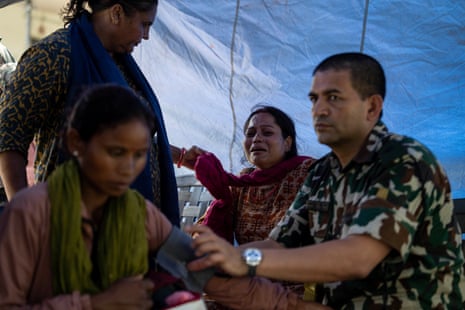
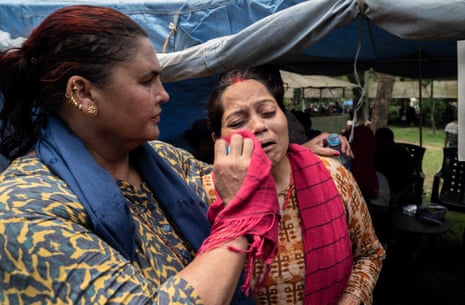
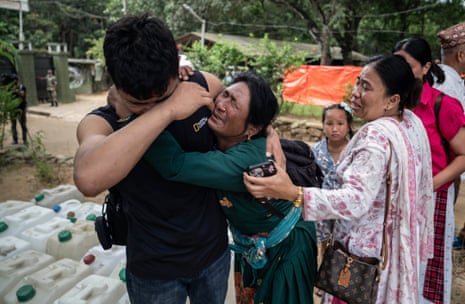
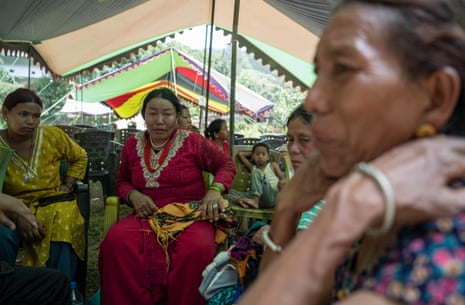
The three women sat together in the army tent and wept. They cried out for their sons, their husbands, their homes. As flash floods coursed through the Himalayan mountains on Wednesday morning, a monstrous black wave took everything from them.
As a melting glacier high up in the Himalayas between Tibet and Nepal splintered and crashed into the valley below, it set off a deadly cascade of water, mud and debris down the Bhote Koshi River. The impact of the glacier collapse was so strong that experts initially reported it as an earthquake. The Nepali village homes that lined the riverbank and clung to the mountainside stood little chance.
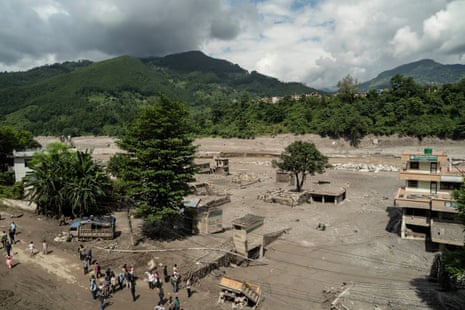
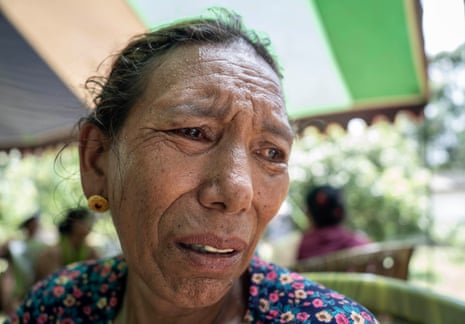
Sangke Dolma Tamang, 61, had been cheerily cooking snacks in her village of Mailung in the Rasuwa district when the floods came without warning. The whole family ran uphill for safety, but as she grabbed for her husband, he slipped from her grip and was washed into the dark, fast-moving waters.
“Others tried to pull him to safety, but the flood swept him away,” she said, tears rolling down her weathered cheeks. There was, she said, nothing left of her village now. She had spent a night sheltering on higher ground, until an army helicopter arrived and brought to her safety at the barracks. Her son too was missing since the disaster, and she waited anxiously for any news.
“Now I have nothing left to live for,” said Tamang. “The whole house is gone. We couldn’t salvage anything.”
Two days after the disaster, at least 579 people have been confirmed dead and more than 1,900 are still missing, the numbers rising by the day. Many in Nepal fear that the true scale of the disaster has yet to emerge, as the worst-hit areas in districts such as Rusawa are only accessible by helicopter. The situation remains even more opaque in Tibet, which is under tight Chinese media control. Though it was at the centre of the disaster, Chinese authorities insist only five people there have died.
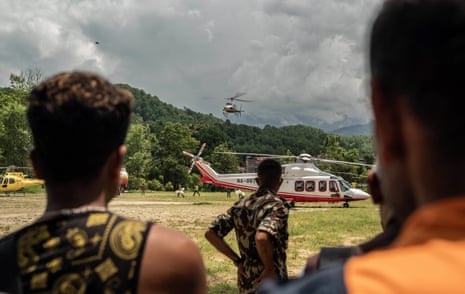
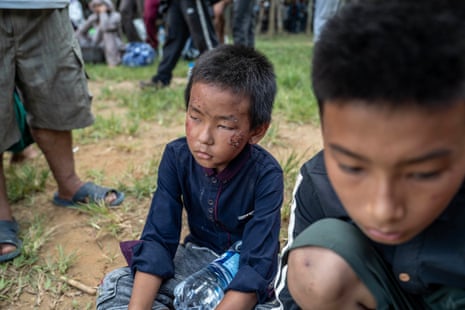
In the army barracks in the town of Bidur, where Nepal’s rescue efforts were being coordinated, helicopters carrying those rescued from flooded areas continued to arrive every few minutes, while others carrying vital supplies of food and clean water flew out and high up into the mountains.
On Friday morning, ground rescue efforts were halted over fears that the river levels were rising once again. But the Nepali army spokesperson, Brig Gen Raja Ram Basnet, said the helicopter rescues would continue for as long as people were missing. He accepted that the death toll was hard to calculate. “Right now, our focus is mostly on finding the living,” he said.
Among those recently brought to safety was 60-year-old Murali Maiya Tamang, who had been in Rusawa and was found hanging in a tree. As the flash floods came down the valley, she had watched as her house was washed clean away. She convulsed with tears as she waited desperately for news of her son, who was in their village when the floods struck and has been missing since.
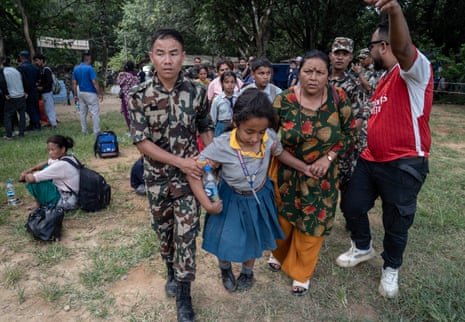
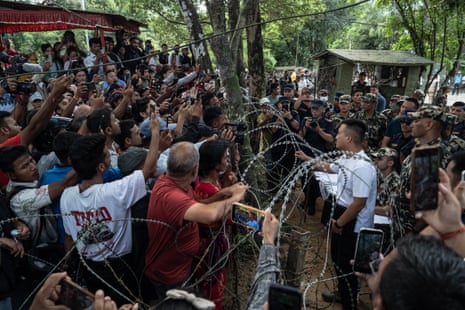
“My husband had already died in Nepal’s 2015 earthquake,” she said. “Now this flood has taken away the only son I had left. I am all alone now. What is the point of living now?”
Many in the barracks waited of news of their fathers, brothers and husbands who had been working on vast hydroelectric projects along the Bhote Koshi River, many of which were washed away and the tunnels filled with mud. On Friday, footage showed rescuers pulling some workers to safety from within the tunnels.
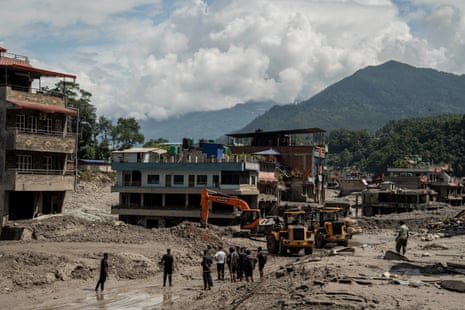
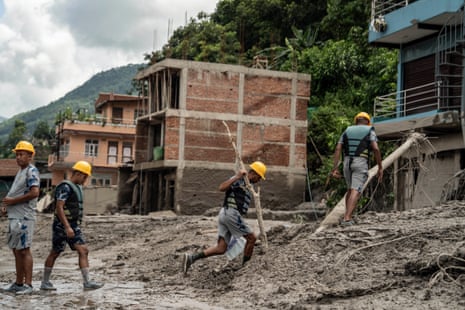
A few miles from the army barracks stood the remains of the town of Bidur, on the banks of the Trishuli River. It was one of the last towns to be hit by the flash floods, but it took just a few minutes for it to be reduced to mangled debris. The ruins of a bank, a government office and an ATM booth stood still half submerged in mud. Rescuers said there were bodies buried inside, but it was still too dangerous and the terrain too unstable to collect them.
On Friday afternoon, Nepal’s newly elected home minister, Sudan Gurung, surveyed the damage. “It is so sad to see such a heavy loss of human lives,” he told the Guardian. “Our priority right now is rescuing people. We are searching for everyone who is still missing, assuming that they are all alive. We are searching for everyone, whether they are Nepali citizens or international nationals.”
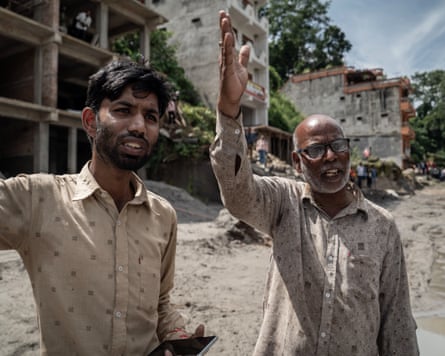
Dozens of local people made attempts to return to the site of their homes, in a bid to collect any remnant of their lives. Most just found a deep abyss of mud. Picking through the deep mud and devastation of the town, Ashok Chaurasia, a shopkeeper, said he had heard the terrifying roar of the water before he saw it. The dark muddy waters already snapped at his heels as they ran uphill for safety, a bridge over the river collapsing behind them. He survived by just 20 seconds, clinging on to the wall of a monastery for dear life. His nephew and his sister-in-law were not so lucky.
Yet even as he blessed his survival, he wept at his losses. “We had a three-storey house here, and now there isn’t even a single brick left,” he said. “Nothing can be seen. We have nothing to eat or wear. The flood took everything I have.”