.png) 3 months ago
58
3 months ago
58
A notification on my smartwatch warns me that I’m in a loud environment, and I’m not surprised. Casemiro just played an impudent no-look pass into the penalty area. His Brazilian compatriot, Matheus Cunha, receives the ball on the half-turn and wallops it with a vengeance into the top corner. I’m at Old Trafford, and Manchester United just went 2-0 up against Fulham.
The match-day crowd has become a sea of twirling scarves and flailing limbs, and I’m swept along with it, hugging strangers while shredding my vocal cords. As the celebrations die down and the teams head to the centre circle for the restart, a momentary lull falls over the Stretford End. There’s a popular song that fans at Old Trafford sing at glorious times like this. It goes: “We’ve seen it all, we’ve won the lot, we’re Man United, and we’re never gonna stop.”
I’ve never done this before, but the half-time refreshments and the excitement of Cunha’s goal has lent me some rare courage. “We’ve seen it all, we’ve won the lot …” I begin to sing, but no one joins in. I trail off, my cheeks redder than United’s jerseys. I can feel people giving me awkward side-eyes, and hear stifled snickering to my rear.
Moments later, the chant is belted out by a bloke standing somewhere behind me, and the whole Stretford End joins in, followed by the other three stands, save for me, as I’m preoccupied by a mild existential crisis.
What does he have that I don’t? I ask myself. What does it take to get chants and songs started in the first place? Do they simply manifest by osmosis, or are they written and authorised somewhere else by committee?
If anyone knows how to get a chant off the ground, it’s Pete Boyle. Boyle is a lifelong Man Utd fan and creator of many terrace anthems. “As a kid, I was mesmerised by my first game. I was four years old with my dad in 1974. As well as the football, I was mesmerised by the colour of the scarves, the people and the songs,” Boyle says. “I had a couple of poems published as a kid. No one in my family had any sort of musical or poetry background; I just had a bit of a knack for putting words together.”
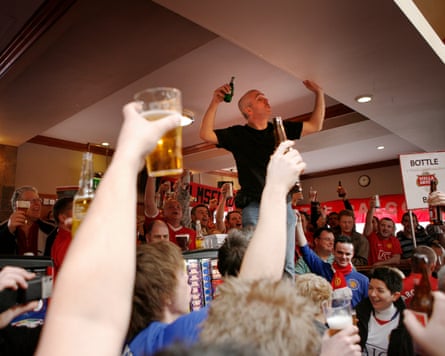
If you give Boyle a tune, he can attach lyrics to it. He has created dozens of songs over the years, many of which are still belted out to this day. Odes to players such as Eric Cantona, Gary Neville, John O’Shea, and Ole Gunnar Solskjaer. He even released a few compilation CDs of his greatest terrace hits. Boyle’s most famous song is Eric the King. He presented it on the Big Breakfast in 1995 while Cantona attended court for kung fu kicking a Crystal Palace fan, conducting a small group of fans with a French baguette: “We’ll drink, a drink, a drink / To Eric the king, the king, the king / He’s the leader of our football team / He’s the greatest French Footballer / That the world has ever seen.”
“In the 60s and 70s, some old United fans used to hand out song sheets. Sometimes it works, sometimes it doesn’t,” Boyle says. He came up with most of his songs in the pub, mainly the Bishop Blaze just outside the ground, or on the coaches to the games. “If people didn’t join in, I didn’t get embarrassed, I would just go: ‘Come on you bastards’ and carry on. A lot of people back then wanted to chant, but if it failed they were mortified. It never bothered me.”
Boyle doesn’t frequent the pubs any more and says he thinks he’s done his bit for the United songbook. Still, he might make a comeback because he’s not impressed with the derivative chants from the Stretford End these days. There’s been an effort to create a song for United’s new striker, Benjamin Šeško, and it looks like it will be pegged to the Cranberries’ megahit, Zombie. The problem is that lots of fanbases are repurposing this anthem and Boyle’s not having it. “We’re not Arsenal, we’re not Newcastle, we don’t copy overall. We make them up. But some people have got no shame.”
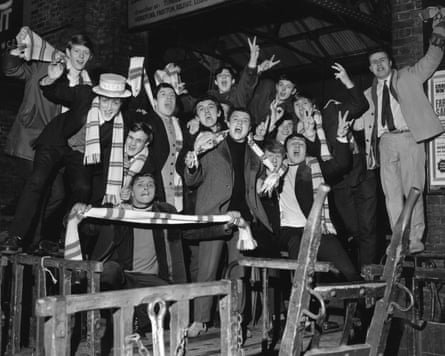
Football fans have been singing for more than a century. The earliest terrace tunes and chants date back to the 1890s. Victorian match goers adopted war cries and music-hall ditties such as Sheffield United’s Rowdy Dowdy Boys. Edward Elgar wrote He Banged the Leather for Goal, an ode to Wolverhampton Wanderers striker Billy Malpass. Sadly, it did not score with the Wolves faithful.
Andrew Lawn, author of We Lose Every Week: The History of Football Chanting, says that his beloved Norwich FC were responsible for the oldest football song, On the Ball, City, which is still sung at Carrow Road. Lawn began attending Norwich games with his dad when he was about five years old. “The thing that captivated me wasn’t the game,” says Lawn. “It was watching the crowd and being surrounded by adults, who were making loads of noise and shouting and doing all the things that, as a kid, you’re told not to do.”
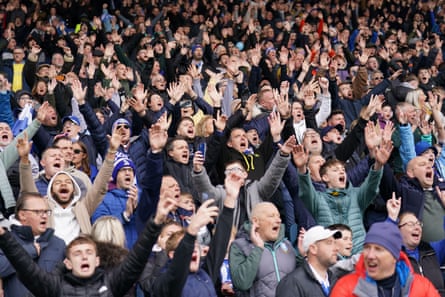
Photograph: Eleanor Hoad/Every Second Media/Shutterstock
In the 1960s, better rail connections between towns and cities allowed fans to watch their teams play away from home, making supportive chanting feel even more urgent. It was also when pop music debuted on the stands. Liverpool supporters adopted the Beatles and Cilla Black hits. Lawn says that away fans would hear these tunes and then change the words, “making it either a weapon to hurt the other team or make it your own song.” You’ll Never Walk Alone, Liverpool’s goose bump-inducing anthem, in the hands of some supporters became “you’ll never walk again,” or “you’ll never work again.”
A good portion of football chants are about giving your rivals a good kicking. These chants are 1970s and 80s hangovers, when having a scrap and attempting to take over the opposition’s main stand was just as, if not more, important to some fans than watching the actual game. My dad is 68 and a lifelong Preston North End fan. He remembers the fighting being so intense one afternoon in the late 70s that, after the final whistle, some fans were asking what the score was. “They were that busy fighting away fans that they’d lost track of the match,” he recalls.
Thankfully, football is mostly calmer now. But the songs can still bite. I like to think I’m a lefty, and yet I’ve bellowed some classist lyrics at Old Trafford over the years.
What comes over me in these moments? Why do I take leave of my values just because a bag of air is being punted around in front of me? This is what prompted Lawn to write his book.
Lawn attended Carrow Road when Norwich played Ipswich while a serial killer was at large in the city in 2006. Steven Wright murdered five women and Lawn recalls the Norwich fans singing an offensive song about it. ”
Lawn believes that anonymity in a crowd and age-old tribalism can dissolve inhibitions. “When you go to watch football, you expect to sing, swear, and kind of be let off the leash a little bit,” he says.
Some of these songs, however, cross the line between banter and hate speech. Misogynist chants, racist chants and tragedy chants – deeply offensive chants that reference stadium disasters or other tragedies that have faced the opposing team – are all punishable by law in the UK. Still, they persist despite endless campaigns such as Kick It Out and the Football Association’s Love Football. Protect the Game campaign.
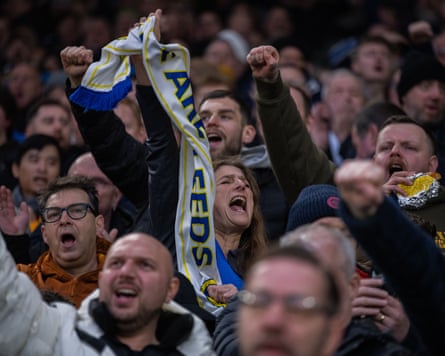
What about chants that don’t cross legal barriers, but cross ethical ones? For Les Back, Millwall fan and professor of sociology at the University of Glasgow, it is better when the fans themselves police tasteless chants.
“You ask football fans where’s the line between rival celebration and offensiveness and abuse? And the fans themselves are very articulate about this,” says Back. “The rivalries are important, the banter, the humour, the edginess, the sharpness, is what makes football such a compelling experience to watch and to follow.” While there’s still a way to go, he says, “the best way to police that boundary between what is unacceptable and what is vital banter is within the fans themselves. That was some of the deepest, most interesting forms of social change, where the fans themselves are deciding that kind of chanting or those kinds of songs are unacceptable.” Back says he’s seen self-policing in action at Millwall, Norwich City and Glasgow Rangers. I’ve seen it myself, too.
Most football songs aren’t about the rival team, though. Most songs are overwhelmingly positive and supportive of their players. Liverpool fans are brilliant at this. They have created many songs for their players over the years. The lyrics for a song about the late Diogo Jota, a Portuguese forward who died in a car crash alongside his brother André Silva last July, were adapted from Creedence Clearwater Revival’s Bad Moon Rising. Jota wore the number 20. Since his death, Anfield has taken to singing his song at the 20-minute mark of every game.
“Oh, he wears the number 20 / He will take us to victory / And when he’s running down the left wing / He’ll cut inside and score for LFC / He’s a lad from Portugal / Better than Figo, don’t you know / Oh, his name is Diogo!”
Back at the game, much has happened since I failed to get the chant going. Fulham got two back, equalising in injury time. It looks like the west London outfit will break United’s short-lived winning streak. While the Cottagers go wild, United’s players look crestfallen as they trudge back to the middle of the park. Their bowed heads trigger something in me, and I find myself screaming, “Come on, lads. UNITED, UNITED!” To my shock, everyone around me has joined in, and it’s spreading around Old Trafford. Maybe that’s the key to success on the terraces. Blind passion. Miraculously, in the final minutes, United come back and the game ends 3-2, and even though Bruno Fernandes’ pirouette and pass were gorgeous, and Sesko’s finish biblical, I can’t help but feel I had something to do with it.