.png) 3 months ago
73
3 months ago
73
The Guardian Footballer of the Year is an award given to a player who has done something remarkable, whether by overcoming adversity, helping others or setting a sporting example by acting with exceptional honesty.
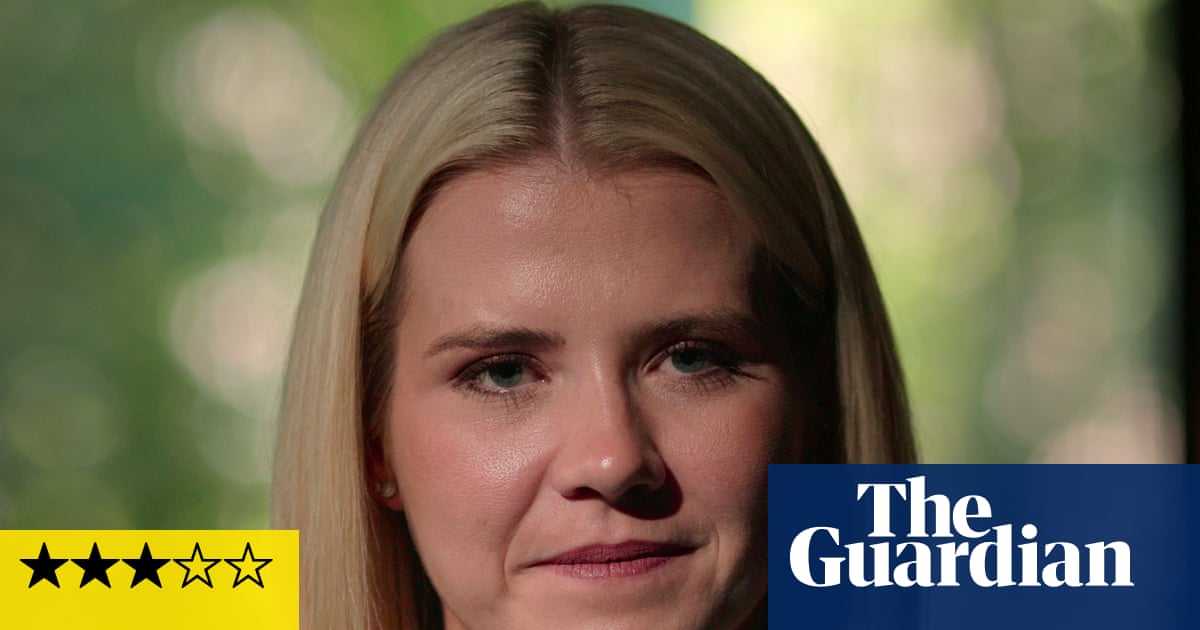
Jess Carter has spent her life grappling with when to hold back and when to speak up; wrestling with being naturally herself, embodying the characteristics her parents instilled in her of being open, honest, vocal and confident, and subduing herself because, while society values those traits, in a black woman they can be viewed negatively.
Racist stereotypes of black women as aggressive, confrontational, loud, ill-tempered, overbearing and more, mean that black women walk a tightrope of acceptability, where one wobble can bring them down in horrific and unreasonable ways.
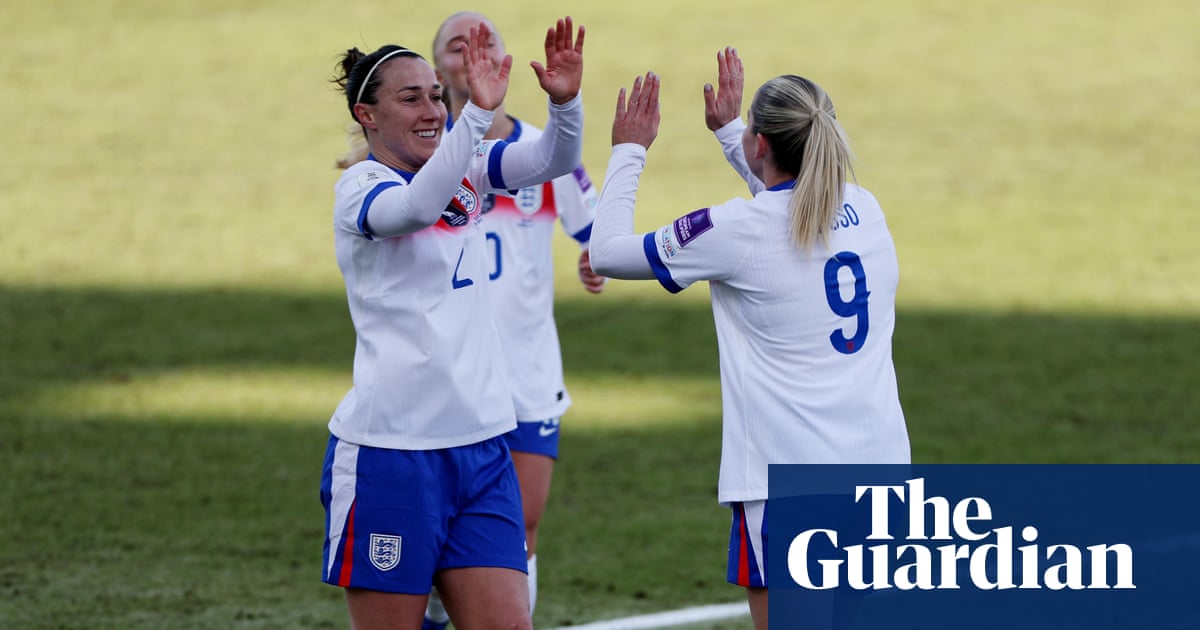
“It makes it really difficult to speak up on different things,” says Carter, the Guardian’s footballer of the year after she publicly confronted racist abuse and went on to win a second European Championship and first National Women’s Soccer League title. “There’s a lot of things I’d like to say or do, and I maybe would if I didn’t have that pressure either as a black woman or as an England athlete, but we have to always act the right way, behave a certain way. I used to find it tough when I was a bit younger. I like directness so I used to be direct too.”
When Carter spoke out during the Euros about racist abuse aimed at her on social media it wasn’t calculated. She had tried to bury her voice, again, to “stay in the bubble”. Except the bubble had been pierced.
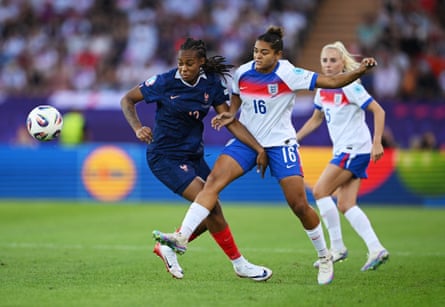
Carter was first targeted when she had a tough time in England’s opening game, a 2-1 defeat by France. She, like every Lioness, struggled. Shortly after the game, Carter was sitting with her family and was in her Instagram direct messages. Usually she doesn’t look at her DMs and deletes them unread unless they are from someone she knows, “because I’m a little neat freak and I hate seeing the notifications”. But one caught her attention and she clicked. “Oh, that’s a bit much,” she thought. Then she saw others, also racist, that hit harder. She deleted them and tried to move on.
How did they make her feel? “It just really devalues you,” she says. “It makes you question everything about yourself, who I am. Just my skin colour?
“When we’re younger we’re taught to get on with it, that there’s always going to be people like that and you just have to ignore it, but at that time I was not feeling very confident in myself in terms of my football. Where normally I don’t care what people have got to say about me, I think having that lack of confidence and then getting the abuse meant the impact was totally different.
“A lot of people don’t like the way I play football and that’s absolutely fine, but then attacking someone because of what they look like? I can’t do anything about that one, and I wouldn’t want to. I could never imagine going on to my social media to tell you how I think you’re doing at your job.”
Carter could not push it away; it was too deeply in her head. “It gave me a lot of anxiety throughout the tournament and I’d never had that happen before – I’m not an anxious person,” the 28-year-old says. “Having that on top of the lack of confidence was really tough. It made me very anxious when I was on the pitch. I was thinking: ‘God, if I mess up or this happens, what will happen?’
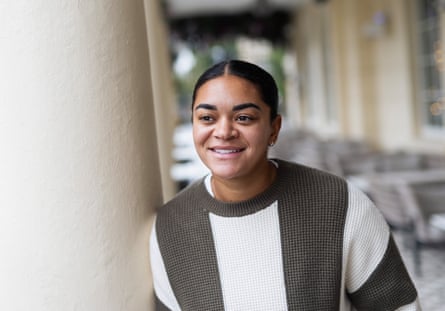
“I remember not wanting to go out at all in between games. I did, because my partner [the Germany goalkeeper Ann-Katrin Berger] was like: ‘Just go out, you can’t hide away.’ But I didn’t want to. I saw the potential for someone to be abusive in everyone.”
After England’s win against the Netherlands in their second game she stayed away from her socials, but she saw after the 6-1 defeat of Wales four days that there was more racist abuse. The penalty shootout victory over Sweden in the next match was when the switch flipped.
“I contributed to the two goals we conceded – that’s how I saw it anyway. After we’d won the game, I was sitting in the stands with my family and I went to go and get up one of the goals on Instagram, to see it again, because sometimes when you’re in that moment it’s a bit of a blur. I opened up my Instagram and there’s more messages, a lot of them. My sister saw my face and asked what had happened. I said: ‘Oh, it doesn’t matter, it’s fine.’ She went into protective sister mode, so I showed her.”
This time Carter didn’t delete them, and at the team hotel she asked England’s social media team how to block and report people on Instagram. She also logged on to X for the first time in a long time to do the same. The Football Association asked whether there was anything further it could do but she said she would just report and it would be fine.
The following day her sister encouraged her to speak out, but Carter was resistant. “One, nothing gets done about it. Two, we already have so much scrutiny as England players. I’m already under so much scrutiny; we didn’t need any more media attention.
“I just wanted to try to protect the bubble we were in and to block out that outside noise as much as I could. Then, my sister was like: ‘If that was LJ or Khiara or Mich [Lauren James, Khiara Keating or Michelle Agyemang], what would you want them to do? How would you want to support them?’
“I was the oldest player of colour there, I felt a sense of responsibility with them, to try to help and be there for them if need be. I’ve got mixed-race nieces and nephews and my sister said: ‘What would you say to them?’”
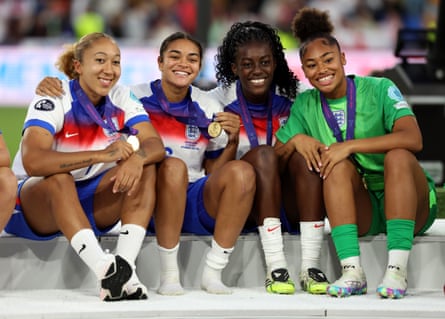
Carter went back to the FA and said she was going to post something saying she was coming off social media. Then she spoke with the leadership team, some senior players and the head coach, Sarina Wiegman, and explained what had been happening. “The other players of colour came in too, because we’d spoken briefly for some time about how we felt like taking the knee was irrelevant now and that it had lost its value,” Carter says. “We felt quite strongly about that. I explained what had happened. Obviously, everyone was really gutted and down about it and straight away they were like: ‘Absolutely, we will write a message, the whole team will do something, together as England.’”
The collective message condemned the “online poison” aimed at Carter and revealed the squad would stop taking a knee. Carter’s Instagram message said she was stepping back from social media and that it was not acceptable “to target someone’s appearance or race”. After a police investigation a man is due in court on 9 January, summonsed over social media messages sent to Carter. The players intended to stand in solidarity before the semi-final against Italy but that did not go to plan.
“The idea was that the ref would blow the whistle for taking the knee and then we wouldn’t, so there’d be that pause where people would wonder what’s going on. It didn’t happen that way. The ref just blew the whistle and the game kicked off, so our standing didn’t really make the statement we hoped it would.”
The impact of sharing what she had been going through with the team was significant. “The moment I’d spoken to them I just felt like a massive weight was lifted off my shoulders. I knew I wasn’t alone. I’ve always had an incredible support system, but I had felt incredibly isolated from that France game onwards. Just having my teammates be there mattered.”
Carter was dropped for the semi-final. “I was actually instantly relieved,” she says. “I said to Ann it was the first time I’ve ever been glad I’m not playing. The training afterwards, when I was acting as Italy and preparing the starters, was the most stress-free I’d trained and played that whole tournament and it was the nicest feeling. That’s how I know what an impact the abuse had on me.”
Carter says her “amazing” relationship with Wiegman helped. “I’ve always found it so easy to have really honest, private conversations with her. We trained and then she sat me down and said: ‘Look, I’m thinking of not playing you in the game. It’s purely a tactical decision. I think that the game will present itself in a way that will better suit Esme [Morgan].’ And I was like: ‘That’s absolutely fine.’ I truly believe when you’ve got a good manager, decisions should be tactical and with Sarina I don’t need an explanation because I trust that her decisions are purely that.”
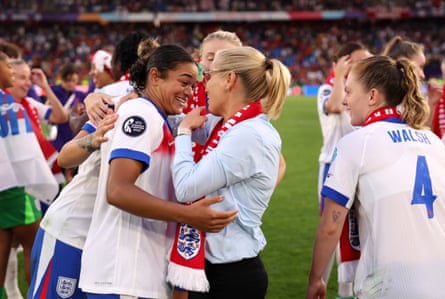
Carter came on in added time of extra time and it felt like a huge vote of confidence. “She could have put someone else on but she didn’t.”
Despite a tournament fraught with struggle on and off the pitch, Carter was told she would start the final against Spain. She hadn’t seen it coming. “I was well aware that I’d had inconsistent moments and Esme, I felt, didn’t put a foot wrong against Italy,” she says. Her assessment of her own form? “I made quite a few errors that I don’t normally make. It was a tournament where I felt like I’d underperformed.”
Carter barely slept the night before the final. It was the first time she had experienced “sheer panic, stress and anxiety” before a game. “I wasn’t equipped with the tools to manage it, because I’ve never needed to,” she says. The defender, though, has a pragmatic approach to her work. “Football is not my everything like it is for other people,” she says. “I do football because I love it and if, at times, I don’t love it then I remind myself that it’s my job.”
For the final she had to channel that: “If we win we’re going home, if we lose we’re going home. It didn’t matter. So, it was just: go out, do your thing, and then it’s over.”
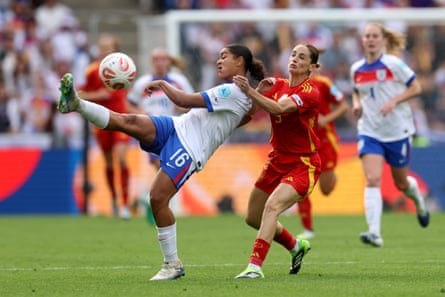
At the end of the penalty shootout, a second Euros trophy secured, the overwhelming feeling was relief. “I’m not a huge celebrator. It’s not because I’m not excited, but I just had a huge feeling of relief. I feel like maybe when I’m overwhelmed with something I don’t celebrate loudly.”
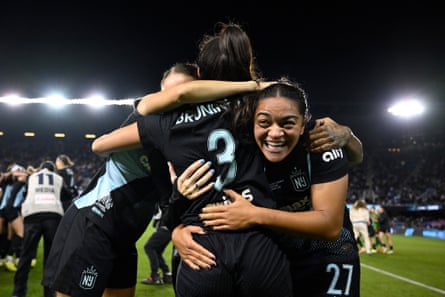
Carter skipped the celebrations on the Mall and went back to the US to link up with Gotham FC, the team she joined a year earlier after leaving Chelsea, as they vied for a playoff place. Carter, who has US citizenship through her father, says of her Chelsea exit: “I wasn’t happy there any more. It had been like that for a couple of seasons. The things that I valued the most for myself and for my team weren’t there from my perspective any more. Of course, we were still winning and it was great, but I care more about how I feel and my happiness than I do about winning a game of football or a title.”
Carter got a mixed response when she told ITN she experienced “almost like a sigh of relief” when Beth Mead and Grace Clinton – white players – joined James in missing penalties against Sweden. “For me, there’s been clear examples of black players representing England where black players make the same mistake as white players but black players get scrutinised for it more,” she says now.
“It is a real thing and the fact that players of colour step up to the penalty spot and have to think about anything else other than scoring a penalty is wild to me. Having to try to find a way to filter out the fact that whatever happens you’re going to get scrutinised so much, not just for playing poorly or missing a penalty, but because of the colour of your skin. That’s so much more added pressure.”