.png) 1 month ago
58
1 month ago
58
I never gave much thought to aliens beyond Star Wars. I put extraterrestrials and their flying saucers in a box marked “nonsense” long ago, along with political manifestos, loyalty cards, Black Friday, fairies, pixies, elves, ghosts and ghouls.
Then, in 2017, the New York Times published an article with the headline “Glowing Auras and ‘Black Money’: The Pentagon’s Mysterious UFO Program”. Apparently, the US government had been chasing UFOs for years. These weren’t the ramblings of the kind of straw-chewing rancher you would see in a sci-fi film; the story was told by a military intelligence officer called Luis Elizondo. He claimed he ran a secret Pentagon programme called the Advanced Aerospace Threat Identification Program (AATIP), which had found evidence that UFOs were flying around military bases, behaving in ways that defied the laws of physics.
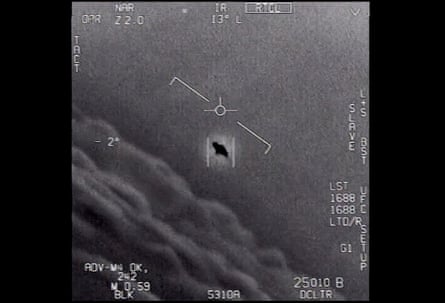
A couple of striking videos accompanied the New York Times piece and were subsequently released by the Pentagon. One appeared to show a dark, glowing object that looked remarkably like a flying saucer, while the voices of startled navy pilots played in the background.
“There’s a whole fleet of them; look at the SA,” came the first voice on the video, referring to the multifunctional cockpit display.
“My gosh!” a second voice replied.
“They’re all going against the wind. The wind is 120 knots [138 miles an hour] out of the west,” chimed in a third voice.
“Look at that thing, dude. Look at that thing … It’s rotating!”
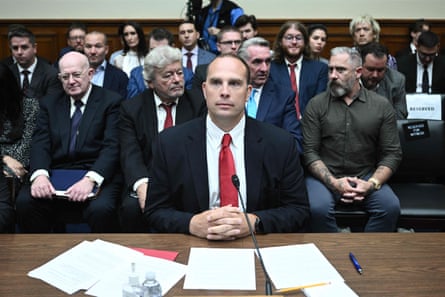
A few years later, the plot thickened. In June 2021, the Pentagon released a report confirming that it could not explain more than 140 incidents of flying objects reported by navy officers over the previous two decades. A month before, on The Late Late Show With James Corden, Barack Obama had confirmed that things were happening in the sky that could not be explained. (In February, he went further and told a podcast host that aliens were “real”.) In July 2023, a former US intelligence officer, David Grusch, told a packed congressional hearing that secret government programmes were hoarding crashed spaceships and “non‑human biologics”.
I found myself withdrawing little green men from the nonsense box in my mind. Either an alien invasion was taking place under our noses or there were some very confused people in the upper echelons of US intelligence. Either way, there was a story to tell. So, much to the surprise of my close friends and family, in the autumn of 2023, I dropped everything and headed to the US to chase aliens.
I don’t know what I was expecting, but I fantasised about having a Woodward and Bernstein moment on my trip. In a dusty diner in the American south-west, a source would hand me a brown envelope containing indisputable proof of the alien invasion. However, none of the major players in the disclosure movement – those who have been lobbying the government to declassify the UFO evidence – replied to my emails or calls. These include Elizondo and the Blink‑182 frontman Tom DeLonge, who has an entertainment company devoted to uncovering alien life.
The radio silence prompted me to dig a little deeper into the stories of whistleblowers such as Elizondo and Grusch. It didn’t take much excavating to realise that the alien invasion wasn’t all that it seemed.
It was true that the Pentagon had a UFO programme, but it wasn’t called AATIP and, according to the Pentagon, Elizondo had nothing to do with it. The programme that was concerned with UFOs – or unexplained anomalous phenomena (UAPs) – was called the Advanced Aerospace Weapon System Applications Program (AAWSAP). The story of how AAWSAP came about is convoluted and absurd, but it all started because a spook saw a ghost on a ranch.
The spook was James Lacatski, an intelligence officer who had visited the 200-hectare (500‑acre) Skinwalker Ranch in Utah, a supposed hotspot for paranormal activity and UFO sightings. Lacatski had read Hunt for the Skinwalker, an obscure book about the ranch published in 2005, which documented research funded by the ranch’s owner, the real-estate billionaire turned aerospace mogul Robert Bigelow, whose National Institute for Discovery Science looked into space exploration and the paranormal. The book is a bizarre tome, featuring flying orbs, mysterious cattle mutilations, monsters, portals to other realities and invisible objects emitting magnetic fields on the property.
In June 2007, Lacatski wrote to Bigelow, requesting to visit the ranch to see “how my office can characterize the potential threat aspects of the phenomena encountered in your research efforts”. Shortly after arriving, Lacatski claimed to have had a strange encounter. He described seeing an “unearthly technological device” that took the form of “a complex semi-opaque, yellowish, tubular structure”. Apparently, it looked a bit like the image on the cover of Mike Oldfield’s album Tubular Bells.
This alleged encounter led to the creation of AAWSAP in 2007. In 2008, Bigelow’s company was the only bidder for a $22m government contract to research the technical aspects of the putative advanced aerospace weapon systems of the programme’s title. It did not mention that it wanted intel on monsters, apparitions, orbs, portals, werewolves or dinosaurs, but that is exactly where the taxpayers’ money went.
Elizondo disputes the Pentagon’s statement that he never led AATIP. In 2021, he filed an official complaint, accusing his former employer of campaigning to discredit him. That year, a book co-authored by Lacatski cataloguing AAWSAP’s research claimed that AATIP was “an unclassified nickname” used for a “completely separate, small” initiative to study UFOs encountered by people in the military.
What is clear is that the full story of Elizondo’s background was not apparent in the initial reports around his whistleblowing. In his 2024 memoir, Imminent, he wrote about possessing psychic powers. He also claimed he had met “remote viewers” – people who believe they can see things that their eyes can’t, sometimes thousands of miles away. Elizondo claimed he managed on one occasion to pay a psychic visit to a jailed terrorist. If these details had been publicly available when he blew the whistle on the Pentagon, his story may not have taken off in the same way.
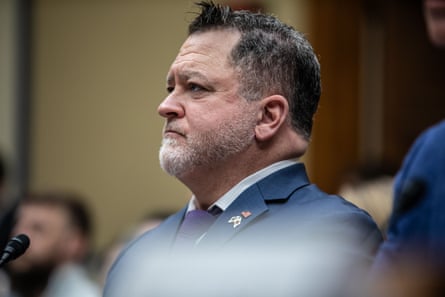
Elizondo did not respond to my many requests to interview him, but I seized an opportunity to meet him in Washington DC in May 2025, at a UFO hearing he was chairing. The meeting was organised by the UAP Disclosure Fund, “a nonpartisan nonprofit supporting UAP legislation, protecting whistleblowers, and raising public awareness for greater transparency”. We spoke briefly before his opening speech and he promised me time later. I then took my seat and watched him put forward the views he has been sharing for close to a decade: that UFOs are thumbing their noses at physics while posing threats to national security.
At one point during the three‑hour-long event, Elizondo held up a photo of what appeared to be a large, white floating disc casting a shadow on what looked like agricultural land. Elizondo described the object as “lenticular” and “anywhere between 600 and 1,000ft in diameter”. Elizondo claimed he received the image from a civilian pilot. However, internet sleuths were quick to point out that Elizondo’s lenticular object was almost certainly two irrigation circles, one white and the other black, creating the illusion of a flying disc.
Seven months earlier, at an event in Philadelphia, he had presented a slide purporting to show a giant light emerging from clouds in Romania. He said it looked like “the mothership from Close Encounters of the Third Kind”. The image, which ended up online, was believed by many other observers to show a window reflecting a ceiling light. Indeed, if you look closely, you can see the outline of what appears to be a head of hair, presumably that of the photographer.
Then there were those videos recorded by the US navy. Mick West, a UFO video analyst, deduced that the object of the video that made an officer go: “Oh gosh,” was likely glare from a nearby heat source – probably a jet plane’s exhaust.
And yet, beyond publications such as Popular Mechanics and niche YouTube shows such as The Basement Office, these updates have been missing from the media’s coverage of UFOs in the US. Elizondo, Grusch and other ufology “whistleblowers” and “experts” appear regularly as talking heads on rolling news channels. Just this month, the talkshow host Bill Maher remarked on his HBO show: “If you don’t believe aliens are here, then maybe you’re the conspiracy theorist.”
Elizondo and I did not meet after the Washington event. I emailed him and he said he would be happy to be interviewed once he had returned home from a tour, but I never heard from him again.
I spent several months travelling across the US trying to find evidence that aliens were among us. I interviewed people who alleged they had been abducted by aliens in places as different and distant as Florida and Arizona. I tried to connect with aliens through “starseeds”, people who believe they lived past lives as aliens on other planets. Through it all, I learned far more about human beings than I did about extraterrestrials.
So, if there are no aliens, what is going on? Why has ufology had a resurgence? Perhaps it is because the past decade of political unreality has made it almost impossible to separate fact from fiction, or because popular culture has trained us to point to ET when unexplained phenomena appear in our skies.
UFOs are spotted worldwide, but stories of alien visitors sit particularly prominently in American minds. The US’s obsession with UFOs erupted in the late 60s, a period of great unrest and mistrust of power, from the “red scare” to the Cuban missile crisis, the assassination of John F Kennedy to Watergate.
Hollywood reinforced these beliefs when it succeeded in turning extraterrestrials into an American myth on a par with the cowboy on the frontier. American exceptionalism is at the heart of this: if the US is the greatest slice of land in the known universe, then why would invading aliens go anywhere else?
When I interviewed the Harvard physicist Avi Loeb, who achieved notoriety when he hypothesised that an asteroid passing through the solar system could have been an interstellar solar sail belonging to an extraterrestrial, I asked him if intelligent life begins and ends with us. “Oh, that would be very disappointing,” Loeb said, sipping from a glass of water. Humans, he said, “are not that intelligent. If that’s the best that the universe made, I would lose my respect for the size, the scale and the length of time that the universe existed.”
The assumption here is that an extraterrestrial that succeeds in reaching Earth must possess an intelligence that far exceeds our own. The hope is that aliens aren’t cosmic colonists hell bent on winning their latest planetary trophy, but beings that travel to share wisdom.
Of course, there isn’t a shred of evidence that aliens have visited our planet – and it’s highly unlikely that there ever will be. The distance between our solar system and others that could host a planet similar to Earth is vast. The nearest exoplanet to ours is Proxima b, 4.2 light years away. The fastest spaceship humans have engineered would take thousands of years to cover such a distance and would need, according to one calculation, a year’s worth of Earth’s total energy output. Ask yourself this, then: would you embark on a journey you would never finish for the remote possibility that your distant descendants might meet the men from Ork? Aliens would have to answer the same question.
There is also no guarantee that life on Proxima b will be complex. Earth is 4bn years old. The human race is 300,000 years old, which effectively means it took 4bn years for us to come on the scene.
Unique things exist. Maybe human beings are among them. Maybe we are truly alone, but even if we’re not, we should start acting as though we are. Perhaps divine wisdom isn’t going to descend from the heavens and shepherd us towards nirvana. Maybe this is it. If so, we are all we have – and we should look after each other.
Chasing Aliens by Daniel Lavelle is published on 30 April (Viking, £20). To support the Guardian, order your copy at guardianbookshop.com. Delivery charges may apply