.png) 3 months ago
77
3 months ago
77
Scottish avalanches are back. More than 200 have been recorded this winter, against the previous year’s record low of 42. The worst season for fatalities was 2012-13 when eight people died, four of whom were buried in deep snow when an avalanche struck without warning while they descended Glen Coe’s Bidean nam Bian.
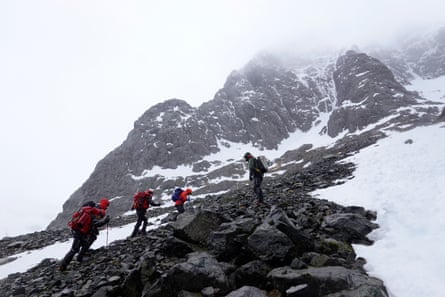
Fortunately, so far – despite one person being carried a distance down Ben Nevis and two people falling through cornices and triggering slips – there have not been any confirmed avalanche deaths, though one person is still missing on Ben Nevis. The search goes on in and around the sites of recent avalanches.
-
A mountain rescue team looks for a missing climber in Observatory Gully on the north face of Ben Nevis, an area where there has been a succession of avalanches
-
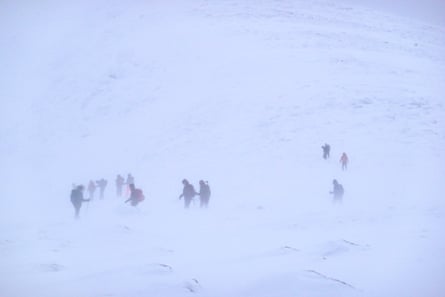
Walkers and climbers on a ridge of the Fiacaill a’Choire Chais retreat due to deteriorating conditions, including strong winds and drifting snow
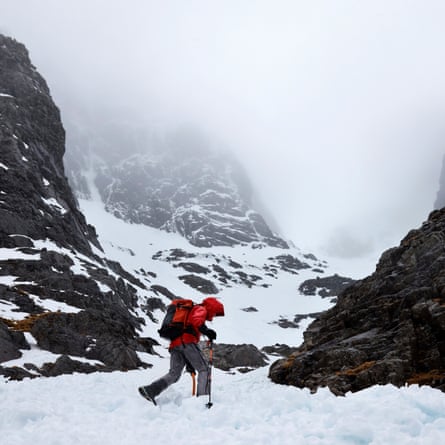
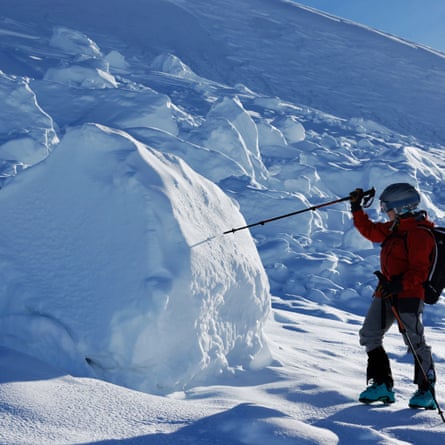
-
Left: avalanche debris in Observatory Gully. Right: forecaster Sam Noble inspects debris from recent large avalanches in Glenshee
In the past month, there have been tragically high numbers of avalanche fatalities in the Alps and the US. In the recent Californian tragedy, nine people lost their lives, six of them women: mothers, wives and sisters. The accident has underlined the potential consequences for all mountaineers.
Tracing its origins back to 1988, the Scottish Avalanche Information Service (SAIS) has for several decades published a daily avalanche forecast for six separate Scottish mountain areas – Lochaber, Glen Coe, Creag Meagaidh, Torridon and the northern and southern Cairngorms – beginning in mid-December and continuing until mid-April.
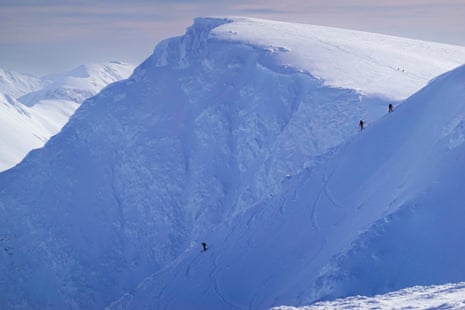
-
Skiers on Summit Gully on Aonach Mór with Aonach Beag beyond.
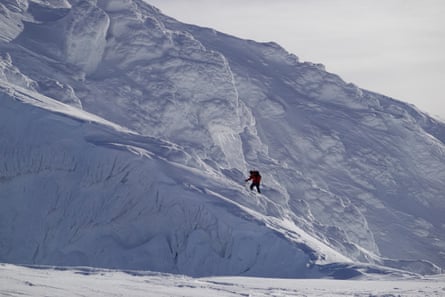
-
A walker ascends Coire an Lochan in the back corries of Aonach Mór, in the Nevis Range, Lochaber
The SAIS has 19 forecasters on its books, each of them highly experienced expert mountaineers with an additional comprehensive training in the science of avalanches and forecasting. Specialists in their own right, they are guides, instructors, climbers and skiers, and are often involved in volunteer search and rescue teams.
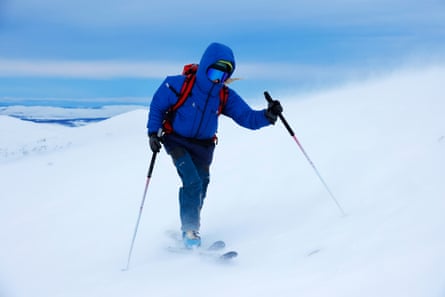
-
SAIS senior avalanche forecaster Kathryn Grindrod skis across Coire an t-Sneachda in the northern Cairngorms after gathering avalanche data and observations for her forecast. The wind has become strong and it is time to depart. Grindrod has been involved with SAIS for more than 20 years, gradually building up her skills to become a senior forecaster
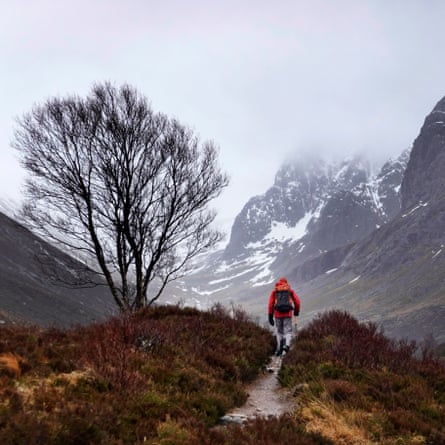
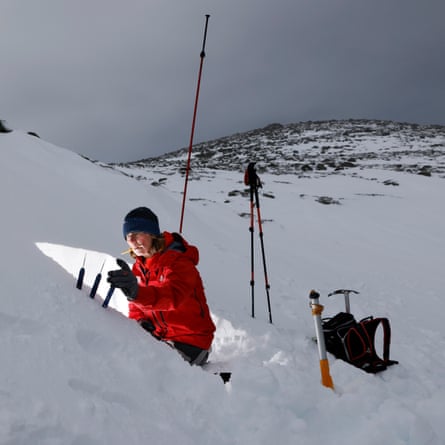
-
Left: forecaster Blair Fyffe walks towards the north face of Ben Nevis at the western end of the Grampian mountains in Lochaber. Right: Sam Noble digs a pit from which she will take measurements and gather data about the nature and variations in the layers of snow on Lochnagar, the southern Cairngorms
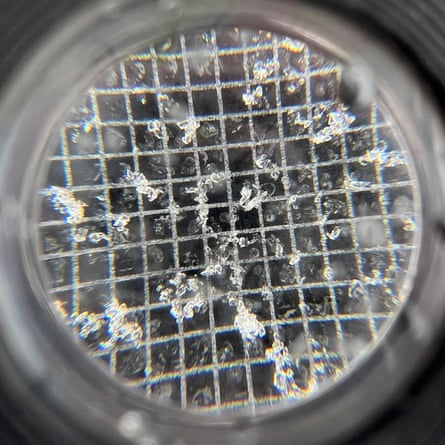
Early each day, they head out on skis, snowshoes or on cramponed feet into the frozen wilderness to investigate and record conditions and changes. They make general observations, dig snow pits and inspect and measure tiny ice crystals with magnifiers.
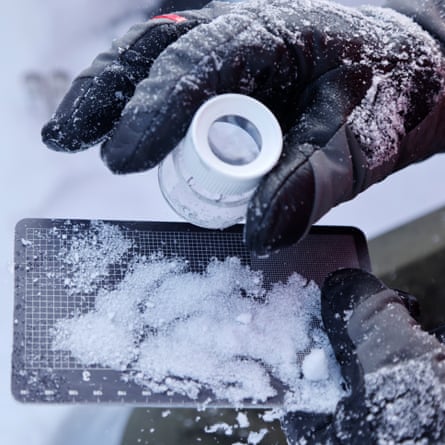
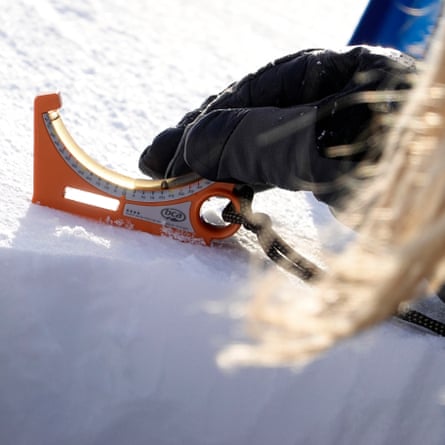
-
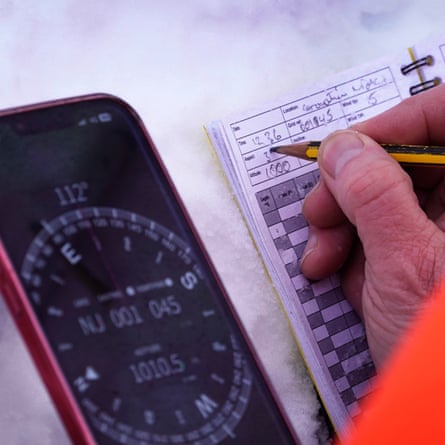
Clockwise from top left: a forecaster uses a magnifier and crystal card to inspect the constituent snow crystals in the layers of a snow pit; calculating the slope incline angle to gather avalanche data; observations are recorded for the daily forecast; snow crystals under a magnifier
Forecasters work to establish the nature, dimensions and constituents of a snow pack, with a view to identifying weak layers, which they describe as being like the jam and cream in a Victoria sponge: tilt the snow far enough (slope angle), give it a tap and the top layer is going to slide right off (avalanche). Weak layers can be formed by many things, such as a frost forming on snow which is then covered by a fresh fall or a windblown slab.
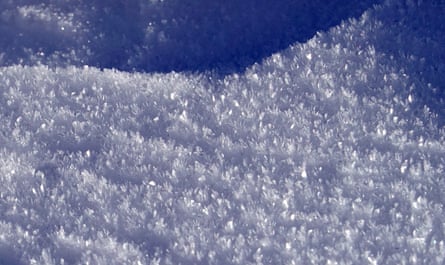
-
Hoar frost on snow that will be buried by fresh or windblown snow, possibly developing a weak layer in the snow pack and exacerbating the risk of avalanche
Each forecaster returning from their morning excursion writes a forecast based on data gathered and observations made. They say 90% of victims start their own avalanches, which can be triggered accidentally by human activity, such as walking and skiing, and occur naturally when cornices – snow overhanging steep ground – collapse.
-
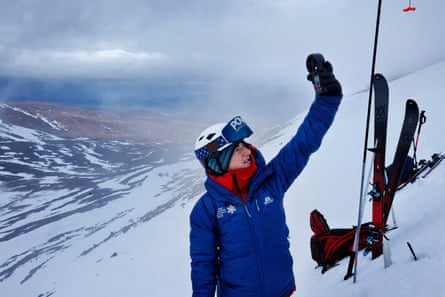
Alison Thacker checks the wind speed and direction on Coire an t-Sneachda in the Northern Cairngorms. While running an instructor training course about mountain safety in Zermatt, Thacker encouraged her students to dig and find a flaw in the snow pack. After an ominous ‘whumpf’ sound, she said ‘the snow pack started moving towards them where they were all digging at the bottom.’ Fortunately, it stopped in time and only two of the students were partly buried
-
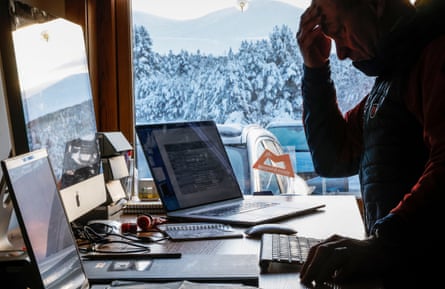
Mark Diggins writes up his report at the office in Glenmore, the Cairngorms, Aviemore
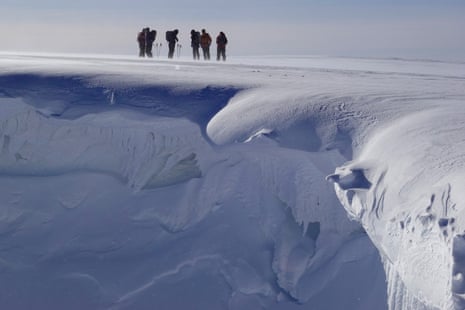
A potential avalanche is a tricky foe, often almost invisible to the ordinary adventurer. Sometimes, there are obvious indicators, such as a cornice sticking out from a summit like a freeze-frame windblown comb-over. It is easy in poor visibility to unwittingly walk the plank out on to the cornice from the summit and fall through into the void below, possibly triggering an avalanche as you hit the steep slope below. Or perhaps, with a thaw, a large chunk falls off, liquefying the whole slope and bringing it pouring down to where you are peaceably minding your own business.
-
Drooping cornices: skiers and walkers looking out from the back corries on Aonach Mor
-
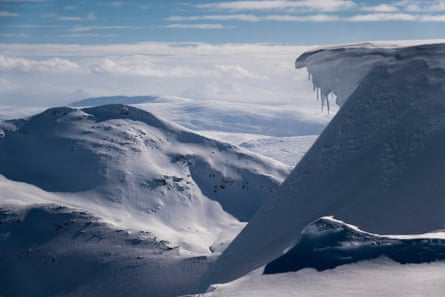
Icicles hang from a cornice
Wind slab avalanches are even worse. There can be little to see. Helped by a convex hillside or a slope angle of more than 30 degrees, they can even be triggered remotely. Often, a skier may be below a slope and hear the dreaded “whumpf” sound, heralding the collapse of the weak layer in the snow pack. The shock is carried up the slope beneath the surface. It is at the top that the crack appears, then propagates until the slope begins to slide down, leaving a visible crown wall (a steep, exposed fracture) from where it has departed.
If the worst happens and you are buried, then the first 15 minutes are critical. Statistically, you have a 93% chance of survival if rescued. After 30 minutes, the survival rate drops significantly due to asphyxiation. Your companions are crucial, which is why most wear transceivers and carry shovels and probes. A long delay in fetching help will have profound consequences for survival prospects.
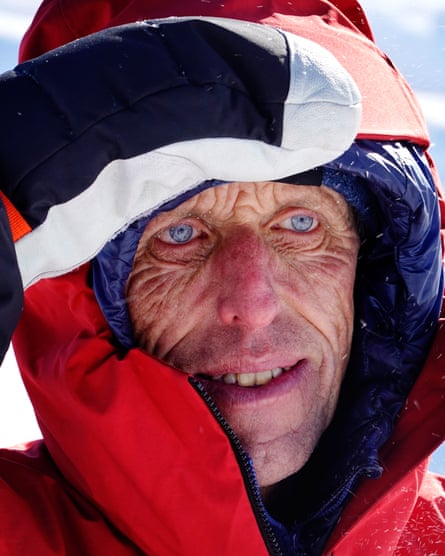
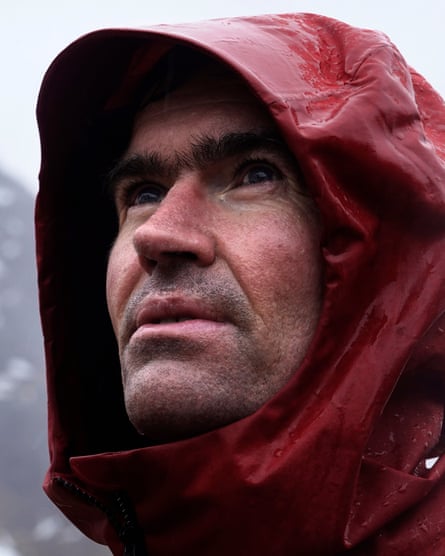
-
Forecasters Brian Morrison, left, and Blair Fyffe. Morrison has been a forecaster for 15 years. As a student he was avalanched over a small cliff. ‘To be honest, I thought I was going to die. My top tip, if caught in an avalanche, is to keep your mouth shut.’ Despite the faceful of snow, he managed to free himself. Fyffe has almost 20 years experience as a forecaster and has spent time in Switzerland with the Avalanche Research organisation SLF studying the fraction mechanics of snow by taking blocks of snow and cracking them in half to look at the properties of failure
The first coordinator of the SAIS, the late Blyth Wright, co-authored a book entitled A Chance in a Million?. With a well placed sense of irony, this publication took its title from the common but false notion that avalanches only happened in the Alps and similar greater mountain ranges – a potentially grave misapprehension.
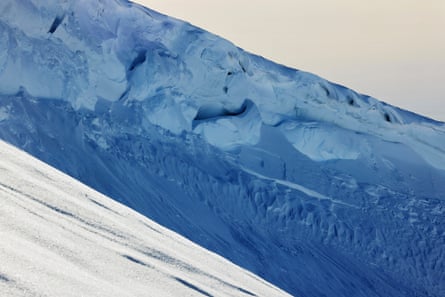
-
Hangfire, the name given to unstable fragments at the head wall of an existing avalanche site, present a continuing threat
-
Graham Moss, coordinator of the Scottish Avalanche Information Service
Graham Moss, the SAIS coordinator, says the service has operated the same way for the last 40 years, based on where people were avalanched when they were climbing 40 years ago. “We need to look at a way of becoming more reactive to conditions. Also, 40 years ago no one went ski touring.”
Moss says that from day to day people will respond to what the conditions are like. “So if it’s good skiing, they’ll go skiing. If it’s good climbing, they’ll go climbing. We just need to find a better way of managing that with our limited resources.” Over the next two to three years, the service hopes to revamp its communications, phone app, online and social media presence.
-
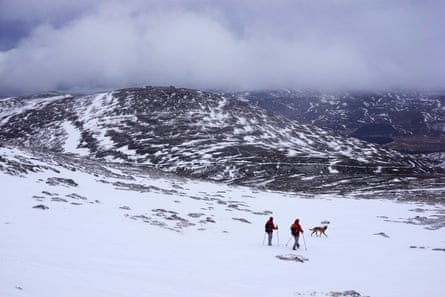
Forecasters Sam and Paul Noble with their dog Rogue gather avalanche data and observations for their daily forecast. They are active rescuers with the Search and Rescue Dog Association (Sarda)
‘In many countries, such as France and Switzerland, the forecasters don’t go outside at all – they are office based and rely on information coming in from observers. This sets our experience apart from the rest of Europe. Our model has always been to send the forecaster out to have a look at the snow and come back and write the reports themselves.”
-
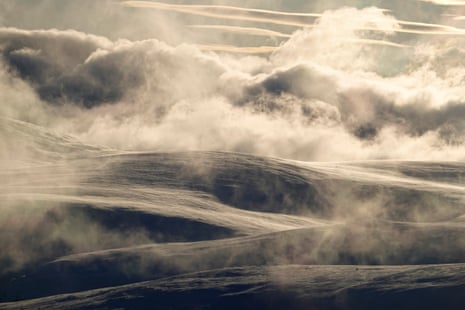
Looking out to the Stob Coire an t-Sneachda in the Northern Corries
Some say the rapid variations in temperatures and wind speed make the Scottish winter environment highly unusual and more interesting than other locations. The pioneer Canadian forecaster Alan Dennis, who has more than 50 years of international experience, concluded Scotland was the most exciting place in the world to work, just to experience the fast rate of change.