.png) 2 hours ago
6
2 hours ago
6
Soon after the hostile reception of the theatrical version of Trainspotting, another landmark 1990s movie, The Silence of the Lambs, attempts a similar manoeuvre. In this case, director Nikolai Foster is surely sensible not to turn this source material into a musical. And adapter Gina Gionfriddo is working not from Jonathan Demme’s film but Thomas Harris’s 1988 novel about the dangerous interrogation of psychotic psychiatrist Dr Hannibal Lecter by FBI rookie Clarice Starling for his insight into serial killer Buffalo Bill.
The biggest risk of theatricalised movies is that the acting becomes a form of karaoke. Mollie Gallagher, making a confident stage debut in effectively the lead role, echoes Jodie Foster’s Virginia accent and ramps up the pugnacious posture and walk. John Partridge’s Lecter, who is more sonically American than Hopkins’ variation on his Welsh register (the character is actually Lithuanian), avoids the hissy lip-sipping and also injects less charm and culture.
Another jeopardy of staged films is that much of a cinema director’s job is moving the camera in, out and around while the frame of a stage is essentially a default wide shot. Nikolai Foster, however, impressively varies the perspective. He creates a sort of split-screen by bracketing the main scene with a silent tableaux of other characters.
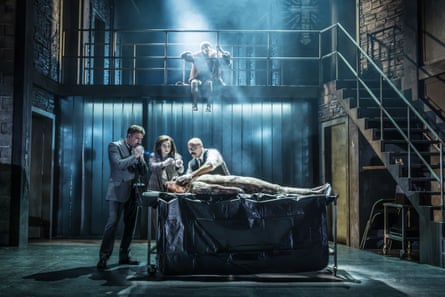
In the Lecter-Starling scenes, Howard Hudson’s lighting subtly directs our gaze, encouraging a sort of tight focus. Careful placing of characters also allows a clever approximation of a two character shot.
Another moment interrogates the relationship between audiences and the horror stories. The genre-standard autopsy scene feels rawly appalling when played downstage without the protection of a multiplex screen or the camera cutting away from views. The brief touch between the two main characters also electrifies live.
But, for all Foster’s imaginative presentation of the action, the content can feel queasy. The Buffalo Bill strand, sometimes more a main than subplot, means that much of the evening consists of watching women stalked and tortured.
Gionfriddo is a front-rank dramatist – twice a Pulitzer prize finalist, including for Becky Shaw, a London success – and intelligently addresses this problem. Stressing the pervasive sexism of the 1983 setting, she also, reflecting changes in attitudes across the four decades since novel and film, gives the female victims – neatly differentiated by Lottie Amor – more plot-time and agency. A shocking new line (spoken twice) reflects the devastating calculations a victim may make with the aim of survival.
Most daringly, while all versions of the Lecter-Starling narrative have seen it as a sort of love story, the stage version maximises the romantic context, albeit on a scale from warped to desperate. Buffalo Bill targets single women on the dating scene. The status of FBI boss Jack Crawford (Oliver Farnworth) as a recent widower is emphasised and haunts his mentorship of Starling.
A risk of such crossovers is that they will encourage streamer searches for the film instead, but it’s a show worth seeing.