.png) 6 hours ago
9
6 hours ago
9
The Song of Hiawatha, Black British composer Samuel Coleridge-Taylor’s turn-of-the-century cantata trilogy, packed the Albert Hall for weeks on end between the wars, but it really shouldn’t work today. The unmistakably Victorian if charming score is the least of the difficulties. More problematic is the libretto: 800-plus lines of “Rum-ti Rum-ti Rum-ti Rum-ti” (trochaic tetrameter, to be technical) from Henry Wadsworth Longfellow. More challenging still is a story that shows the Native American Hiawatha endorsing his country’s colonisation by “people with white faces”.
Rafael Payare did not know Hiawatha before Nicola Benedetti invited his Orchestre Symphonique de Montréal to give this Edinburgh international festival premiere, but he conducted with commitment and verve. Tightly coiled yet expansive of gesture, he never let the tension drop. The occasional drawbacks of his approach – soloists denied flexibility and space; chorus not guided towards longer phrases and quieter singing – were outweighed by the rewards. Payare highlighted the cantatas’ thematic and tonal connections and was alert to their dancelike character.
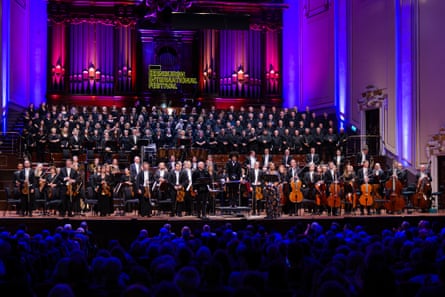
Hiawatha is demanding for the chorus, which sings a lot of notes and needs to conjure up the scenery – Longfellow tells rather than shows. The Edinburgh Festival Chorus, meticulously prepared by James Grossmith, produced clear textures and crisp diction, though tenors and basses dispatched lines with such aplomb that upper voices sometimes seemed underpowered by comparison.
Only the third cantata, Hiawatha’s Departure, permits the soloists to embody genuine characters, and here the performance gained dramatic momentum. Soprano Francesca Chiejina displayed a radiant upper register and a steely core sound but remained score-bound. Baritone Christopher Maltman’s moving rendition of Hiawatha’s farewell harnessed the weary authority of his Wotan. Tenor Nicky Spence injected proceedings with welcome theatricality – greeting the chorus like comrades before his bravura aria in Hiawatha’s Wedding Feast, enjoying the banter as he couldn’t convince them he’d seen a flood, conveying the sheer weirdness of his invocations of Jesus and Mary.
So did it work? Almost. Hiawatha’s eccentric dramaturgy and questionable politics mean it will never return to the regular repertoire, but the musical riches unveiled by Payare more than justified Benedetti’s bold decision to programme it.