.png) 1 month ago
48
1 month ago
48
Britain should spend less on defence. It is a waste of money and should be reduced so more could be spent on supporting employment, welfare and growth.
Why is there no such debate? Why should “defence” be awarded an almost religious invulnerability? At present, parliament, broadcasters, print and social media, thinktanks and pundits all admit to only two points of view. One is that Britain should spend more on defence, the other is that it should spend far more.
Yes, Russia is fighting in Ukraine and making a nuisance of itself in many ways. But while the case for domestic spending is glaring, that for greater military preparedness is not. Army chiefs in Europe apparently claim Russia is ready, and we must assume intending, to march to war across Europe “by 2029”, just three years’ time. The absurd date seems intended to get Europe’s taxpayers to facing up to the US’s understandable reluctance to act as Nato’s military backbone. Keir Starmer’s defence investment plan commits a “mere” 2.7% of GDP for defence by 2030, an amount believed to be a come-on to Vladimir Putin, while Nato’s target of 3.5% by 2035 would apparently have him quaking in his boots.
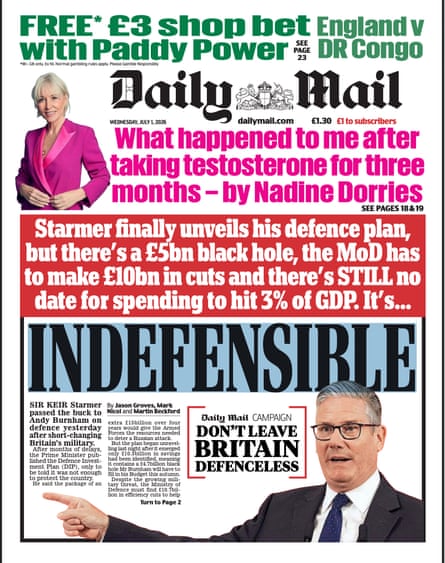
Even 2.7% is too much, however. There is no evidence that Russia has evil designs on British territory that require a massive deterrent force. That one nation may have the capacity to “threaten” another far from its borders is not evidence that it intends to do so.
Donald Trump has not been alone in questioning a perceived threat to the west from Russia – certainly since the end of the cold war. Realists such as George Kennan and Henry Kissinger long questioned the need to treat Moscow as a power with evil intent, at least beyond its immediate neighbours. Mikhail Gorbachev said to the US general Colin Powell: “I’m very sorry, you’ll have to find a new enemy.”
At present, adding to the security of Britain’s borders cannot justify a blitz on domestic public spending. Its shores and surrounding seas certainly need policing and protecting. So do its airwaves, its commerce and communications. The agencies of Russia and China can be pesky. But against them, military spending is no deterrent. As for whether Britain should aid its foreign friends against their foes, that is a matter of money, not warmongering overseas.
When I served as a lay member of Tony Blair’s strategy defence review in 1998, we were bombarded with unquantified abstractions. We were told not to query or quantify concepts such as menace, aggression, force or “nuclear threat”. As for the last, it was said to be “like the Virgin birth”, axiomatic to the concept of deterrence. Today’s case for spending £63bn on renewing Britain’s nuclear deterrent must be close to slight. Yet it receives no peep of debate.
The vacuity of these arguments is fuelled by the sums of money at stake. As long ago as 1961, President Eisenhower warned against letting the “military-industrial complex” gain too much leverage over defence politics. In 1998, with the cold war over, a desperate defence lobby argued that Britain would need to move towards “expeditionary armed forces”. It never said where or why. The result, in Afghanistan and Iraq, was tragic.
When David Cameron tried to cancel the second of two wildly expensive aircraft carriers, he was told it would cost more to stop than to build. In 2021, Boris Johnson sent one of the carriers to the South China Sea, merely to posit a global Britain. He also deployed British warships to the Black Sea, to challenge Russia. The objectives were facile, but cost billions.
after newsletter promotion
We are still to spend huge sums on battlefield weapons. The nearly 600 clearly defective Ajax armoured vehicles on order are years overdue. These machines have been shown in Ukraine to be outdated, vulnerable to drones and other autonomous weapons. Speaking to a defence conference in London last week, Nato’s deputy allied commander, Air Chief Marshal Sir Johnny Stringer, admitted what was needed were mass-produced, low-cost drones and interceptors, not “high-end, expensive platforms that can take years to produce”. He was right, and showed sound economic sense.
As for the new defence budget, Keir Starmer said that transport and energy projects would have to be slashed to pay for it. He did not mention which ones. When in 2020 Johnson gave the final go-ahead for HS2 – now priced at more than £100bn – I thought that no future government would dare plead lack of money for anything. As I sat last month on a half-empty train from Euston to Birmingham, I thought of that £100bn. The entire military drone programme – only £5bn – is less than one year’s current spending on this needless railway, not to see completion before 2043. When it comes to conspicuous consumption, one thing the British governments do not lack is money.
-
Simon Jenkins is a Guardian columnist
-
Do you have an opinion on the issues raised in this article? If you would like to submit a response of up to 300 words by email to be considered for publication in our letters section, please click here.