.png) 2 hours ago
7
2 hours ago
7
Jamie Parker, played Harry Potter
My initial response when I was asked if I was interested in the role was confusion – I felt a bit long in the tooth to play a teenager. I had read the first Harry Potter book and seen a few of the movies, but was just past the right age when it was all kicking off. I didn’t know that there was the coda in the final book that places the action 19 years later, and that’s where the play would be picking up from.
I’m happy to admit now that I thought the show was a terrible idea. But a lot of hit shows are terrible ideas on paper. And I’m used to eating my own words – which began the moment I saw the team involved – producers Sonia Friedman and Colin Callender, and so many of the other creatives I would have taken a contract blind just to work with them, not least Jack Thorne. I thought, if this is as close as I get to being in This Is England, I’ll do it.
Of course, once I took the role, I had Stephen Fry’s readings of the books on a loop. By the time I got through the rehearsals, the year in London, and then the year in New York when it went to Broadway, I had listened to the entire series seven times and was a bit of a Potterhead.
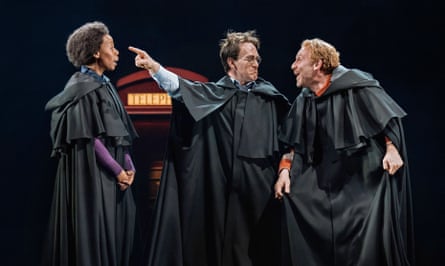
The two parts of the play are the story of the next generation coming up, and of chickens coming home to roost, but it wasn’t a one-man show and the pressure felt shared. Everything you do ends up being a crucible for your own neuroses that you pestle and mortar into some kind of grit that you use as part of making the theatre piece. Like Harry, I was barely 12 when I also got on a train and went to a boarding school in Scotland. I also had round glasses!
I’m always looking for things that challenge me, and I had never done anything like this with all the magic. I thought, I hope I can learn how to do that … I don’t know, but let’s find out! Playing various musical instruments helped – there’s a musicality built into the rhythm of the illusions. But, as anyone in my life will tell you, I can’t walk through a doorway without banging the back of my hand against the latch – my spatial awareness is dreadful. That I went through all those tight entrances and exits, and around all those bits of heavy moving machinery at speed, in the dark, without ever doing myself or anyone else serious mischief is a miracle.
There were occasional moments when things didn’t go as planned. One night in the duel scene with Alex Price (Draco), I gesticulated and my wand caught on part of my clothing. It skittered out of my hand, and helicoptered downstage right. Without thinking I launched myself after it and blindly reached into the dark with half my torso off the stage in the auditorium. Somehow I caught it. Alex just went, “Yes!” – like he was watching the cricket!
During the first preview, the ripple of energy and anticipation that went through the theatre was almost visual. It was put to us that this was like opening the new Star Wars film but in one cinema worldwide – we had audiences coming from Australia to the Philippines to Canada. But, outside of the big commercial opening aspect, there was a real sense of this place being a precious, even dare I say, sacred space. Audiences were in their seats 10 minutes before the start and I didn’t hear a phone go off once. I’ve never known attentiveness in an audience like it.
Jamie Harrison, illusions designer
I got into magic as a child and for a while made a living out of it, but later, studying acting at drama school, I was told by some of the lecturers that it was vaudevillian and that I should hide it from my CV. I set up my own theatre company, Vox Motus, and began introducing illusion into our shows without really knowing what I was doing, but it was a safe environment to explore new things.
When I got the first draft, I couldn’t sleep for three nights thinking, “What have I done? This is so full on. There’s so much magic!”
There were moments that Jack had written into the script – ”and they vanish” or “a spell happens here” – and it was up to me to decide what to do. Then there were other points where we knew exactly that it had to be a Patronus charm, or the Polyjuice potion that turns one character into another.
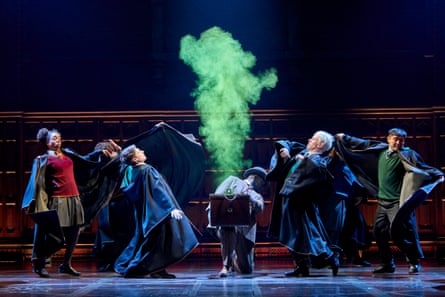
People often think that magic and illusion are off-the-shelf. They say, “Who invented that?” But I’ve always tried to draw on the work of brilliant illusionists of the past, while reworking them so that we’re bringing something new to audiences.
Audiences particularly love the phone box and the entry to the Ministry of Magic by dialling “MAGIC”. That almost didn’t happen at all. John [Tiffany, the director] was trying to give the show its own identity and make it distinct from the films. He said, “I don’t want to a big red phone box on stage … can we think of a different way of doing it?” Christine Jones, the designer, and I looked over old photographs of King’s Cross and we spotted an emergency telephone on a wall in one of those small booths.
I made it out of cardboard and bits and pieces in fabric, and we started to re-create a famous trick called the mascot moth that a magician called David Devant created 120 years ago – a person comes on stage with big moth wings on, folds them around himself and vanishes. It was terrible to begin with but we developed it and brought in clever makers to make different iterations. We got it working and it looked fantastic – I was really proud. Then we did the first preview in front of a test audience of Harry Potter superfans. And one of the main bits of feedback was: “You can’t do the Ministry of Magic without a phone box!” So Sonia and John said, “We know we said we didn’t want a phone box, but we need one by this time next week!”
I’m not going to reveal any of our secrets. Absolutely not! I can say that people often think there are trapdoors being used in sequences where there aren’t. The show uses shadows and light in ingenious and incredibly precise new ways. It might look very organic and handmade, but there is an absolute wodge of technology involved and a huge crew. There are a lot of computers – it looks like a spaceship.
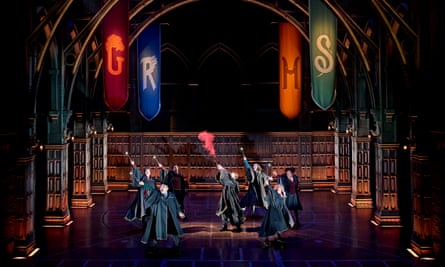
The Expelliarmus spell (where a wand jumps from one person’s hand into another’s) is a highly skilled effect that the performers have to start practising on day one – there’s a real knack to getting it right. There are now probably hundreds of actors who have toiled away and have an insight into what life could be like to be a magician. That was the first thing that I had to show JK Rowling. She was really interested to see that and the Time Turner when she came to one of the early workshops. We set up a presentation, but none of the performers were confident enough to do it yet. So John said, “You’re going to have to perform it.” I was more nervous than the flipping actors! I demonstrated it and she went, “Oh! Do that again!” You know you’ve got somebody if they ask to see it again. I was thrilled. I wanted to say no, a magician never repeats his tricks, but it was JK Rowling, so, yes, we did do it again.
The original two-part production of Harry Potter and the Cursed Child celebrates its 10th anniversary on 30 July and is at the Palace theatre, London until 20 September; the one part production opens on 9 October.