.png) 9 hours ago
7
9 hours ago
7
British flying taxi startup Vertical Aerospace has said the UK government has expressed interest in buying a military variant of its aircraft as it races to gain approval for flights with paying passengers.
Vertical also welcomed another £10m grant from the government, taking its total UK state funding to £48m.
The company demonstrated its prototype model of the flying taxi on Monday at the Farnborough international airshow, an industry event at an airfield west of London.
The aircraft is one of several electric vertical takeoff and landing (eVTOL) aircraft which manufacturers are hoping will revolutionise urban transport by landing quietly – relative to a helicopter – in built-up areas with no direct emissions.
However, those companies have found it much harder than initially expected to start flying passengers, and several have collapsed after an investment bubble during the coronavirus pandemic burst.
Vertical itself faced a cash crisis in 2024 which led to the eventual exit of founder Stephen Fitzpatrick, the owner of energy company Ovo. It was taken over by the US distressed debt investor Jason Mudrick.
The company survived and is now going through the complex process of gaining certification for a totally new aircraft from the UK’s Civil Aviation Authority.
It is racing against its US rival Joby Aviation, which has also switched from conventional to vertical flight in public tests from New York’s JFK airport to Manhattan. Other rivals that are further behind are Eve, owned by Brazilian jet maker Embraer, and the US startup Archer Aviation – as well as several Chinese companies.
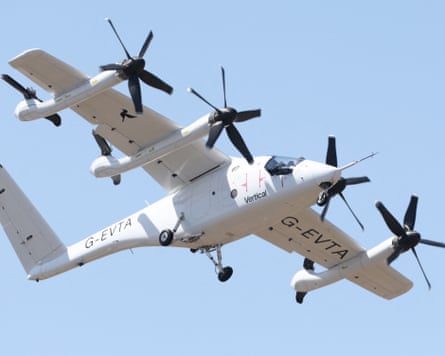
Monday’s flight was the first public demonstration of Vertical’s aircraft transitioning from conventional flight using its aeroplane wings to vertical flight – when four of its propellers tilt upwards.
The aircraft flew in to land on the runway at Farnborough, before hovering in the air, helicopter-like, and dropping slowly to the tarmac.
Vertical’s focus remains on its electric model, which offers the prospect of flight with no direct carbon dioxide pollution, but it is also working on a hybrid system that will add a gas turbine.
While burning fossil fuels to power the motors would cause significant emissions, it could also allow greater range and quicker refuelling than recharging batteries.
Stuart Simpson, the Vertical chief executive, said in an interview that the hybrid option opens up “dual use” – civilian and military.
He said: “It leverages the commercial airframe, but with a different powertrain, which the military are very interested in.
after newsletter promotion
“Because silent takeoff and landing, you can cruise up to 1,000 miles in it, low noise signature, low heat signature – [it is] really interesting.”
Vertical said the UK government had “confirmed interest from the Ministry of Defence in the defence applications for Vertical’s eVTOL, hybrid-electric and autonomous capabilities”.
The company plans for similar flights for four passengers in its Valo production aircraft in 2029, after announcing a further delay to certification earlier this month. The company had originally aimed to be in service by 2025.
Simpson said “we’re really confident” the company would meet the new target timeline after communications with the regulator.
“I set 2028 hand in hand with them,” Simpson said. The CAA and EU Aviation Safety Agency (EASA) “both signed up to work towards 2028, and they’re both comfortable with 2029 because they knew they could do 2028”.
Vertical said the government money was offered “in connection with Vertical finalising the down-selection of UK sites for its aircraft and battery facilities”.
It intends to build about 150 aircraft a year at its existing facility in Kemble, Gloucestershire, but it eventually wants a larger site to build 1,000 a year, as well as to assemble its battery packs.
The company said building in the UK would make it easier to certify the aircraft.
Vertical says flights should cost about the same as a taxi ride, because the same aircraft will be able to do several return trips in the time a cab could do a journey such as from London’s Heathrow airport to the centre of the city.