.png) 1 month ago
39
1 month ago
39
Unheard 1965 recordings by David Bowie, from when he was starting out in swinging 60s London as Davy Jones, are finally to be released – some featuring a pre-Led Zeppelin Jimmy Page.
Before he broke through with 1969’s Space Oddity, and scaled up through The Man Who Sold the World and Hunky Dory towards the explosive impact of his Ziggy Stardust alter ego in 1972, Bowie started out as a very different kind of artist: sharp-suited and coiffured, playing the kind of forthright, blues-influenced, sometimes faintly psychedelic pop-rock that was the hallmark of mid-60s London, from the Beatles to the Small Faces and the Who.
Singles from this period – such as Can’t Help Thinking About Me and Do Anything You Say – have previously been made available, but a new compilation released on 18 September, David Bowie: The Shel Talmy Recordings, brings together a range of unreleased material.
One song, I Want Your Love, is available now: a bluesy rock’n’roll number with Bowie horn-doggishly yearning for a lover.
Performed either solo or with the backing bands the Lower Third and the Manish Boys, the other unheard songs are entitled Cupid, Leave Her to Me, You Gotta Tell Her, Certain Woman, Today, I Live in Dreams and I Do Believe I Love You, plus there is an instrumental called Keep Up With the Jones. Other tracks have been previously released, or are unheard versions of existing material.
At this point in his career, Bowie, born David Jones, used the name Davy (sometimes Davie) Jones, before he changed it in 1966 to David Bowie to avoid confusion with Davy Jones of the Monkees.
The compilation’s tracks were recorded with the producer Shel Talmy, a significant figure in 1960s rock who also helmed hits such as the Kinks’ You Really Got Me, the Who’s My Generation, and multiple songs by Manfred Mann.
Talmy frequently worked with Jimmy Page, then a session guitarist, and Page was brought in as a member of the Manish Boys who backed Bowie. Nicky Hopkins, who also played piano with the Rolling Stones, the Beatles, Jeff Beck and more, is another session player on the unheard recordings.
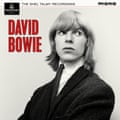
Two Talmy-produced songs, I Pity the Fool and You’ve Got a Habit of Leaving, were released as singles. “I thought he absolutely was going to make it,” Talmy said in 2017. “The only unfortunate thing is that he and I were about six years ahead of the market.”
Being very much of its period, Bowie’s 60s material didn’t quite herald the arrival of an artist who would completely reshape the boundaries for rock music, a fact acknowledged by music historian Alec Palao in the compilation’s liner notes: “The sounds here should not be judged by the standards of his later career, but by the standards of what was happening in Britain at that precise point in time.”
He adds: “David Bowie the artist is a book of chapters, the turn of each page delivering something completely different and unexpected from the last … a cardinal error would be to pit any of these episodes against the others, when in fact each fascinating phase in his career should be considered complementary. This collection, a primary chapter if not the very earliest instalment in David’s musical journey, deserves legitimate consideration.”
And if Bowie certainly became more experimental and daring, folding in everything from funk and soul to drum’n’bass and jazz into his songcraft over the years, he didn’t disown this earlier material.
He revisited various songs in 2000 with the band he’d wowed the Glastonbury festival with that year, re-recording tracks such as his debut single Liza Jane and others, for an album entitled Toy. But Bowie then refocused on writing new songs – an impressive run of albums from 2002’s Heathen to 2016’s Blackstar – and Toy ended up being released in 2021, five years after his death.