.png) 3 months ago
84
3 months ago
84
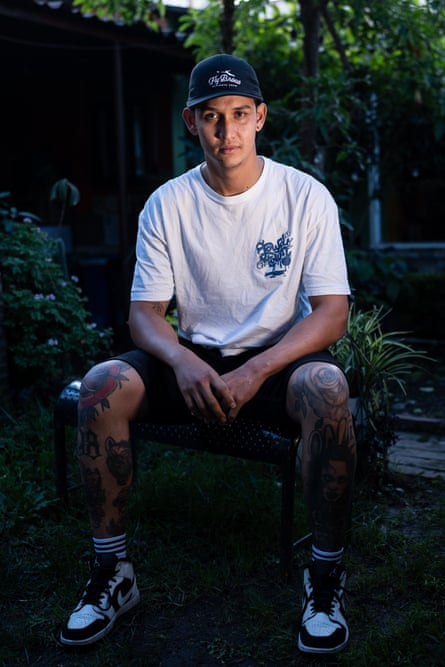
It was the busiest hour of the evening in Bolivar Square, one of the most iconic spots in Bogotá, Colombia’s capital. Amid the buzz of smiling tourists, however, Luis Muñoz Pinto sat very still, his head in his hands, as memories of his deportation from the United States to a Salvadorian prison flooded back.
Muñoz Pinto, 27, was one of more than 250 Venezuelan men accused by the Trump administration of being part of the dangerous Tren de Aragua gang and deported from the US to the brutal terrorism mega-prison called Cecot in El Salvador last March.
“I thought that my life had somehow ended,” he said of the shock of landing there and the harsh treatment from the moment of arrival.
Now free, he is one of more than 100 of those deportees whom a federal court in the US has ruled must be allowed to return to American soil to be given the due process Judge James Boasberg says they were denied when they were deported, even though the US state department is pushing back.
Muñoz Pinto is scared but also longing for a chance to be heard and to clear his name.
As tourists continued to pass by, seemingly oblivious, he pointed to large tattoos, one on each knee, that the US government sees as evidence of criminal gang membership and still claims that Muñoz Pinto is part of Tren de Aragua.
“I would like to explain that these two tattoos, these two roses, are for my younger sisters, they are twins, and have nothing to do with any gangs,” Muñoz Pinto said in Spanish in an exclusive interview with the Guardian in the center of Bogotá.
“When I was detained in the US, an immigration officer saw the roses and immediately said ‘you’re a member of the Tren de Aragua’ and I told him that I had been a college student. That I wanted to work and help my family and I even told him that he had tattoos too and he responded ‘but you’re Venezuelan’.”
Muñoz Pinto said he was a robotics engineering student in Valencia, the third-largest city in Venezuela, when he joined hundreds of thousands of people taking to the streets in 2017 spring protests – some of which turned deadly – demanding autocrat Nicolás Maduro ease economic hardship and hold presidential elections.
Fearing persecution by the state, Muñoz Pinto decided that leaving was the lower risk. He left his studies, his family, his friends, gathered what funds he could and fled to neighboring Colombia.
He lived there until January 2024 before migrating to the US, and while he was in Bogotá he got the key tattoos that ultimately plunged him into more trouble than he could ever have imagined.
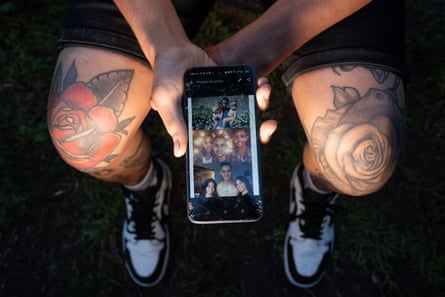
“I got the rose on the right knee in September of 2021 and the rose on the left knee in January of 2022 and I made that decision because it was a way to keep my sisters close to me, a pair of roses, just delicate and beautiful like them, they are my strength to this day,” Muñoz Pinto said.
Alirio Rodríguez, a Venezuelan tattoo artist living in Bogotá, recalled in an interview with the Guardian doing at least seven tattoos for Muñoz Pinto, including the roses.
“Luis told me he wanted a couple of tattoos that represented his twin sisters, not their names, something more feminine and somewhere on his body that described what he was going through, and that’s when we thought of the knees because they endure all kinds of pain in life,” Rodríguez said.
“When I later found out that Luis had been deported [from the US] because of the roses I couldn’t believe it, those roses are not from the Tren de Aragua. Look, even my wife has tattoos of roses on her hands and that doesn’t mean she’s a member of the Tren de Aragua, right?”
Muñoz Pinto has no criminal record in any country. He made a harrowing cross-country journey from Colombia to the Mexican side of the US-Mexico border and after months waiting for an American asylum appointment, in June 2024 he crossed into the US without authorization, but was swiftly expelled back across the line. He later received an asylum appointment. He told the Biden administration immigration authorities that he feared for his life if he had to return to Venezuela, and signed a sworn statement that he had no gang affiliations. But he was promptly detained, had to strip and had his tattoos photographed. He was taken to the Otay Mesa detention center in San Diego, California, and between then and being flown to El Salvador in the early weeks of the second Trump administration he never set foot on American soil as a free man.
“At Otay Mesa I understood that I had been classified as a gang member because I was sharing a cell with men that had tattoos of Mara Salvatrucha and Barrio 18,” Muñoz Pinto said, referring to two brutal transnational gangs. “I had just told the immigration officer that I wanted to work to help my family and I was then surrounded by all those people filled with hate in their eyes … I knew something bad was coming.”
The Trump administration classified Tren de Aragua as a state-sponsored international terrorist organization staging what amounted to an invasion of the US, despite skepticism reportedly even from US intelligence about the Venezuelan government’s involvement. Immigration officials were instructed to consider several factors, including tattoos, to determine if Venezuelan migrants were gangsters.
Meanwhile, the Texas department of public safety listed stars, crowns, firearms, grenades, trains, dice, roses and big cat predators as tattoos associated with Tren de Aragua. And the federal Immigration and Customs Enforcement (ICE) agency claimed that Tren de Aragua members dress “in high-end urban street wear” and “favor the Chicago Bulls basketball jersey, specifically Michael Jordan jerseys with the number 23 and Jordan ‘Jump Man’ footwear”, prompting skepticism from many with its sweeping claims.
Experts in organized crime in Latin America expressed fresh doubts on this topic when speaking to the Guardian last month.
Ronna Rísquez, who spent several years investigating the origins and the expansion of the Tren de Aragua in the region and wrote a book about it, said: “There are no distinctive features or tattoos among the members of the Tren de Aragua in the way that other gangs in Latin America do.”
She added: “Most of the tattoos that members of the Tren de Aragua have are aligned to pop culture. In fact, the list of tattoos that were published in the US and were associated with the Tren de Aragua are tattoos that famous people like soccer players and reggaeton singers have.”
Luis Fernando Trejos, a professor at Universidad del Norte in Barranquilla, Colombia, whose research centers on illegal armed groups, said: “There is a stigmatization that has grown with [Nayib] Bukele, that every man with tattoos in El Salvador is automatically a member of the Mara Salvatrucha [MS 13]. And it happened the same in the US when a list of tattoos were [allegedly] indicative that any Venezuelan could be a member of the Tren de Aragua – and that’s how more than 200 of them ended up in Cecot.”
The Guardian asked the DHS for any substantial evidence supporting the US government’s claim that Muñoz Pinto is tied to Tren de Aragua. The federal agency responded with a statement, saying: “We are confident in our law enforcement’s intelligence, and we aren’t going to share intelligence reports and undermine national security every time a gang member denies he is one. That would be insane.”
It continued: “Luis Orlando Muñoz Pinto is an illegal alien from Venezuela and Tren de Aragua gang member.” The statement said that he illegally entered the US, “received full due process” and was ordered removed by an immigration judge.
However when the Trump administration abruptly loaded Muñoz Pinto and 250 other Venezuelans onto planes last March and flew them to prison in El Salvador, the US president defied a federal court order requiring the deportation flights to turn back to the US. His family didn’t know what had happened to him, he said. Then images of the men shackled and held bent over by baton-wielding Salvadoran police flashed around the world, and when CBS News obtained internal government documents revealing the names of the men who had essentially been disappeared, it confirmed his family’s fears.
“I remember that while the guards were shaving my head I thought that my life had somehow ended or was going to end there, I remember asking myself ‘what had I done?’ and contemplating that I would rather have the guards shoot me right there than continue the humiliation,” Muñoz Pinto said.
Sitting in the rainy Colombian evening last month, he recounted almost serenely why he left behind his family in Venezuela, why he migrated from Colombia and his scary time in US detention. But it was only after he began recounting the lingering psychological impact of his time in Cecot that the tenor of his voice started to change.
“The guards in Cecot would make noises with their keys in front of our faces or across our cell so we couldn’t sleep,” Muñoz Pinto said. “Now when I hear any keys I stay quiet, like everything stops, and I think of those guards in El Salvador, I start having so many flashbacks, I tremble.”
His soft voice dropped almost to nothing as he talked of frequent beatings by the guards and being made to kneel for hours in pain.
The government of El Salvador did not respond to a request for comment on the harsh treatment and widely-documented allegations of torture and abuse of prisoners at Cecot.
As suddenly as the Venezuelans arrived at Cecot, having been told nothing about where they were going and then fearing they could be held there for years or even decades, they were just as suddenly released last July in a prisoner swap deal and were returned to Venezuela. Some time later, Muñoz Pinto made his way back to Bogotá where old friends there helped him find work delivering food for a local restaurant. It was at least a way to start again. He works seven days a week, 10-hour shifts.
Meeting at a restaurant in Bogotá’s historic center after one of his work shifts, Muñoz Pinto proudly shared photographs of his parents, who are both long-term sick in Venezuela, so he sends money home, and his twin sisters, now 19 and both pursuing careers in medicine there.
He also showed the first tattoo he ever got, the face of a wolf etched between his stomach and chest.
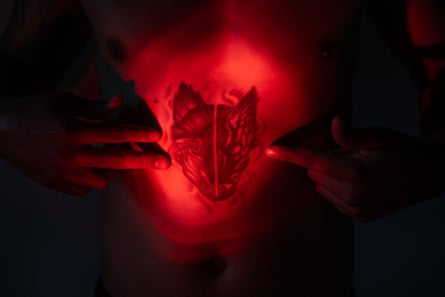
“My parents had been sick since I was little, so I had to go out of the house and work and make extra money for everyone, I am like the lone wolf that has to leave to protect his family,” he said. One day he would like to resume his engineering degree, maybe even in the US, or in a brighter, safer Venezuela.
A nostalgic look came over his face and he didn’t have much to say for a while. Then a song started to play inside the restaurant, Mi Libertad (My Freedom) by Jerry Rivera, a salsa song commonly viewed in Latin America as an anthem for those who have experienced the pain of confinement and seek redemption. He sang along softly and wept as some puzzled diners turned and looked.
“You want to know why I survived Cecot? Because the other Venezuelans and I used to sing this song and became like a family in the middle of the tragedy. Though singing meant more beatings by the guards, it gave us some sort of freedom,” Muñoz Pinto said.
This time, he didn’t cover his face. The future remained unclear but the singing was defiant.