.png) 1 month ago
28
1 month ago
28
Berthed in a dry dock near Bristol city centre, the grand old ship SS Great Britain is billed as the vessel that changed the world.
But a new museum opening in one of the old dock buildings close to Isambard Kingdom Brunel’s creation highlights that the ship did not always change the world for the better – and life for those who helped build it and travelled on it could be pretty miserable.
Tim Bryan, the project manager for the museum, said it presented a “warts and all” story.
“It’s the ship that changed the world, but there’s always an upside and a downside,” he said. “That’s human life. We have tried to provide a rounded picture of history, which we think is what people want.”
The museum describes, for example, how after the ship ceased operating as a transatlantic ocean liner, it was used to help Britain maintain imperial power, carrying soldiers to put down the Indian rebellion of 1857.
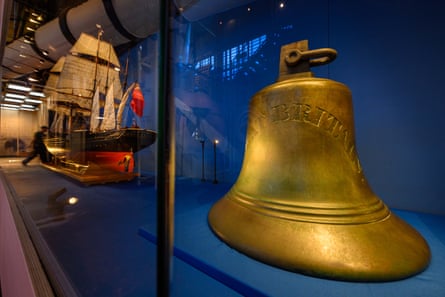
Later it took passengers to Australia, playing its part – as the museum acknowledges – in rapid and damaging change to the way of life of Indigenous people.
The new museum is part of a reimagining of the maritime site, which includes a name change from Brunel’s SS Great Britain to Bristol Dockyards, a move intended to make it “cooler” and more inclusive.
A key aim of the revamped attraction is to make it a place for conversations about difficult subjects such as migration and the British empire.
Bryan said another important strand was the museum’s focus on the people whose lives were entwined with the ship.
He said: “This exhibition is also about the people behind the ship – the people who built it, worked on it and travelled on it. Visitors are very interested in the people side of the ship – who they were, where they were going, what life was like onboard. It’s not just a big object in the dry dock – it’s about people.”
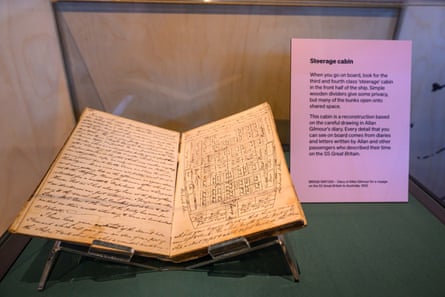
There are tales of first-class life, but the more gripping ones centre on the stories of the less well-off, such as Allan Gilmour, who travelled from the UK to Australia in 1852.
He kept a diary, in which one striking page is filled with a diagram of a steerage cabin, illustrating how painfully cramped it was.
The story of the ship’s builders and operators are also featured: people such as the apprentice shipwright James Johnson, who travelled from Gloucestershire at the age of 13 to work on the ship, and the fireman John Lee, originally from Ireland, who shovelled coal for hours at a time to keep the engines turning.
Bryan said: “The ship didn’t appear out of nowhere. It appeared not just because of people like Brunel, but also because of the work that was done by those guys who were in the dockyard riveting the plates together, doing the hard, physical work.”
An important part of the museum project has been bringing local people in to help delve into the archives and tell the site what stories they want to focus on.
Bryan said: “We started working with local communities a few years ago. We offered them the opportunity to discover things in our archive and to look at stories that really interested them.”
Another story told is that of James W Jones, who in 1837 was transported from Barbados to Australia for stealing a horse. In 1862, he travelled from Australia to England on SS Great Britain, working as a barber on the way, performing poetry, and taking part in a mock court trial where passengers debated the issue of slavery.
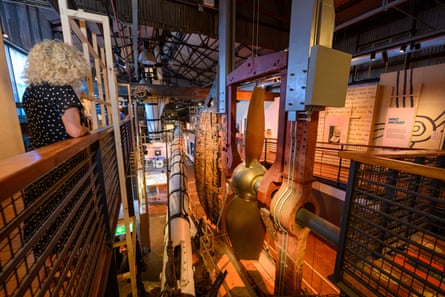
Though the vessel – the first ocean-going ship to be made of metal and use an underwater propeller – led the way for modern long-distance ships, it was not always a resounding success, the museum explains.
It was launched in Bristol in 1843 to help the city compete against other UK ports, but authorities in the south-west did not give it the backing it needed and Liverpool became its home port.
The exhibition also concedes that the ship was initially unpopular with passengers because its engines were not quite powerful enough for choppy seas.
After it stopped carrying passengers in the 1880s, the engines were removed and it was used as a cargo ship for wheat and coal until it was badly damaged in a storm and sold off as a wreck.
The ship was used as a floating warehouse in the Falkland Islands until it was abandoned in the 1930s. It was brought back to Bristol in 1970 and restored as a museum ship.
The new museum opens on Saturday 18 July.