.png) 2 months ago
62
2 months ago
62
It was October 2001 in New York City, and Mira Aroyo and bandmate Reuben Wu were invited to DJ a new party. The gritty, 200 capacity Luxx on Brooklyn’s Grand Street specialised in forgotten queer electro sounds from the 1980s. The party’s name? Electroclash.
“It was us, Peaches, people from Berlin,” remembers Aroyo. Larry Tee, the Atlanta DJ and RuPaul collaborator, had booked them for their love of overlooked gems by Gina X or Bobby O. “It was hedonistic, nonbinary, flamboyant.”
Returning to Liverpool, this fed into their band Ladytron’s definitive electroclash statement: 2002 single Seventeen. Against a throbbing synthesised bassline, vocalist Helen Marnie’s hushed, deadpan vocal warns ominously about teenage female disposability: “They only want you when you’re 17 / when you’re 21, you’re no fun.”
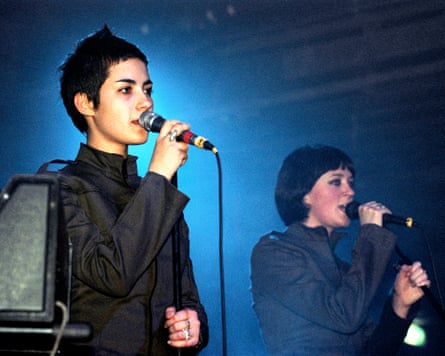
In 2026, Ladytron are back. Recording eighth album Paradises, the band that Brian Eno once praised as “the best of English pop music” decided on a pivot to the dancefloor. “The guiding principle,” says multi-instrumentalist Daniel Hunt, “was fun.” Single Kingdom Undersea is pure Balearic influenced bliss, while A Death in London is a deluxe 2020s update of the band’s signature noir sound.
Following a melancholic lockdown album, Hunt was aiming to recapture a feeling he remembered from being a Wirral teenager in 1989, when singles by Neneh Cherry or Soul II Soul zapped the indie rock from his body. “I wanted to capture that shock of modernity.”
The 1990s were the heyday of Scouse house, as high-energy, vocal-led club sounds made in Liverpool boomed from the city’s nightclub, Cream. Hunt, who DJ’d weirder, more alternative parties in the city, was keener on Stereolab. But his studio-space neighbour was Dan Evans, of house act 2 Funky 2. The producer instructed him how to programme a proper beat. “That was the epiphany,” remembers Hunt. “You didn’t have to be in a band rehearsing four nights a week, getting sick of each other.”
Aroyo, who was born in Bulgaria and moved to England aged 14, met Hunt DJing. She gave up studying genetics at Oxford to form Ladytron with him, who were completed in 1999 by Marnie and Wu. Hunt remembers watching Aroyo freestyling in Bulgarian over clattering electronics and thinking: we have something different here.
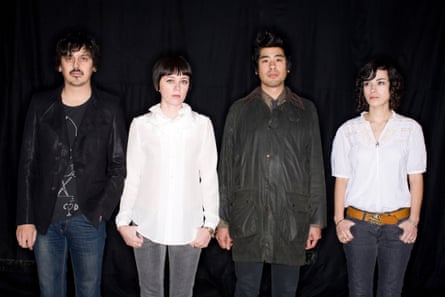
This meant doing things differently. Why suffer the British small venue circuit when you could play a rave in Berlin or Paris? “Liverpool’s a very outward looking city,” says Aroyo of their Mersey internationalism. There was, Hunt concedes, “an element of provincial chip-on-shoulder too. We didn’t want to play the game.” They only played London after debut 604 was on shelves.
As electroclash surged, the band rebelled against it. Possibly too much. Today, Hunt is proud of a movement that he terms “a portal” for suburban kids into a glamorous androgynous future. But they were wary of being typecast. “People were like: oh my God, the way you say you aren’t electroclash is so electroclash,” he remembers. “It was like the Streisand effect.”
All this fed into their remarkable 2005 album Witching Hour, shelving sequencers and drum machines to become a bewitching and oblique psychedelic act. “It’s only because that record was so good that we survived,” says Hunt – the release was marred by their label going bust. “It was received well by people who hadn’t previously taken us seriously.”
Some of those were in unlikely places. Nobody knew that Christina Aguilera was a Ladytron stan until her management asked to fly the band out to collaborate in 2008.
“She is actually a really big fan,” says Hunt, rather than her having “been given a list of people who might be cool”. There’s an alternate timeline where their collab, the ominous darkwave Birds of Prey, changed everything for Ladytron. But, distracted by her Burlesque movie, the track trickled out on the bonus disc of her 2010 album Bionic.
The band went on hiatus the following year, to have “normal experiences”, as Ayoro terms it. She studied and had a family. Marnie went solo. Hunt moved to São Paulo, embracing leftist activism in the city. When Ladytron returned in 2019 with their self-titled comeback (minus Wu, who left amicably), Hunt was interviewing Lula, working with Corbyn’s Labour and speaking in the House of Commons on Bolsonaro’s crackdown on human rights.
All this made what happened next even more surprising. In 2021, Seventeen exploded on TikTok. Users clipped its central hook for dances and lip-syncs, but also personal reflections – often harrowing – identifying with its lyrics. The song’s “renewed interest is a wonder”, says Marnie. “Kids are really grasping hold of it and making it their own.” The song soared from an average 3K daily listens to 160K, entering Spotify’s US Viral Top 50 chart at 11. Their streaming royalty payments tripled.
But they turned down requests from their record label to capitalise on it. Hunt is scathing about the “microcelebrity” self-promo that puts pressure on artists to act out online. “Every minute an artist spends on marketing or social media is one minute less they spend on writing and making records.” The trend came and went, and Aroyo is delighted to see “17, 18-year-olds with crazy Day-Glo makeup” at concerts rubbing shoulders with the old guard.
Once, it was Ladytron doing the rediscovering. Now, it’s their own pop past that teenagers are picking up and trying on for size. With band members scattered across the globe, Ladytron are surprisingly international underground pop survivors. “We’ve become,” Hunt says proudly of their evolution, “the people we always pretended to be.”