.png) 3 months ago
47
3 months ago
47
Game feel is one of the most elusive concepts in the glossary of interactive entertainment, at once perfectly clear and difficult to define. Obviously, it refers to what a game feels like to play, but where does that feeling come from? How does it manifest? Or consider it from a different angle. When the chef Samin Nosrat started her career at the renowned Chez Panisse in California, she began to understand that what diners really responded to in their food were four key factors – salt, fat, acid and heat – and how these elements interacted. This idea formed the basis of her bestselling cookbook. It perhaps also inspired a video game audio director to once compare game feel to eating a potato chip: the salt and fat are part of it but so are the crunch and the sensation of the chip dissolving in your mouth (pdf). Game feel is a combination of elements – the responsiveness of the controls, the intuitiveness of the action, the aesthetics of the world and the creative opportunities they engender – all coming together in the right quantities.
I’m thinking about this a lot right now, because three games released in the last few days illustrate the idea of good game feel beautifully. The first is Pragmata, Capcom’s sci-fi action adventure in which you explore an abandoned colony base with the help of a child-like android, who lets you hack robotic enemies, lowering their defences before you blast them to pieces. The hacking mini-game takes place on a grid with nodes that add power-ups to your hack attack. As you progress, you add new types of nodes, as well as new weapons, and the interplay between these elements is complex, multifaceted and fun. This takes place in a linear world filled with hidden areas, so exploration is guided but discovery is possible. You run, jump and glide – it all feels seamless. It is joyous simply to be there.
Saros, the latest title from sublimely talented Finnish studio Housemarque, has similarities. It’s about human astronauts trying to make contact with a lost colony on a hostile planet, but the game systems are different. Here, you can use a shield to absorb incoming enemy fire, thereby powering up your own special weapon to unleash deadly bursts. Through this simple system, there’s a lovely interplay between attack and defence: you observe, track and dart into enemy fire, while managing your shields and firing your weapon, which uses the analogue triggers to access a variety of shooting styles. It feels as if you’re playing a classic 2D shooter such as R-Type, but in three dimensions, while doing several other things. But again, the movement is luscious, the guns give great feedback when shot, and the world is gorgeous. It reminds me of the Dark Souls games by FromSoftware and how they’re hard but fair because you always know why you lost, and it was always your fault. The game gives you everything you need and want – the potato chip is crunchy, yet it dissolves in the way you expect.
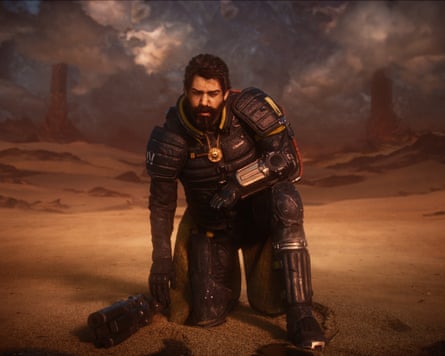
The final game is Vampire Crawlers, a deck-building roguelike in which you explore pixellated dungeons while collecting treasure and defeating monsters with differently powered cards. This is a massively oversubscribed genre, and yet Crawlers is still maddeningly compelling. It has the nostalgic visual appeal of an old Commodore 64 or Amiga game and lovely sound effects, from the crunchy noise of skeleton bones being skewered to the vibrating hum of a newly discovered treasure chest. The speed at which combat happens and cards are played is so fluid, so perfectly devoid of unnecessary friction, that it drags you into a flow state so deep it takes hours to emerge from.
What has been so lovely about discovering and playing these games is that they are an affront to what we’re supposed to want at the moment: online multiplayer blasters, where the rewards are often superficial – new costumes, custom gun skins, little trinkets to impress other players. There are no other players in these worlds, your only company is mechanical. Pragmata, Saros and Vampire Crawlers are great old-fashioned meals – succulent, tasty and moreish, yet served on simple white plates. They are nostalgic for an age of challenging single-player action games that differentiated themselves through clever systems and responseful controls; they focus on little ideas that come together to make something larger. If you want to understand game feel, don’t Google it, don’t go to ChatGPT – load one of these games and tuck in. You’ll know it when you taste it.
What to play

I have something a little different for you this week, but bear with me (that’s a pun, by the way – all will become clear). Mix Up Fairy Tales is a collaborative story-generating card game by Warcradle Studios, produced in conjunction with the British Library’s Fairy Tales exhibition. Each card in the deck contains a portion of a classic tale such as Goldilocks and the Three Bears, Hansel and Gretel and Cinderella (as well as a beautiful illustration from the library’s collection), and the aim is to mix up plot points to meet the requirements of a series of challenge cards. You may have to craft a story that features a witch or a cat (or both) to beat the challenge and get points – or you might have to ensure your story doesn’t contain a house or a monster. While you beat challenges, the story continually changes, making a sort of emergent narrative experience, which reflects the adaptable oral history of the genre.
Fairytales have been a huge influence on video games – the standard tropes of rescuing damsels in distress, battling supernatural foes and saving imperilled kingdoms have all been appropriated and remodelled since the days of Donkey Kong. This is a lovely way to reconnect with those formative tales in a playful way.
Available from: the British Library store
Estimated playtime: 15 minutes per session
What to read
-
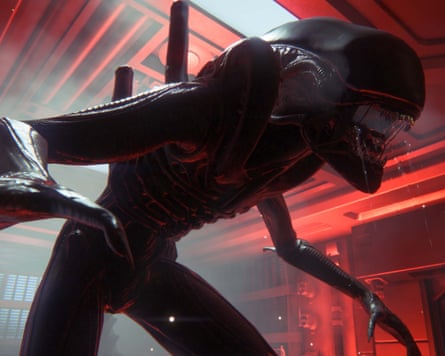
Prepare yourself for several hours of hiding in a gym locker: Creative Assembly has just announced that an Alien Isolation sequel is in gestation. The short teaser trailer is mostly darkness and beeping noises followed by doors opening on to some sort of wind-ravaged environment. Is it Earth? LV-426? A whole new colony? We’re just going to have to wait behind the sofa for more details.
-
The ever-reliable Rob Fahey has a good piece on GamesIndustry.Biz arguing that Call of Duty was never right for the Xbox Game Pass. Forthcoming instalments in the blockbusting shooter will no longer be placed on the subscription service from day one, and Fahey suggests this is the best outcome for CoD fans and non-fans.
-
Ars Technica has a superb long read on Peter Molyneux’s failed Legacy game, which attracted millions of dollars of cryptocurrency investments before collapsing. The picture it paints of Molyneux and publisher Gala is not pretty and the whole thing reads as a stark cautionary tale from the boom era of NFTs.
What to click
-
Saros review – you’ll strafe until your thumbs hurt in this primal alien shooter | ★★★★☆
-
‘Opening the hidden door within us’: how Exit 8 took a simple game to purgatory
-
Michael B Jordan to take on big-screen adaptation of hit video game Battlefield
Question Block
Here is a timely question from Carrie:
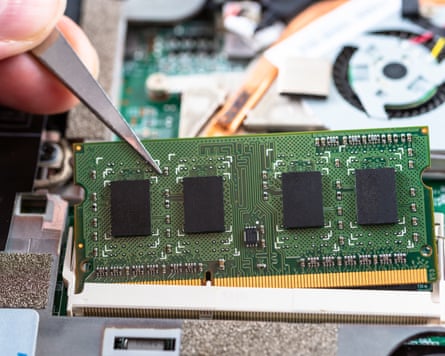
“Considering the rising RAM prices (thanks, AI industry!), is it still possible to buy a new gaming PC for less than £500?”
Um, kind of. But you’re going to have to make sacrifices. First, if you can build it yourself you’ll get a better deal; there a few online retailers offering ultra-budget preassembled PCs, but you won’t be sure of how well everything is put together or where costs have been cut. I’d go for a bundle on the CPU and motherboard. You can get an AMD Ryzen 5 or 7 (go for a G-series or 9000 series model) or Intel Core Ultra 5 CPU, plus a decent motherboard for about £250 to £350 online. If you just want to play older games or less demanding modern titles, the integrated graphics solutions in these CPUs should be enough. For system memory, I’d go for 16GB of the older DDR4 type, rather than 8GB of DDR5 (although check for compatibility with your CPU). This will cost about £150. For storage, an M.2 SSD at 500gb or 1tb (if you can find a good deal) will be £75ish. From here, a mouse and keyboard bundle and a cheap case will set you back £75, or slightly more if you’re being fancy.
So, for a PC with all-new parts that will run undemanding games (on lower graphics settings, let’s be honest), we’re at £550. Oops. You can lower the cost by buying used parts on eBay, CeX or other online resellers, but get a warranty and check PCPartPicker to ensure everything is compatible. There are lots of YouTube videos on PC building and the Build a PC subreddit is usually wonderful for troubleshooting. Good luck!
If you’ve got a question for Question Block – or anything else to say about the newsletter – hit reply or email us on [email protected].