.png) 3 months ago
100
3 months ago
100
In 2025, when Elon Musk joined the government as the de facto head of something called the “department of government efficiency”, he declared that governments were poorly configured “big dumb machines”. To the senator Ted Cruz, he explained that “the only way to reconcile the databases and get rid of waste and fraud is to actually look at the computers”.
Muskism came to Washington soaked in memes, adolescent boasts and sadistic victory dances over mass firings. Leading a team of teenage coders and mid-level managers drawn from his suite of companies, Musk aimed to enter the codebase and rewrite regulations and budget lines from within. He would drag the paper-pushing bureaucracy kicking and screaming into the digital 21st century, scanning the contents of cavernous rooms of filing cabinets and feeding the data into a single interoperable system. The undertaking combined features of private equity-led restructuring with startup management, shot through with the sensibility of gaming and rightwing culture war. To succeed, he would need “God mode”, an overview of the whole.
If the mandate of Doge was to “[modernise] federal technology and software to maximise governmental efficiency and productivity”, in the words of the executive order that launched the initiative on 20 January 2025, the reality was a strengthening of the state’s surveillance capacities. Over time, Musk had become convinced that the real bugs in the code were people, especially the non-white illegal immigrants whom he saw as pawns in a liberal scheme to corrupt democracy and beneficiaries of what he called “suicidal empathy”. He understood empathy itself in coding terms. It was an “exploit” or a software vulnerability against which the system architecture needed to be hardened.
Musk’s office featured a gaming rig complete with an oversized curved screen, and the Doge website had a leaderboard for tallying cuts in real time. But beneath the jokes and cosplay lay a serious conviction. If the state was just a database, then inefficiency came from bad data: undocumented foreigners, ghost employees, even “vampires” collecting social security. These were bugs in the codebase, irregularities to be traced, quarantined and purged. Musk had revamped and retrained Twitter into X. To him, the US state was just another system – a glitchy dataset to be scrubbed and optimised.
Call it StateX.
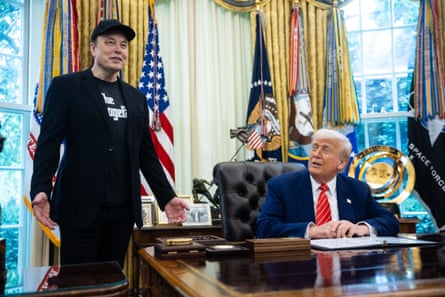
Doge marked a new stage in Musk’s relationship to government. His companies had always fed on public subsidies and contracts, but now he stepped inside the state itself. He did so under the banner of a meme. Doge owed its name to the popular Shiba Inu meme, as well as to the memecoin it inspired. Musk called himself the “Dogefather” and used a cartoon dog as Doge’s first logo. Musk revelled in the absurdity. “Doge started out as a meme,” he mused in February 2025. “Now it’s real. Isn’t that crazy?”
To explain the project, Musk turned to one of his favourite movies, Star Trek II: The Wrath of Khan. In the 1982 film, Captain Kirk wins an unwinnable training simulation called the Kobayashi Maru by reprogramming it. Doge, Musk said, took the same approach. Shortly after launching Doge, he explained that “the only way to achieve success is to reprogram the matrix such that success is one of the possible outcomes. That’s what we’re doing.” Texting a friend after his first campaign appearance with Trump, he reiterated his reasoning: “Tomorrow we unleash the anomaly in the matrix.” Musk had already defied the logic of the automotive and aerospace industries by disrupting the incumbents: “SpaceX is an anomaly in the matrix,” he tweeted. Why couldn’t he do the same in government?

Musk’s lighthearted approach suggested he thought the task would be an easy one. It might even be fun – beating a game on easy mode. When he posted a picture of his Doge office with the gaming rig, it included a Photoshopped portrait of Pepe the Frog dressed as a Roman gladiator on the wall behind his desk. This was Kekius Maximus, an alias that Musk used in two of his favourite video games, Path of Exile 2 and Diablo 4, which he played while conceiving of and implementing Doge.
Both games belong to a subgenre known as “dungeon crawlers”. You navigate labyrinthine environments filled with monsters, and descend deeper into dangerous areas, facing waves of attacks by enemy swarms, clearing one room after another by slaying all occupants. It is easy to see how such games may have informed his mindset. He had already cleansed Twitter of wokeness. Now he would enter the dungeons of Washington DC and slay what he called the “the woke parasite in the government”.
Musk occasionally made the cross-fertilisation of the domains of games and government explicit. Days after Trump won his second term, he shared a clip that purportedly showed him mowing down masses of demons in Diablo 4. He appended a comment: “The goal of @Doge is to speedrun fixing the federal government.”
Speedrunning is a popular spectator sport on livestreaming platforms such as Twitch that involves completing a game, or a portion of a game, as fast as possible. It echoes Musk’s managerial style: he prioritises speed at his companies, often by setting unrealistic deadlines and pushing his employees hard to meet them. He himself has invited the comparison: “Speedrunning Factorio in real life …” he tweeted in September 2020, referencing a game that involves building factories. Speedrunning also often depends on using loopholes. Some games have glitches that enable you to skip levels, go through walls, or perform other shortcuts. Others are vulnerable to “arbitrary code execution”, an exploit where custom code is injected into a game’s memory to change its behaviour. Which tricks are considered permissible depends on which corner of the speedrunning community you belong to. “Any%” is a term that means all glitches and exploits may be used.
Musk’s Doge speedrun belonged to the “any%” category. What that would mean became clear during Trump’s second inauguration. Minutes after the ceremony began, programmers working for Doge requested access to the computer systems of the US Office of Personnel Management. Within half an hour, they had taken possession of files with information about millions of federal workers. Days later, they also gained the authority to send out an email to all federal employees from a single address. They used this power to make the same offer in the same language (subject line: fork in the road) that Musk had made at Twitter years earlier: quit with paid leave or face the likelihood of getting fired.
The pattern recurred across the federal government. Speaking to the World Governments Summit in Dubai by videocall in February 2025, Musk announced his intention to “delete entire agencies … If you don’t remove the roots of the weed,” he said, “then it’s easy for the weed to grow back.” From the start, Musk made it a priority for Doge to gain access to databases and other digital infrastructure. He often talked about the need to “control the computers”, one source told the New Yorker. His surrogates surged into one agency after another with laptops in backpacks, sometimes hauling in mattresses for sleepovers. Establishing centralised command-and-control positions, they rolled out a playbook that can be summarised as: delete, automate and integrate.
The logic of deletion was clearest in zero-based budgeting (ZBB), the method that Musk embraced at both Twitter and Doge. Invented in the 1960s, ZBB forced every department to justify each expense anew rather than carrying budgets forward. Long dismissed as unworkable, by 2024, Silicon Valley firms were claiming that new technology had finally made ZBB feasible. Manually analysing and justifying each budget item was terribly time-intensive. But with large language models (LLMs) and AI accounting tools, this process could be performed automatically. Budgets could be rebuilt by bot. According to Wired, Musk captured the computer systems of the US Treasury’s Bureau of Fiscal Service in Doge’s first month in the hopes of creating “a ‘delete’ button he could wield against any agency by cutting off its funding at the source”. Some agencies, such as USAID, were effectively dissolved, fed into “the wood chipper”, as Musk put it in a tweet.
Zero-based budgeting rarely succeeds in cutting costs. Its real effect, in Musk’s hands, was the concentration of power. His approach assumed that all expenditures were waste, and that bad data – whether fraudulent contracts, useless staff or illegitimate people – could simply be deleted. What Doge sought to automate, the media researcher Eryk Salvaggio noted, was “not paperwork but democratic decision-making”. Efficiency became the alibi for centralisation.
This centralisation took material form in Doge’s approach to data, which aimed to put all of the government’s information into a single repository. Washington had pursued the dream of data integration since the post-9/11 Patriot Act but the kind of total digital unification envisioned by Doge was unprecedented. It found its most ambitious expression in the attempt to make all taxpayer data – including names, addresses, social security numbers, tax returns and employment information – accessible from one portal.
The analogy to Silicon Valley platforms was deliberate. Uber had its “God View”, letting employees watch every ride in real time. When Musk was buying Twitter, he demanded access to the platform’s “firehose” – the unfiltered stream of all user activity. Now the same principle was being applied to the state. Peter Thiel’s data integration and analytics company Palantir was a major partner in this undertaking. The company received more than $113m in government contracts in the first months of the Trump administration for work that included making it easier to integrate information from different agencies.
Pooling data meant eliminating the legal and privacy guardrails that existed throughout the federal government. Silos are not necessarily bad things. They are spaces of privileged information. The barriers between them can be safeguards – checks against overreach, misuse and surveillance. But from the perspective of Doge, they were obstacles to integration.
Such integration also made it easier to introduce AI software, another priority for Doge. To train AI models, and to use them to replace federal workers, data needed to be centralised and standardised. At the Department of Veteran Affairs, Doge deployed an AI script to cancel unnecessary contracts. (The model hallucinated, mistaking contracts worth thousands for those worth millions of dollars.) Doge also used AI to locate “diversity, equity, inclusion (DEI)” language in government policies and programmes. Most startlingly, in July 2025, Doge’s operatives announced the rollout of the “Doge AI Deregulation Decision Tool”, which they promised would cut 100,000 federal regulations within six months. They vowed to save 93% of the human labour involved in eliminating regulations by automating away the most time-consuming aspect: namely, reviewing comments submitted by American citizens. They boasted that hundreds of thousands of comments could be analysed by AI almost instantly.
Doge’s endpoint was governance by AI: the state not as a space of deliberation but as lines of executable code. Musk reinforced the conceit with a “tech support” T-shirt at cabinet meetings, presenting his role in apolitical terms. But the project was deeply political. Doge’s dream of data omniscience went beyond cost-benefit analysis or software modernisation – those had been mantras of earlier administrations. For Doge, the hunt for “waste, fraud and abuse” blurred seamlessly into the hunt for illegitimate people: irregularities to be deleted. Muskism was not just about trimming budgets. Scaled to society, it meant purging those deemed out of place.
Once governance became a question of code, the next issue was obvious: which data counted as valid and which should be deleted? For Musk, the bugs were not only wasted dollars or redundant staff, but suspect people. Early in his Doge tenure, he insisted that social security cheques were going out to the dead – a conclusion born of misreading agency data. Lacking experience in government, his team often struggled to interpret its systems. When asked by an interviewer to respond to critics such as Bill Gates, who claimed that cuts to USAID would cost millions of lives, he dismissed them. In his coder’s idiom, “the empathy exploit” was simply “a bug in western civilization” to be patched. This had been integral to Musk’s thinking for decades. According to a biography of Musk, his brother Kimbal took up the smartphone game Polytopia because Musk said it would teach him how to be a CEO. The first lesson was “Empathy is not an asset.” The second was “Play life like a game.”
Treating life like a game had its own ethos and its own philosophers. In a theory often cited by Musk, Nick Bostrom speculates that we may be living in a simulation running on a mainframe in the future. Further, many of the people around us may not be human beings but computer programs: what Bostrom calls “shadow-people”, convincing imitations that lack interiority. The ethical consequences are significant. If we are surrounded by shadow people, then appeals to empathy are not moral imperatives but manipulative code. The rational response is to steel yourself against humanitarian sentiment. The economist Robin Hanson came to this conclusion in 2001 in a famous article called How to Live in a Simulation. “If you might be living in a simulation,” he wrote, “then all else equal it seems that you should care less about others.”
Seeing the world as code bled easily into politics. Musk called George Soros a “system hacker” who was funding a “fake asylum-seeker nightmare”, while NGOs were bankrolling “fake protests” against Tesla dealerships. The federal government was overrun with fraud, Musk claimed. It belonged to a broader exploit: Democrats were using the money to import undocumented immigrants en masse to “create a permanent majority – a one-party state”. He believed they were doing so through a “hack” of asylum law. “Just say the magic phrase ‘I seek asylum’ and you’re in,” he said. “No evidence at all is required.”
According to Musk, Biden had opened the border. The US was “rolling out the red (in more ways than one) carpet for homicidal cannibals” and making it possible for “illegals” to vote – meaning that “2024 will probably be the last election actually decided by US citizens”. The day before the election, Musk told Joe Rogan and his tens of millions of listeners that migrants were “literally being flown into swing states”, in some cases resulting in “700% increases” in the number of undocumented residents. The border, he said, “basically doesn’t exist”.
These statements were not true. The border was not open. Asylum seekers were vetted, and many applications were denied. No non-citizens, let alone undocumented people, were permitted to vote and incidents of such fraud were vanishingly rare. There were no cannibals. An analysis of tens of thousands of tweets by Bloomberg found that Musk had become “X’s biggest promoter of anti-immigrant conspiracies”. In 2024, he tweeted more than 1,300 times about immigration and voter fraud, receiving about 10bn views in total.
Musk’s panic-mongering about people out of place expanded beyond the US. These were the same months he promoted the European far-right demand for the forced “remigration” of its immigrant population. Remigration was the human equivalent of zero-based budgeting: wipe the slate clean, remove redundant or illegitimate entries, and start over.
The convergence of code and nativism was stark. Doge’s most consequential act of data integration was designed to accelerate mass deportations. By March 2025, Musk’s operatives had begun building what Wired called a “master database” to track immigrants – knitting together records across the Department of Homeland Security, IRS, Social Security Administration and voting rolls. It dovetailed with Palantir’s $30m “ImmigrationOS” contract with ICE (Immigration and Customs Enforcement), which promised “near real-time visibility” on non-citizens.
The next month, the New York Times reported that the Trump administration had added thousands of individuals to the social security administration’s “death master file”, which cut off access to their credit cards and bank accounts. One former commissioner called it “financial murder”. The goal was to choke out people’s ability to make a living and force them to “self-deport”. Trump also called for a national census that would not count undocumented residents, breaking with the principle that had guided American practice since 1790 – the exceptions being enslaved people, counted as three-fifths of a person, and Indigenous people, not counted at all. What began as “tech support” for government databases meshed seamlessly with exclusionist politics.
Before and during his time at Doge, Musk repeatedly referred to what he was doing as “reprogramming the matrix”. But what did he mean? In the film The Matrix, a young hacker named Neo discovers that life is a simulation: humans are stored in bio-mechanical honeycombs as batteries for a digital super-intelligence that pacifies them with an illusion. “Take the red pill,” Musk tweeted for the first time in May 2020, invoking the scene where Neo must choose between seeing the truth (red pill) or staying in blissful ignorance (blue pill). The phrase has become a byword for the 21st-century far right. Neo’s transformation from passive observer to active combatant is catalysed by the red pill. Taking the red pill is not just about seeing through the simulation but mastering it. The decisive shift comes when Neo learns to reprogram the matrix from the inside, enabling him to defeat the black-suited agents who hunt down anomalies.
By the end of the film, Neo has adopted a chilling interpersonal style. If everyone is living in a simulation, then nobody’s life matters. The film’s most dramatic sequence features Neo in an overcoat doing cartwheels while mowing down dozens of enemies with guns in both hands and a blank expression on his face. But these are not acts of murder any more than they would be in a video game. The casualties are fake people.
The Matrix is a touchstone for the manosphere, an online community proudly touting male supremacy and misogyny. Musk has sometimes been described as being part of this group. He has indeed been welcomed by manosphere leaders such as Andrew Tate, who had previously been banned from Twitter, later to be restored by Musk. In an online conversation with Musk, Tate said the purchase of the social media platform had “cracked the matrix in real time and it becomes extremely difficult now to run the psyops they were previously running and enslave the populace which is their primary goal”.
Yet there is a basic but important difference between Musk and the manosphere. Tate talks about the need to break the matrix or escape from it. Musk is the rare figure who sees the matrix not as the problem, but as part of the solution. Muskism, in the end, means building a better matrix.
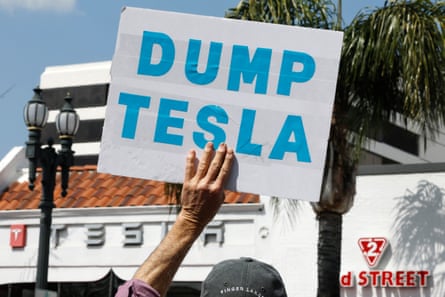
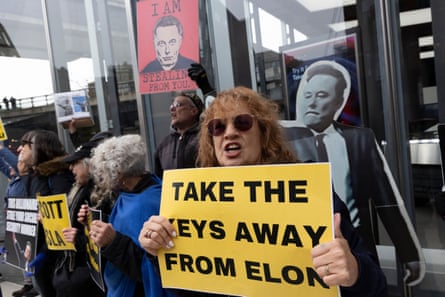
This is what Musk was trying to do with Doge, combining ludic qualities of gaming with the fear of infiltration and an attempted renovation of governance through coding. In April 2025, he made the analogy literal, posting an image of himself as Neo brandishing two submachine guns in the lobby of the CIA. But reprogramming the matrix was not as easy as he imagined. Musk left Doge at the end of May 2025 after his 130-day tenure as a “special government employee” not in sunglasses but with a black eye (reportedly delivered by his toddler). By then, Doge’s website claimed $170bn in savings. An investigation by the Financial Times could verify “only a sliver of that figure”. After the generous tax cuts for the wealthy in Trump’s One Big Beautiful Bill were passed in July 2025, the savings were erased altogether. Doge became what Musk described as a “whipping boy” for all manner of public discontent. Tesla sales plummeted along with Musk’s popularity.
Seen one way, Doge exposed the limits of Muskism as a mode of governance. Companies can treat workers as disposable units because the surrounding state guarantees their basic existence. Musk had ruthlessly deleted workers at his own companies and made deft use of labour law’s loopholes, but in seeking to make real cuts at Doge, he collided with the fragile contract at the core of American life – misleadingly called “entitlements”, but better understood as the survival infrastructure for many millions of people. As Americans vented their anger at feared or actual loss of access to social security and Medicare benefits, Musk’s reputation suffered.
Musk had imagined Doge as the realisation of the dream of reactionary technocracy, in which engineers disciplined society like a factory floor. But society is not a factory. It encompasses children, elderly people, disabled people, the geographically stranded – the very categories of life that markets define as surplus. In trying to impose a cyborg logic of optimisation, Musk discovered that humans were not programmable units, and that the public sector’s role is precisely to provide goods that the private sector can’t or won’t. The conflation of codebase, company and state didn’t work.
From another angle, of course, it was the state that instrumentalised Musk. Trump’s circle used Musk to wage war on the “woke” domains of higher education, foreign aid and scientific research under the cover of “efficiency” while attacking the administrative state and terrorising the federal workforce. Doge also gave an experimental prod to the flesh of the welfare state to see how the body politic responded. When resistance surged, Musk absorbed the blame, but many of the changes remained. Perhaps the most important was the federal government’s expanded capacity for domestic surveillance, as facilitated through Doge’s data-integration efforts. In this sense, Muskism proved not a governing philosophy but a toolkit available to those who govern.
The end of Doge can thus be read in two ways. One is personal: Musk’s overreach, his inability to transform celebrity capital into co-leadership of the state. The other is structural: the deeper implantation of contractors such as Palantir into the backend of government. For all the pyrotechnics of the feud with Trump that unfolded after Musk’s departure from Washington, Musk’s companies continued to be awarded new Pentagon contracts. In July 2025, Musk’s company xAI announced that it had entered a contract with the Department of Defense for its “Grok for Government” suite of AI products. This happened the same day that the company introduced “Ani”, an animated AI companion that can engage in sexually explicit conversations. Summing up the situation, one headline read: “Grok rolls out pornographic anime companion, lands Department of Defense contract.”
In 2026, the core themes of Muskism are more visible than ever. In February, xAI signed a deal to deploy its AI bot Grok on classified military networks – just in time for the US-Israeli war on Iran. In March, a former Doge employee in his 20s who gutted the Consumer Financial Protection Bureau and retweeted Nazi apologist Nick Fuentes was appointed chief data officer in charge of AI at the Department of War. Meanwhile, the White House posts propaganda videos on X that blend video games, memes and real-life drone footage shot from the battlefield. The line between digital and political power, between gaming and government, between speedrunning and statesmanship, has disappeared. Welcome to life under Muskism.
This is an edited extract of Muskism: A Guide for the Perplexed, published on 24 March by Penguin. To support the Guardian, order a copy from guardianbookshop.com. Delivery charges may apply