.png) 3 months ago
56
3 months ago
56
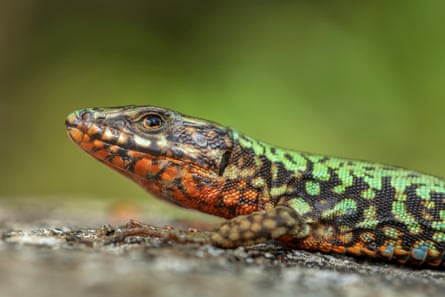
Twelve miles from the heart of Rome, Dr Javier Ábalos pauses his walk, lifts his sunglasses and points. To his right, perched on a rocky wall, sits a beautiful lizard. Its body is coated in charcoal-black tones speckled with striking yellow across a green dorsum, and its head, with a prominent jaw, is splashed with fluorescent blue spots. The reptile basks in the sun, unconcerned by our presence.
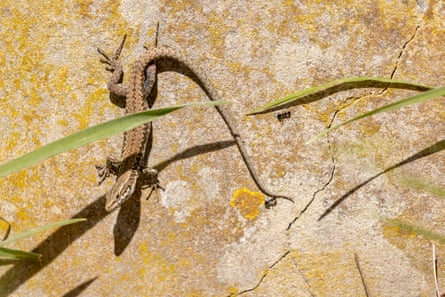
About 80 miles (130km) drive farther along the road that connects the capital with the small village of Poggio di Roio, the researcher from the University of Valencia has barely stepped out of the car when he spots another lizard. This one is smaller, with a brownish body and a narrower head crisscrossed by a network of dark stripes.
-
Researchers fear the common wall lizard of the white morph could be driven to extinction by the arrival of a new variation
Even after more than a decade studying colour variations among European lizards, their differences still amaze Ábalos. “Who’d guess they’re the same species?” he says, smiling.
Despite their obvious differences, both animals are adult males of the common wall lizard (Podarcis muralis), a widespread species whose remarkable variation in colour, size and behaviour reveals a crucial dimension of biodiversity: the variation within species.
-
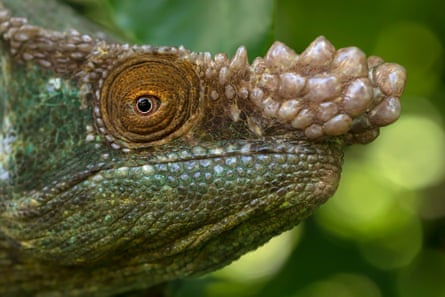
Parson’s chameleons (Calumma parsonii) show variations in the size and colouration of their rostral ornaments
The lizards are evidence that biodiversity is far more complex than a simple inventory of species inhabiting an ecosystem.
Differences in rostral ornaments, or horns, among male Parson’s chameleons (Calumma parsonii) in Madagascar, social or feeding behaviours among populations of chimpanzees (Pan troglodytes), regional song dialects in white-crowned sparrows (Zonotrichia leucophrys), or colour variation in common wall lizards are all expressions of biodiversity within species. And this biodiversity is not static, but often shifts to the tune of evolution.
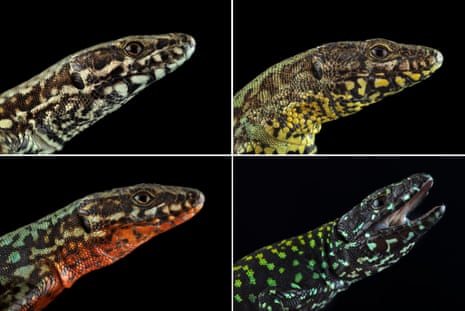
When it comes to the common wall lizard, three alternative body colourations (known as white, yellow and orange “morphs”) have coexisted for millions of years in Italy in what researchers describe as a delicate and enigmatic balance maintained through complex social and sexual interactions.
Some males display brown bodies with pale, almost white, throats and bellies. Others show yellow undersides, while a third group exhibits bright orange or reddish colours.
-
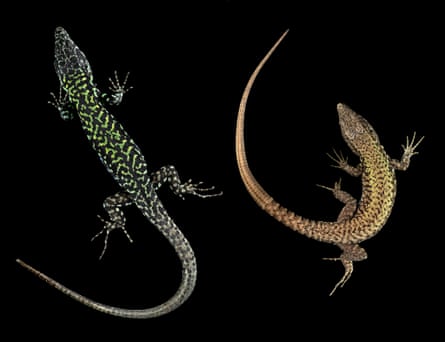
The nigriventris morph, left, is larger and more aggressive than its white morph relative
Yet these three morphs are no longer the only ones. A recently published study in Science suggests that the emergence of a fourth variation of the species (a bulkier form with a bright green dorsal colour over a pitch-black reticulation, known as nigriventris) could disrupt the ancient equilibrium and potentially drive the original three morphs towards extinction.
-
Common wall lizard varieties clockwise from top left: a male white morph; a male yellow morph; a male nigriventris morph; and a male orange morph
The study, conducted by an international team of researchers, measured the colouration of 2,506 lizards captured across 148 locations in Italy, and reconstructed the evolutionary history of the studied populations.
Their results show that the spread of this new, larger, darker and more aggressive nigriventris form (which may have originated on ancient islands that existed in the Rome basin during the Pliocene and Pleistocene epochs) could skew competition among males, leaving the white, yellow and orange morphs struggling to persist.
“We are seeing how the coexistence of different colour morphs – something that has been stable for millions of years – is being lost over a very short evolutionary timescale,” says Prof Tobias Uller, of Lund University in Sweden, who led the study.
“By showing how colour variants that have coexisted for millions of years can be wiped out, we now better understand how the emergence of new traits changes the natural processes that maintain diversity within species.”
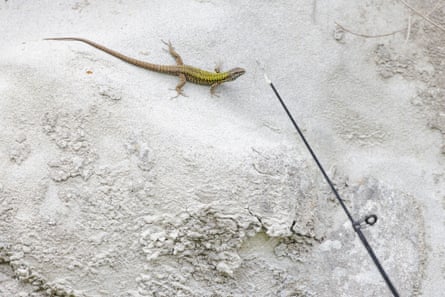
-
Researchers use a modified fishing rod fitted with surgical thread to catch a male common wall lizard
In nature, biodiversity within species extends beyond appearance. Genetic, behavioural and morphological variation shape not only what a species is, but what it might become, offering a reservoir of traits that may help populations face present and future challenges to survival and reproduction.
Dr Nathalie Feiner, of the Max Planck Institute and co-author of the study, says: “Without such variation, evolution would stall, and the capacity for adaptation would be lost.
“Understanding and preventing the erosion of this diversity therefore lies at the very core of conservation biology.”
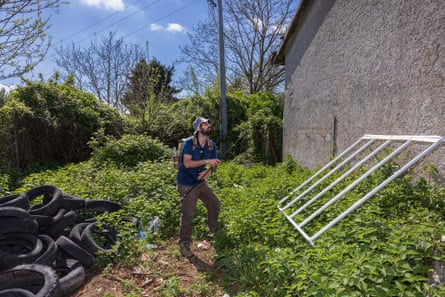
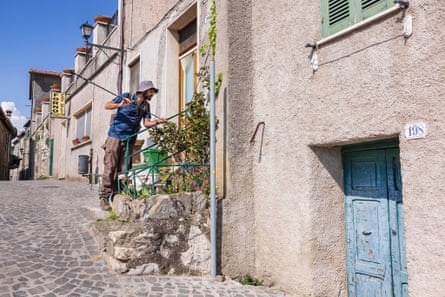
-
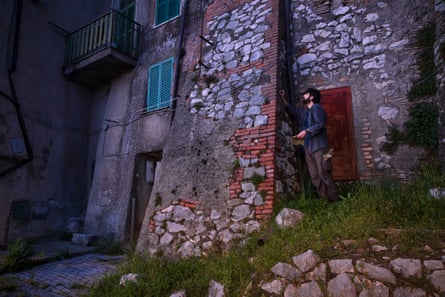
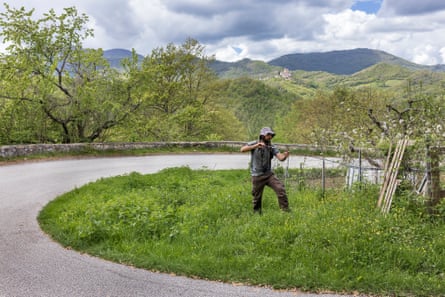
Javier Ábalos looks for common wall lizards, using the modified fishing rod to capture them. He returns them after he has measured them
Yet nature does not unfold in isolation. Human pressures can also push biodiversity (including within species) towards collapse. Here, again, wall lizards provide some insight.
A group of researchers, some of whom contributed to the common wall lizards study, is working hard to save one of Europe’s most endangered vertebrates: the Aeolian wall lizard (Podarcis raffonei). Their goal is to prevent extinction, but also to preserve the diversity that defines the species.

-
Colour data is recorded using specialised cameras and spectrophotometers, which measure how surfaces reflect light across wavelengths
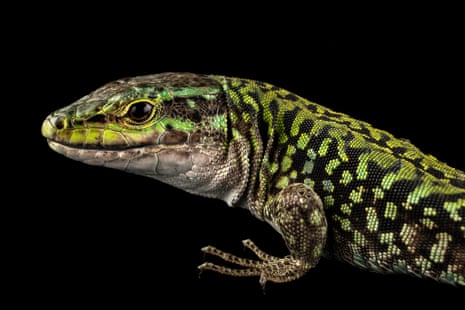
For millions of years, Aeolian wall lizards have inhabited a few small islets in the Aeolian archipelago, north of Sicily. On each islet, the lizards display distinctive colours, ranging from pale brown to emerald green tones. Today, habitat degradation, the presence of the invasive black rat, and, most critically, the introduction of the Italian wall lizard (Podarcis siculus), threaten their survival.
Research shows that Aeolian wall lizards perform poorly during encounters with invasive lizards as they compete over food and shelter, being attacked and having to escape more frequently. The invaders’ strong competitive advantage often results in territorial monopolisation, reducing the reproductive opportunities of Aeolian wall lizards.
-
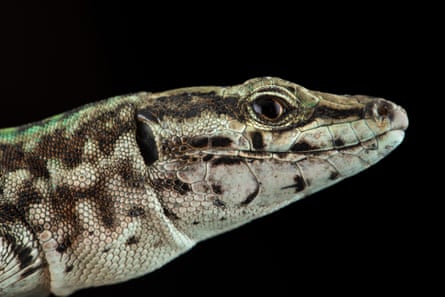
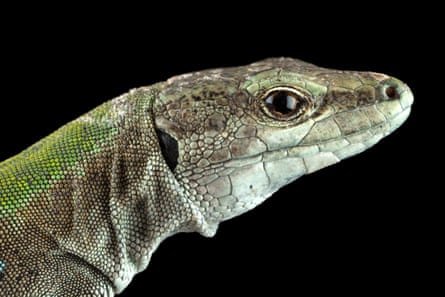
The brown morph (Podarcis raffonei antoninoi) and green morph (Podarcis raffonei alvearioi) of the Aeolian wall lizard (top) are being deprived of resources such as shelter and food because of the arrival of the Italian wall lizard (Podarcis siculus) on the Aeolian archipelago in Italy
In response, researchers launched the Life Eolizard conservation project in 2023. The initiative combines habitat restoration (such as vegetation recovery), rat control and the removal of invasive lizards.
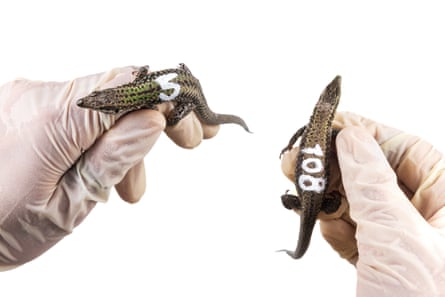
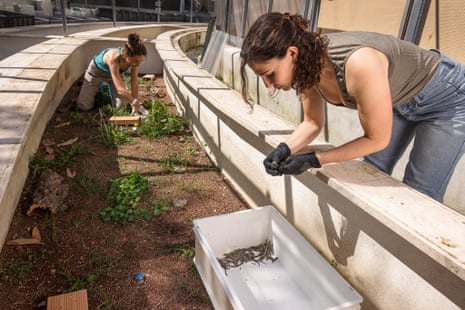
Scientists have also begun captive breeding programmes of two Aeolian lizard populations with different morphological and genetic backgrounds at Rome’s Bioparco zoological centre.

-
Dr Daniele Salvi is creating sanctuaries for the Aeolian wall lizard on the Aeolian archipelago
“In 2025, we selected breeding pairs using genomic data and produced the first 64 captive-born juveniles of this species,” says Dr Daniele Salvi, of the University of L’Aquila, one of the project’s lead researchers.
“This allows us to maximise genetic diversity and resilience so reintroductions start off strong in the wild.”
The ultimate aim is to reintroduce these captive-bred individuals into restored island ecosystems in the near future.
Dr Leonardo Vignoli of Roma Tre University, coordinator of Eolizard, says: “The creation of a dedicated sanctuary on two small islets – Lisca Bianca and Bottaro – is a turning point for the species.
“We are creating safe strongholds where the Aeolian wall lizard can thrive again. This doesn’t just boost numbers, it reshapes the species’ distribution, expanding it into areas that were lost and dramatically improving its chances of long-term survival.”
-
A pair of Aeolian wall lizards in the captive breeding programme at Rome’s Bioparco centre
Diversity within species contributes to ecosystem functioning and represents an often-overlooked layer of biodiversity.
Uller says: “Understanding why wall lizards have this extraordinary capacity to generate diversity is fascinating and brings us closer to understanding why nature works the way it does.”
-
The research team examine Aeolian wall lizards at the Bioparco zoological centre