.png) 3 months ago
66
3 months ago
66
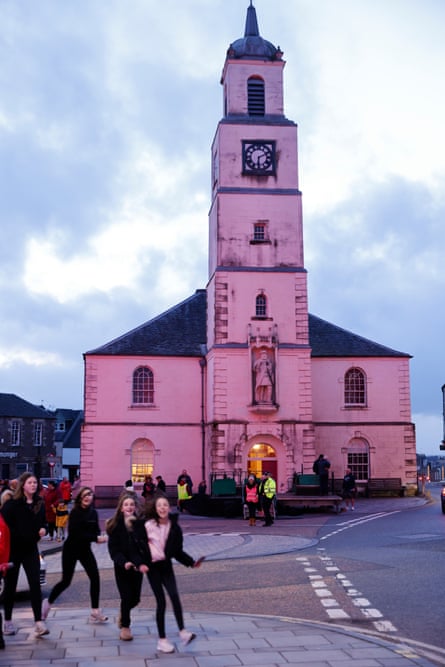
The evening light is thinning at Lanark Cross and there is a hush. Then the wee bell in St Nicholas’s church tower, which has lain silent since last autumn, starts up its six o’clock chimes.
The waiting crowd of children explodes into movement and noise. About a hundred youngsters, helped by grownups, then make three laps clockwise around the church, swinging homemade balls of paper on string above their heads as they run.
This is Whuppity Scoorie, a rite of spring that takes place every year in the historic market town of Lanark. Its precise origins are lost to time, but its continued practice and popularity speaks to a revival across the UK of folkloric customs.
“It’s about heralding spring and banishing the winter woes,” says Eleanor McLean, the secretary of the Royal Burgh of Lanark community council, which has in recent decades hosted the event that takes place every 1 March, aside from when that falls on a Sunday – as happened this year, meaning it moved to the second day of the month.
McLean says local historians have an array of theories about the original practice of the tradition and its unusual name. It was first reported in the Hamilton Advertiser in 1893, when it was claimed the tradition was already 150 years old.
Since the mid-19th century Whuppity Scoorie has been known as a children’s festival that marks the end of the curfew of dark nights with a wild celebration of street play. The colourful paper balls chase away the duller, darker spirits of winter, but in an earlier version the town’s children tied up their caps with long strings and whirled them around to see off the young apprentices coming home from the mills at New Lanark.
And further back still, the custom may have been linked to ancient religious penitents who were whipped (whupped) around the church, then washed (scoored) in the nearby river.
But it is sustained in modern times by Lanark’s “very strong community spirit”, says McLean. “There are a lot of old traditions in the Royal Burgh – like the Lanimer processions in June – and there’s a commitment to keeping them alive.”
The council holds a poster competition in local primary schools to bring Whuppity Scoorie to younger townsfolk, and six-year-old Freddie Stirling, who swings a fat brown paper ball, is one of this year’s winners. He points out a detailed drawing of the church tower with the wee bell inside, though he says he is disappointed he didn’t have time to colour in the stained glass window.
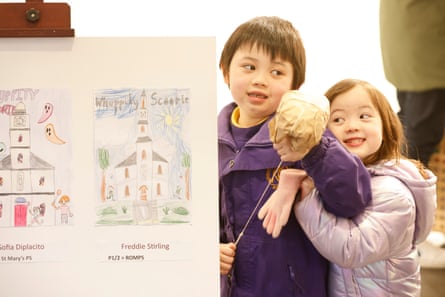
His proud mother, Janet, says: “He’s half Chinese, half Scottish, and Lanark is a very welcoming place; a nice place for kids to grow up.”
Julie Cox has brought her two-year-old grandchild Anna to her first Whuppity Scoorie. “It’s important to keep up the traditions,” she says. She adds that she took her own two sons to the event, too, when they were small.
Allison Galbraith, a Lanarkshire-based storyteller, says: “It brings people out of their houses on the first day of spring, and that’s a need held by our ancestors and still felt the length and breadth of the country – and indeed the world over.”
It’s often the rural towns, which were run on the agricultural calendar, that manage to hold on to old ceremonies, says Galbraith, who has collected local stories and customs in her book Lanarkshire Folk Tales. “Further into cities their continuation has been interrupted by industry or migration. But there’s still a great appetite for it. People want to be out with their community in a safe and happy environment.”
And at a time when most entertainment is segregated and screen-based, she says, here is an inter-generational event, with children bringing parents and grandparents. “And it’s also brilliant for newcomers to the area, and New Scots, because everyone is welcomed equally,” she adds.
From the revival in interest in calendar customs such as this one, to the increasing popularity of the genre of folk horror, “without a doubt” folklore is experiencing a resurgence, says David Clarke, one of Britain’s leading authorities on folklore and contemporary legend.
“We’re seeing this now as a reaction to all the horrible, nasty things going on in the world and people needing something that feels safe and familiar,” says Clarke, an associate professor at Sheffield Hallam University who is spearheading the National Folklore Survey of England, with the aim of understanding this revival in its wider multicultural context.
He adds: “There’s not many things in the present day that get people worked up in a good way, where everyone is enjoying themselves and even people who are not part of the community are welcomed.
“It provides the glue that is missing in other areas of life.”