.png) 3 months ago
82
3 months ago
82
Guillermo del Toro has spent his career humanising monsters, once calling them the “patron saints of our blissful imperfection”, so his adaptation of Frankenstein was always going to be a match made in heaven. The Mexican film-maker’s passion project turns Mary Shelley’s famous novel about the dangers of hubris and playing God into a touching tale about generational trauma, parental abandonment and the healing power of forgiveness. It’s a meticulously crafted, visually sumptuous and powerfully told story that deserves to take home that best picture Oscar.
But it’s not going to be easy. The gothic fantasy seamlessly blends horror, sci-fi and melodrama in its opulent retelling; here Oscar Isaac plays the eccentric scientist, Victor, who brings a hulking creature (Jacob Elordi) made up of dead body parts to life. Fantasy, horror and sci-fi, however, are genres that notoriously don’t do well at the Academy Awards, apart from in the technical categories. Yes, Del Toro is one of the few film-makers to get a best picture Oscar for a fantasy/sci-fi film in 2018 for his amphibian love story, The Shape of Water, but that win was an exception, not the rule.
Clearly, he has its work cut out. But there’s so much to love about Del Toro’s adaptation. As with his other films, Frankenstein is a macabre marvel to behold; shadowy rooms in dingy grand buildings, either lit by candles or a seemingly never-ending golden sunset, filled with grisly dismembered corpses, the skin partly peeled off. Elordi, who spent up to 10 hours a day in the makeup chair, is transformed into a Creature that looks more like a brooding cadaver than grotesque ogre. While Mia Goth as Elizabeth, Victor’s brother’s kind-hearted fiancee, is the solitary bright spark of hope in the film, quite literally – her resplendent insect-inspired dresses (that will hopefully win costume designer Kate Hawley an Oscar) appear as the only daubs of colour in the drab, rainswept landscape.
Del Toro uses the story to look at how harmful toxic masculinity can be; we see abused boys turn into hurt men who go on to perpetuate the same suffering, as Victor’s rampant ego spells doom for everyone around him. The Creature, a morally ambiguous character in the book, is far more sympathetic here. Elordi is the tender, beating heart of the film – his Creature is sensitive, compassionate, and desperate to be loved by his maker. He’s not the real monster, it’s generational abuse running amok destroying families and corrupting relationships. Frankenstein’s message – that we need to connect with rather than turn away from our fractured families – seems more timely than ever.
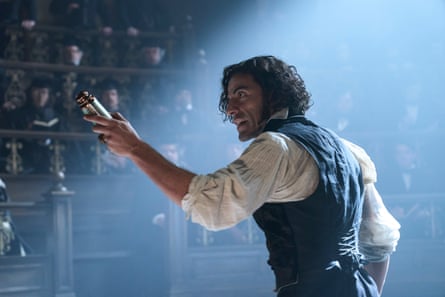
Elordi is up for best supporting actor and he has more than earned that accolade with the deft way he captures the conflicting emotions of a rejected child; torn between an innocent yearning to bond and the furious anger at being spurned. There’s fine work too from Isaac as Victor, who plays the vain scientist with a sweaty intensity, and a luminous Goth, whose Elizabeth finds herself entranced – tragically – by the Creature’s gentle nature.
But despite its many strengths, when it comes to the best picture Oscar, I fear Frankenstein is still an outsider, much like the Creature, who is forced to fend for himself. Del Toro, of course, has an excellent track record when it comes to Oscar success – along with his wins for best picture and best director for The Shape of Water, he was awarded best animated feature for Pinocchio in 2023. He’s a certified Academy Awards darling although their relationship appears to have cooled somewhat – while Frankenstein garnered nine nominations this year, a best director nod was not among them in a truly egregious snub.
It’s a clear sign that the film’s path to Oscar glory may be as fraught as the relationship between the Creature and Victor. Only six films in the whole of the Academy Awards’ history have won best picture without a best director nomination: Wings, Grand Hotel, Driving Miss Daisy, Argo, Green Book and Coda. While the odds are stacked against it, I wouldn’t discount Frankenstein to become the seventh film in that esteemed list. Like Pinocchio, Frankenstein shows how Del Toro can take a much-loved tale and reinterpret it with his signature flair and deeply empathic storytelling.
No one captures the magic of cinema in the way that Del Toro does – the fervid workings of his outsized imagination often leave you breathless with admiration. Frankenstein is the director at his best – a handsome, thrilling adaptation that pumps new life and meaning into a classic story while stirring your heart. Del Toro may already have a nice collection of golden statuettes at home but another one for Frankenstein belongs right next to them.