.png) 3 months ago
79
3 months ago
79
On paper, it already sounds the most Oscary film ever. A movie about a visionary man whose genius made him one of the greatest figures in literature. William Shakespeare is played by Paul Mescal, an actor who leaves no demographic unravished by his outrageous levels of magnetism. And yet Hamnet is a film that sidelines both of these men to supporting roles. The film is about Shakespeare’s wife, Anne Hathaway, long viewed as a dumpy, illiterate woman unworthy of attention – abandoned by Shakespeare in Stratford-upon-Avon when he swanned off to London.
Anne is referred to in Hamnet as Agnes, as she was also known, and played by Jessie Buckley, the Irish actor who could take on the role of a lamp-post and make you feel its pain. We meet Agnes curled asleep in the roots an ancient tree. She may be illiterate, but she is gifted herbalist who makes medicines from plants and a keeps a falcon. She is her own woman – fierce, intelligent, more than match for the man she calls “the Latin tutor”. Shakespeare’s mother warns him that his bride-to-be is a forest witch.
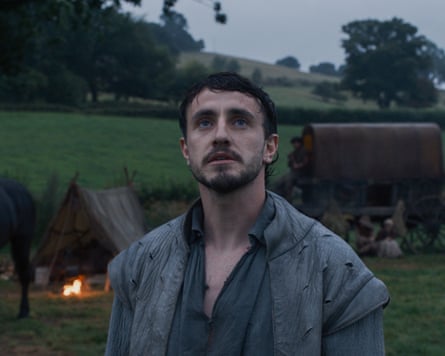
The film is based on the book by Maggie O’Farrell, a what-if novel, that takes off in an imaginative flight from sparse historical facts. What is known is that in 1582 Shakespeare, aged 18, married 26-year-old Anne Hathaway, who was pregnant, in a shotgun wedding. Then, in 1596, the couple’s 11-year-old son Hamnet – a twin – died, mostly likely from the plague. A few years later, Shakespeare wrote Hamlet, giving its tragic hero a variation of his dead son’s name. O’Farrell co-scripted the film with its director, Chloé Zhao. It’s a film with tremendous female gazes behind it.
Some audiences have been irritated by the lack of historical fact. Was Anne/Agnes really a feminist falconer? Most likely not. But this is surely less objective than the misogynistic vilification of her as a dull-witted predator who trapped Shakespeare into marriage. Buckley is a dead cert for best actress at the Oscars; by itself, the raw howl of grief she makes after the death of her son should bagsy her the statue. It’s an astonishing moment.
Buckley aside, Hamnet’s bid for an Oscar sweep has faced a mini-backlash, criticised for being emotional manipulative grief porn – one of those films that marches you to a pool of tears and orders you to weep. I’m a usually a shameless blubber at movies, but did not shed a tear at Hamnet. I was, however, reminded of a GCSE history lesson about a cholera outbreak in Victorian London. My teacher confidently asserted that women at the time would not have grieved the deaths of their children so deeply because child mortality was so high. Even at the age of 15 this felt monstrous.
What Hamnet does is reveal the inner lives of all the Annes and Agneses. And what a shimmering inner life Buckley shows on screen. All the characters, in fact, are played beautifully. Emily Watson gives Shakespeare’s comedically stern mother depth and feeling; Agnes’s brother, played by Joe Alwyn, who doesn’t bat an eyelid when she gets pregnant out of wedlock, is the ally that 16th-century woman ought to have had. Even Paul Mescal ain’t too shabby.